


Expert Advice on How Fruit Growers Can Control Nematodes
 January 16, 2026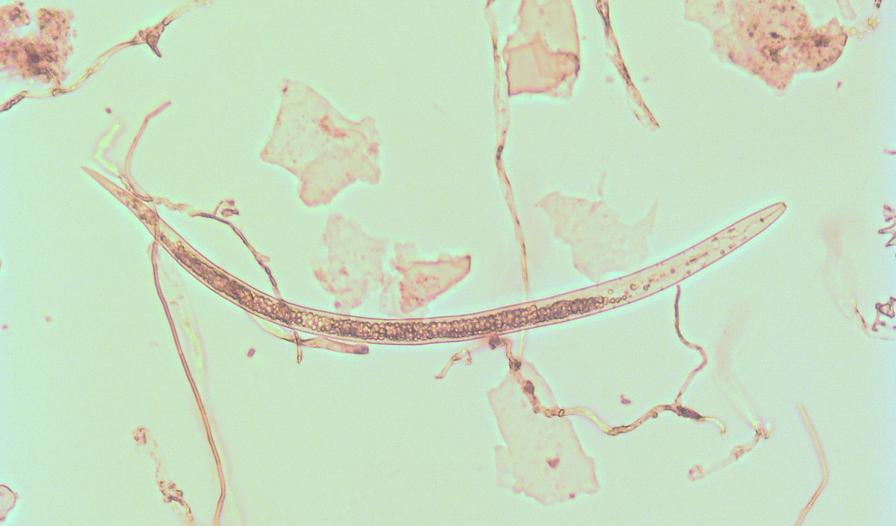
A root-knot nematode under a microscope. Control of these underground dwellers can be tricky.
Photo courtesy of Teleos Ag
Representatives of eight leading crop protection companies — Certis Biologicals, Corteva Agriscience, FMC, Kemin Crop Technologies, Sym-Agro, Teleos Ag Solutions, UPL, and Valent USA — advise fruit growers on the use of nematicides to battle nematodes:
What are nematodes and why should fruit growers fear them?
Matthew Pye (North American Plant Health Technical Manager, FMC): “Broadly speaking, there are three categories of nematodes that impact agriculture: free-living nematodes, which help with nutrient cycling; entomopathogenic nematodes, which kill harmful pest insects; and plant-parasitic nematodes, which are detrimental to crops. Plant-parasitic nematodes are part of the animal kingdom, which makes them challenging to control, as many earlier solutions, like fumigation, were also very dangerous for humans and the environment.”
Bridget Hatfield (Technical Services Manager, Kemin Crop Technologies): “Nematodes are incredibly diverse and often very small roundworms. Fruit growers should care about nematodes because some nematodes can be highly destructive to crop health and vigor, leading to significant yield loss.”
Jared Walls, Todd Spivey (Market Development Specialists, Corteva Agriscience): “Nematodes are probably the most misdiagnosed problem pest facing any crop or farmer because the damage they cause can often be attributed to other crop-related issues, like fertility.”
Paul Johnson (Seed Treatment Portfolio Manager, Seed Applied Technologies, UPL): “Many species are beneficial components to soil health. Unfortunately, there are several plant-parasitic nematodes that feed on plant’s roots, which can result in damaged roots, transmission of viruses, and infection from fungal pathogens.”
Don Yadon (Southern California/Arizona Sales Manager, Sym-Agro): “As a parasitic nematode population grows, it can be very costly and time consuming for tree fruit growers to manage. Early detection and assessment is best, and having a nematode management plan assures the crop has a greater chance of achieving its genetic potential.”
What nematodes are most prevalent among fruit crops? Is there variance among tree fruit, grape, and berry?
Greg Rogers (Director of Technical Marketing and Communications, Certis Biologicals): “Nematodes have wide host spectrum, but some that are known to impact tree fruit growers are root-knot, root-lesion, and dagger nematodes.”
Walls, Spivey (Corteva): “There are different species of root-knot nematodes, and some species are more likely to present increased risks or reach thresholds to specific fruit and/or vegetable crops. But overwhelmingly the southern root-knot nematode is the most problematic on fruit and vegetables.”
Randy Huckaba (Global Director of Product Research and Development, Teleos Ag Solutions): “Tree fruits tend to have more issues with root-knot, ring, and root-lesion depending on the orchard geography. Grapes are commonly impacted by root-knot, dagger, ring, and lesion nematodes in the U.S. Berry crops also experience issues from root-knot, root-lesion, and dagger nematodes, with the specific dominant species varying by geography.”
Andrew Rodstrom (Field Market Development Specialist, Valent USA): “There are variations in nematode pests across tree fruit, grape, and berry crops. Different crops can harbor various nematode species, and their effects vary depending on crop type, soil conditions, and environmental factors. For example, some nematodes are more commonly found in tree fruits, such as apples and pears, while others might impact vineyards or berry plants. Certain nematodes can inflict considerable damage to roots, leading to decreased yield and fruit quality. Nematode damage may also increase the risk of viral, bacterial, or fungal attack on the crop.”
Pye (FMC): “Dagger nematodes, which feed on many crops, can be particularly problematic in grapes through the transmission of fanleaf virus. Both stubby root and dagger nematodes are common in blueberries. A nematode that is a major pest on one crop may not be equally damaging on another.”
What about regional nuances?
Walls, Spivey (Corteva): “In general, sandier soils tend to have more consistent nematode pressure over heavier, clay soils, but it’s always advisable to conduct soil tests and verify. Regional weather patterns can impact nematode activity. In warmer climates, nematodes could stay active year-round while in some regions that experience cooler or colder weather variations, nematodes may be less active during those colder periods. Different soil types can favor different nematode species. Root-knot nematodes may be more prevalent in sandier soils, while reniform nematodes could be more prevalent in heavier soils.”
Pye (FMC): “Yes, there can be, especially in the case of invasive or introduced nematode species. Soil type and temperature are often better indicators of where plant-parasitic nematode problems will occur. Many of the regions struggling with nematode damage are areas with lighter, sandy soils.”
Rodstrom (Valent): “Yes, there are regional differences in nematode species, which can vary by climate and soil type. Also, multiple nematode species often inhabit a field, and cultural practices can impact nematode populations, including irrigation systems and maintenance practices, such as tractors and digging.”
Huckaba (Teleos): “There are regional nuances often influenced by soil temperature and soil texture. For example, in California, dagger, ring, and root-lesion nematodes are more prevalent in the north and central coast areas, while root-knot, dagger, and citrus nematodes tend to be found in warmer regions of the San Joaquin Valley and Southern California. Ring nematodes are a concern for cherry and grape producers in Oregon and British Columbia. Root-knot is a common issue in the Southeastern U.S. area.”
Yadon (Sym-Agro): “Without a doubt, there are regional nuances. Soil types specifically with higher concentration of sandy silt loams, high pH, low organic matter, and higher salinity percentage are prone to parasitic nematode populations in tree fruit crops.”
How do nematodes damage fruit crops?
Johnson (UPL): Plant-parasitic nematodes puncture root cells with a needle-like feeding organ called a stylet. They feed on cell contents, causing localized cell death and tissue disruption. Root-lesion nematode’s root feeding causes lesions on the roots, which can be infected by fungi and bacteria. Root-knot nematodes induce abnormal cell growth, forming galls which interfere with water and nutrient uptake. Dagger nematodes feed on root tips, stunting root growth and reducing root branching. In general, damaged roots absorb less water and nutrients, leading to stress symptoms above ground. This, in turn, results in stunted growth, poor fruit size, and gradual decile in severe cases.”
Pye (FMC): “This depends to some degree on the species of parasitic nematodes. Generally speaking, nematodes extract sugars and nutrients from plants. Root-knot nematodes form galls on roots, which reduce water uptake. Because nematodes impact nutrient and water uptake, they can appear to be under abiotic stress, and the initial diagnosis and treatment may not address nematodes as the true culprits. Some parasitic nematodes, such as ‘ectoparasitic’ (dagger, ring, sting, etc.) that feed on root tips or outer tissues (stubby root), may create openings for plant pathogenic fungi and result in infections such as replant disease.”
What’s the best strategy for crafting a nematicide program?
Walls, Spivey (Corteva): “Nematode species identification is the first step toward effective control. Growers should take soil samples at the end of each cropping cycle or immediately after harvest to obtain the most accurate nematode population numbers. That is typically when populations will be at their highest levels. I advise sampling half-way through the cropping season to get an in-season benchmark to determine when the nematode population may be escalating.”
Hatfield (Kemin): “The best strategy for crafting a nematicide program is to first identify the exact problem: What variety of nematode is present? What is the level of infestation? What are the parameters that you have to work within for control? Once you have identified these parameters, then you can work with your chemical representative to develop an appropriate treatment program.”
Johnson (UPL): “Avoid planting in high-risk area. Prior to planting consider fumigation, cover crops, crop rotation, and/or a follow period depending on the history of the orchard. It is important to remove previous crop’s roots since they can harbor nematodes. Nematode-resistant or -tolerant rootstock will help prevent damage from nematodes. Use of convention nematodes with biological nematicides can help protect the plants while they are becoming established. Nematodes are typically not a problem on well-established plants unless the nematode pressure is high, the plants are under a lot of stress or dagger nematodes are present, which can vector viruses, such as tomato ringspot virus, tobacco ringspot virus, peach rosette mosaic virus, cherry rasp leaf virus, and grapevine fanleaf virus.”
Pye (FMC): “There are no silver bullets for nematode control, even when employing genetics and synthetic solutions. Realistically, you need to take a multipronged approach to managing your parasitic nematode population. Start with learning the nematode history and get soil sampling done to see where you at. Select nematode-resistant root stocks or varieties for new plantings. Fumigation ahead of a new planting may be an option, but it is not a fix. Rotate chemical and/or biological nematicides throughout the season. Whenever possible, avoid spreading nematodes from one location to another by cleaning or quarantining equipment.”
Rodstrom (Valent): “With existing orchards, locate areas of known nematode issues and take soil samples to confirm the species in the area. Samples must be from assumed infested areas, not the entire orchard. Entire orchard numbers may be diluted if clean soil is mixed with nematode-infested soil. Find a suitable nematicide that is labeled for your use, particularly if you have non-bearing vs. bearing orchards. With replanted/new orchards, ideally, test soil samples to pinpoint the infested areas of your fields. Fumigate the ground (as much as possible) and, where possible, plant a non-nematode-hosting crop for one to two seasons. Also, use resistant rootstock for new orchards and apply a nematicide in hot-spot areas.”
Huckaba (Teleos): “Sample the soil in the prospective planting area to determine if a nematicide treatment is needed. Details on how to take the samples and where to send them for analysis can be obtained from the local agriculture extension office. If a treatment is warranted, a plan should be developed that organizes the order of operations, including soil preparation, fumigation, waiting period, and planting.”
Rogers (Certis): “Understanding that ‘control’ of nematodes is not generally possible. We can suppress them, manage them, limit their negative effects on our trees and vines, but they are nearly impossible to control. The best approach is a multi-pronged effort, both through pesticides as well as growing practices. For example, growing a cover crop of sorghum Sudan grass before replanting an orchard can suppress some species of nematodes. Rotation of modes of action can also increase nematode suppression as well as help prevent resistance issues.”
Yadon (Sym-Agro): “Developing a post-planting nematode plan should start with assessing probability of nematode damage. Above-ground tree health inspections along with proper nematode/soil sampling that includes roots are needed to assess nematode populations and species. Soil health is paramount in protecting trees from nematodes and should not be compromised by nematicides that are harmful to non-target and beneficial organisms. I prefer to use a nematode testing lab that also reports beneficial soil organism populations.”
Subscribe Today For
