



Integrated Pest Management Solutions for Strawberries Grown Under Cover
Cornell University researchers focused on biopesticides and controlled environment agriculture (CEA) in berry production, specifically strawberries, during one of the school’s recent Fruit Webinars. Here are key insights from both presentations about integrated pest management solutions for CEA strawberries:
PEST MANAGEMENT ON CEA STRAWBERRY
Samantha Willden, Assistant Professor of Entomology at Cornell AgriTech, presented her findings on pest management strategies for strawberries in controlled environment agriculture (CEA), such as low-tunnel and high-tunnel structures. Many integrated pest management solutions for aphids, thrips, and spider mites are developed for greenhouses and open fields and are not applicable to every CEA system. Therefore, research is necessary to create sustainable IPM solutions for these increasingly popular growing environments.
Willden discussed research she has conducted on pest pressure — insects, pathogens, weeds, and invertebrates — in low-tunnel strawberry growing environments. She found that low-tunnel environments and the ability to keep plants dry reduced common open-field problems — such as common leaf spots, Botrytis, and molds.
In addition, Willden found lower infestations by spotted wing drosophila, possibly due to the plastic’s physical barrier. However, this environment had a neutral impact on thrifts, slugs, various weeds, and tarnished plant bugs (Lygus lineolaris). In addition, Willden believes the warm, dry environment allowed two-spotted spider mites (Tetranychus urticae) to respond very positively to the low-tunnel environment.
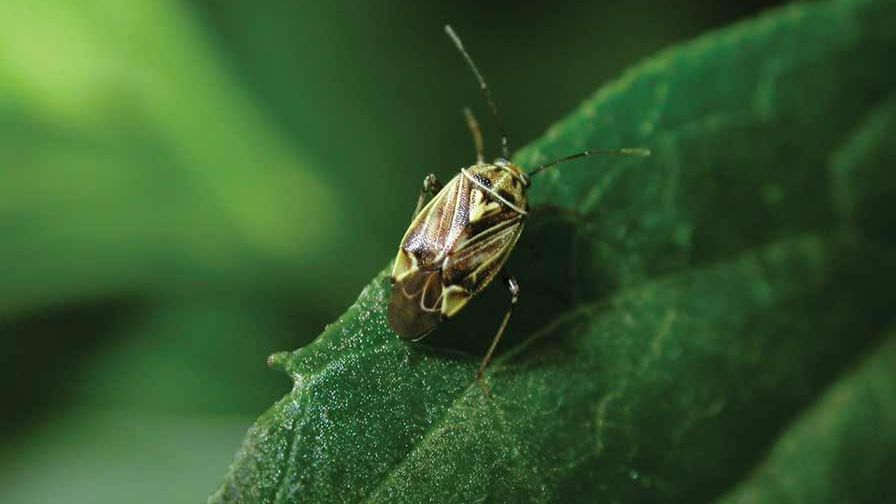
Lygus bug up close. Photo by Lisa Ames
Lastly, Willden looked at how beneficial insects (pollinators like syrphid flies and bees; predators like ground beetles and spiders; and parasitoids like Platygastroidea and Chalcidoidea) managed in a low-tunnel environment. While bees remained unaffected, some of the plastic films that blocked UV light negatively affected syrphid fly populations. Both predatory and parasitoid insects seemingly remained unaffected and were present in high densities in the low-tunnel environments.
Willden’s research examined control for two-spotted spider mites and tarnished plant bugs, two aggressive insect pest pressures. Willden concluded that the ‘Albion’ and ‘Seascape’ strawberry varieties were the most vulnerable to two-spotted spider mite pressure, while ‘San Andreas’ and ‘Portola’ showed the most resilience.
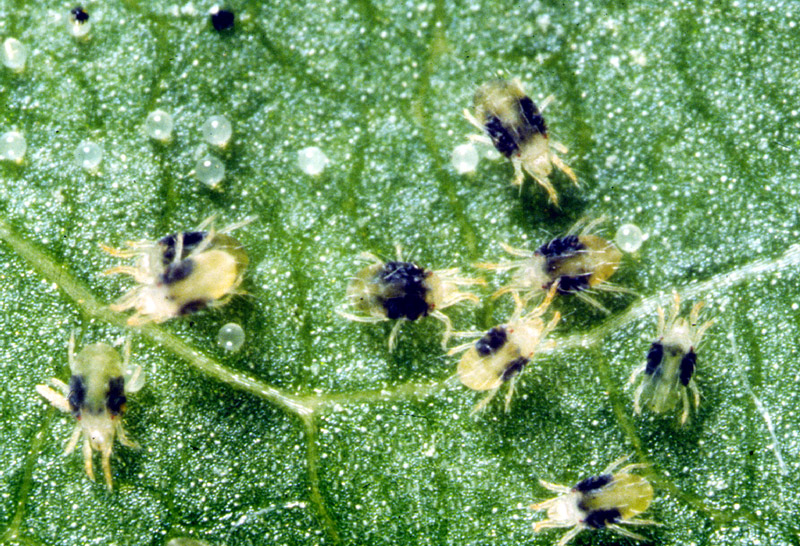
Two-spotted spider mites and eggs. Photo courtesy CSIRO
Regarding biocontrol methods for two-spotted spider mites, the research examined predatory Neoseiulus fallacis and Phytoseiulus persimilis. Willden found the two predators together provided the best short-and long-term suppression of two-spotted spider mites, and they did not appear to compete with each other in either greenhouse or low-tunnel environments.
When looking at tarnished plant bug suppression in low-tunnel strawberries, Willden focused on microbial control by Beauveria bassiana (Mycotrol) and how UV-selective films could reduce product degradation and improve biocontrol. She examined an open (no cover) environment, a low-tunnel covered by Dubois (13% UV filtering), and a low-tunnel covered by Warps (98% UV filtering). Mycotrol was applied and evaluated in three ways — sentinel survival, ambient density, and fruit quality.
Willden found Warps plastic in conjunction with Mycotrol was the most effective at reducing sentinel survival of tarnished plant bugs. Similarly, when examining ambient density, Warp’s UV-blocking qualities again provided the best control with Mycotrol. When looking at fruit quality, both plastics with Mycotrol reduced fruit damage, with 11% less damage under Wraps than Dubois.
Lastly, Willden shared research on overwintering high-tunnel strawberry pest management in June-bearing strawberries planted in October. The study first evaluated OMRI-approved biopesticide sprays (NeeMix, PyGanic, and Sil-MATRIX) for aphid control. Willden found each product provided consistent control for three weeks after a single spraying. Next, the study looked at biocontrol agents Adalia bipuntata, Chrysoperla carnea, and Orius insidiosus. After two releases, Chrysoperla carnea provided the best management of high-density aphid populations in overwintering strawberry plants.
Willden emphasized the need for tailored IPM strategies in CEA and expressed interest in collaborating with growers to address their pest challenges. She encouraged growers to contact her to discuss research collaborations or to seek advice on CEA pest management best practices.
BIOPESTICIDES IN CEA STRAWBERRY PRODUCTION
PhD student McKenzie Schessl, a Research Support Specialist at Cornell AgriTech, working in the lab of Kerik Cox, Associate Professor in the School of Integrative Plant Science, outlined the efficacy of biopesticides and disease forecasting models in both uncovered and CEA strawberry production, with a focus on replacing conventional fungicides like Captan. For this study, they utilized a double row-, low tunnel-style planting of day-neutral ‘Albion’ strawberries.
The research examined the control of common leaf spot (Mycosphaerella fragariae), gray mold (Botrytis cinerea), and anthracnose (Colletotrichum acutatum) over nine weeks during the rainy season. Researchers pitted these diseases against three variables: covered vs. uncovered, application timing, and integrated biopesticide program versus a conventional Captan program.
“The interesting thing about biopesticides is that they also have a multi-site mode of action, but without the harmful environmental consequences that we see with conventional products like Captan,” Schessl says. “So, the big question that we were looking to answer with this three-year study is, can we use biopesticides and single-site fungicides in an integrated management program in place of Captan?”
Across all three years (2021-2023), the research found that the tunnels reduced disease incidence, whether it was a cool or rainy season. In addition, the research learned that while disease incidence with Network for Environment and Weather Applications (NEWA) models was similar or lower than with calendar timing, they could reach a level of control with fewer applications.
“We found that during wet years like 2021 and 2022, the NEWA model may call for more applications than it did during the drier year of 2023,” Schessl said. “But we found that, on all three years, the NEWA model called for less applications than the calendar timing.”
Finally, the research indicated that Captan was often less effective than the integrated biopesticide program, which Schessl labeled “promising.”
“Biopesticides are effective when timed appropriately using models and alternated with single-site fungicides,” she said. “We’ve already seen increased regulation on Captan in apple production. I don’t think it’s too far in the future that we’ll see it within other systems, as well.”
In ongoing research, Schessl reported they’ve completed a year’s worth of biopesticide trials in greenhouse environments, specifically looking at Botrytis and Colletotrichum in strawberry flower and fruit management. They looked at various biopesticides, including bacillus strain fungicides, extracts, barriers, and pathogen growth inhibitors. Inoculations were done at 100% humidity to create ideal conditions for the pathogens and to provide a picture of which products were most effective.
The data showed for strawberry flower management within greenhouse production that OSO proved the most effective Botrytis control with 23% disease incidence, and the most effective Colletotrichum control resulted from Blossom Protect (9%), Stargus (10%), and Sil-Matrix (12%). With fruit management, the data showed higher rates of disease incidence with Regalia (64%) and EcoSwing (69%) for Botrytis control, and LifeGard (65%) and Regalia (82%) for Colletotrichum control.
“We’d like to tease out what’s happening here … 60%, 64%, 69% disease incidence is still very high,” Schessl said. “So, we’d like to repeat this study and see if we can find whether it’s conditions that are more conducive for the biopesticides or less conducive for the pathogen.”
In addition, researchers conducted detached strawberry fruit assays with the same biopesticides as the greenhouse trials to determine effectiveness against Botrytis for pre- or post-harvest fruit management. After seven days, the top control agents were Regalia (15%), LifeGard (7%), and OSO (2%), and after 11 days the top control agents were Regalia (27%) and OSO (18%).
Lastly, in lab assays, researchers tested ultraviolet-C (UV-C) impact on pathogens in CEA strawberry pre- and post-harvest fruit management. Pathogens were exposed to UV-C doses between 0-1000 joules/meters squared in day and night conditions. For Collectotrichum, data showed 100% suppression in day (light) inoculation at 900J/m2, and night (dark) inoculation at 700 J/m2.
“Pathogens have an ability to repair UV damage,” Schessl explained. “We found with multiple pathogens and multiple systems, that when you apply that UV during the day, the pathogen is able to repair itself a little bit. So, you need to use a higher dose, where if you apply that UV at night or just before sunset, you’re going to have more effective control.”
Similarly, with UV-C suppression of Botrytis, conducted only for dark inoculation, the data achieved 100% suppression one day post-treatment at 1,000 J/m2 and three days post-treatment at 2,000 J/m2.
“Botrytis is actually a darker pathogen, so we find that the more melanin that’s in the pathogen, the more resistant it is to UV-C,” Schessl said, adding they hope to include greenhouse trials in the near future.
Subscribe Today For
