



Smart Tech
Is Now the Time To Start Using Drones for Spray Applications in Your Orchard or Vineyard?
 October 21, 2025

Drones are here to stay. Technological innovations will continue to make them more practical, affordable, and beneficial. Already, in agriculture alone, drones have proven valuable in seed spreading, multispectral and thermal mapping (often assisted by AI for analysis), “fly cart” lifting of supplies (such as delivering tools to the center of large fields, or over uneven terrain), and chemical spray applications.
It is in the area of spray applications that drones have made the most significant headway in the market. Is it time for you to take the plunge? Here are the things you need to consider:
QUIETER, CHEAPER ALTERNATIVE
Spray drones can really shine in similar situations to those where helicopters are used to spray — such as uneven terrain, inability to enter the field due to field conditions (e.g., too muddy for tractors), or when entering the field will likely cause crop damage. At the same time, drones are so quiet and fly so low (typically 3 to 4 feet above the crop or tree canopy) that they are rarely met with the same community concerns that sometimes follow helicopter sprays.
Drone sprays can often be contracted for around $15 to $21 per acre, not including chemicals, which must be provided by the farm or ranch. One way to look at this is that it pays for itself if the traditional spray application method would cause more than $15 to $21 per acre in crop damage. This is a primary benefit of drone spraying, along with lack of compaction, reduced need for Worker Protection considerations, and increased efficiency under the right circumstances.
LIMITATIONS AND EXPECTATIONS
The current market leader in manufacturing spray drones is DJI, followed by companies such as XAG, EAVision, and Hylio. Of these, most are manufactured in China, with Hylio being the only one made in the U.S. There are multiple agricultural drone distributors in the U.S., such as Hoober in Pennsylvania and Accurate Ag Drones in Maryland.
Current spray drone models are limited primarily by the capacity of their tanks, which range from 2 to 18½ gallons, and their batteries. which last about 10 to 12 minutes and are the most expensive component of the drone. In fact, most drone applications need to have three batteries in rotation for each job to allow for recharging and cooling while still keeping the drone in the air as much as possible.
The goal is to treat the returning drone like a NASCAR pit crew and get it back in the air with less than a minute between “flies” for optimal efficiency. When considering drones, roughly half of the cost is the drone itself, and the other about half of the cost is for support. Current models range from about $16,000 to $57,000, which includes batteries, chargers, remote, remote batteries, spray system, spreader system, accessories, startup and support. There are surprising few “wear parts” on drones, mainly propellers, washers, and spray system components, such as tips and screens. If you are seriously considering a purchase, companies like Hoober and Accurate Ag Drones will come to you for a free on-farm demonstration.
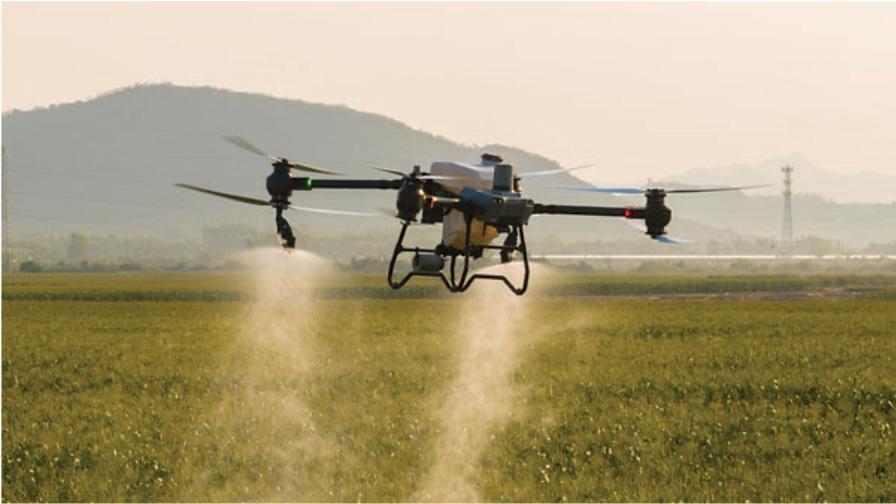
DJI Agras T50 Sprayer Drone in action.
Photo courtesy of Hoober Inc.
ORCHARD OPERATION
Spray drones can be used to apply fungicides, herbicides, insecticides, and foliar feedings. However, a reduced water application rate of 2 GPA or less is typically used. While traditional hydraulic sprayers use disc speed to control droplet size, drones use wind vortices (or “downforce”) from the drone propellers to push product into the crop. This method allows for more thorough coverage without relying on gravity or high water volume. This makes the use of surfactants, such as Aerial, more important. It is also vital that the drone operator maintain an appropriate speed so as to avoid outrunning the benefits of propeller downforce and become gravity-reliant for coverage. Also, spray drones cannot cut a line the way a traditional spray application can, so a greater buffer will likely be needed.
For orchards in particular, some drones have “orchard mode,” which identifies the individual trees and sprays around each tree then moves to the next. This works well with traditional spacing. For high-density orchards, straight row spraying is appropriate.
For effective drone spray applications, pre-planning is a necessity. Pre-flight checks, readying a staging area, route planning, identifying obstacles, and setting application parameters (including speed selection) all need to be completed prior to starting the application. Drone maintenance should involve thorough cleaning and the prevention of buildup.
REAL-WORLD CHECKLIST
What are the practical steps for operating a drone? The legal requirements are outlined at faa.gov/uas:
- Obtaining a Remote Pilot’s Certificate from the FAA (must be at least 18 years old).
- Register the drone and obtain a N# (cost is $5 per drone).
- A heavyweight drone exemption must be authorized by the FAA for drones weighing more than 55 pounds.
- FAA 3rd Class Medical Certificate (similar to a DOT physical) must be completed within 60 days of submitting your application.
- For Drone Spraying, FAA Part 127 Aerial Application License (for Dispensing Chemicals and Agricultural Products with Unmanned Aircraft Systems).
- Ensure you have your state and/or local Chemical Applicator’s License.
- It is recommended that you look into insurance requirements as well.
A current limitation in the market is the relatively low number of ag-use chemicals currently labeled for aerial application. However, the list is quickly growing, and most chemical manufacturers are considering adding aerial application to their labels as they come up for renewal with the EPA. A National Aerial Applicator’s Manual has been produced by the EPA and is available for free download on their website. Several land-grant universities have also published and made available similar guidance resources for aerial applications in agriculture.
Like any new undertaking for a farm or ranch, doing the research ahead of time is key. Nathan Graham, UAV and Drone Specialist with Hoober, says, “Right now drones are a tool in the toolbox, not meant at this point to replace anything.” With this industry experiencing such rapid growth, there are many resources for information available to you.

For more Smart Tech topics, click here.
Subscribe Today For
