



Parrots: Colorful Friends Or Crop-Killing Foes?
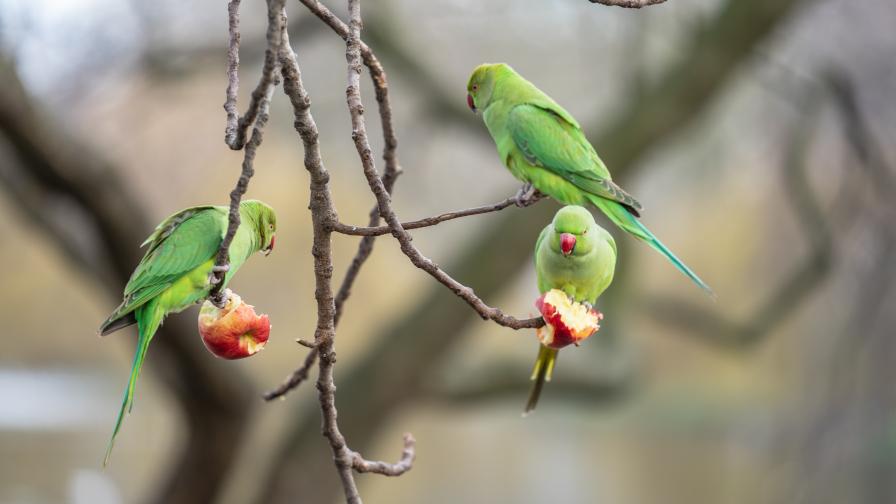
Got parrots in your orchard? They are becoming a more familiar sight in recent years. Photo: Powerofphotos – stock.envato.com
Invasive European starlings cause millions of dollars in damage to American fruit crops, a litany of destruction encompassing apples, blueberries, cherries, figs, grapes, peaches, and strawberries. Besides causing direct losses from their voracious appetites, starlings peck and slash at fruits, reducing product quality and increasing its susceptibility to diseases and pests.
USDA estimates these birds cause about $800 million in agricultural damage annually.
Starlings are not the only winged invader on U.S. shores, as wild parrot and parakeet sightings have risen in recent years. The Cornell Lab of Ornithology’s eBird and National Audubon Society’s Christmas Bird Count calculated almost 120,000 unique parrot encounters between 2002 and 2016.
According to the April 2019 edition of the Journal of Ornithology, at least 56 parrot species are flourishing in 43 U.S. states. The monk parakeet, red-crowned Amazon, and Nanday parakeet are most frequently sighted, with most species living in major cities, such as New York, Los Angeles, Miami and Chicago.
“Florida, California, and Texas are the top parrot states,” Texas A&M University Professor Donald Brightsmith said in a webinar hosted by the Phoenix Landing Foundation, a nonprofit organization dedicated to the welfare of parrots. “(The birds) are not a rarity in the U.S. anymore. There are lots of places you can go and see them.”
Yet there is scarce evidence of pervasive fruit crop damage caused by wild parrots or parakeets — the biggest reason being these birds do not stray far from their urban habitats, noted Brightsmith, Associate Professor of Ecosystem Health in the Department of Veterinary Pathobiology at Texas A&M.
“Naturalized parrots are not having important impacts on native plants or ecosystem structure,” Brightsmith, also a professor with the Schubot Avian Health Center at Texas A&M, said. “They like to chew and strip branches, but they are not denuding landscapes by eating the trees. Even if that impact has been brought up in the literature, there’s no evidence beyond a few favorite trees getting hammered.”
25 SPECIES YET LITTLE THREAT
The animals’ current presence is a direct result of the high demand for exotic pet birds in the mid-20th century. By the 1970s, thousands of wild-caught parrots had been imported into the U.S. from across the globe. Some of these captives simply escaped or were freed by their owners. Today’s flourishing populations are descendants of these birds.
With all 25 known breeding species present in subtropical states, growers of fruit trees in those regions are understandably concerned about their crops becoming a food source for the colorful creatures.
For example, a Florida orchard suffered 20% to 60% crop loss from monk parakeets, while rose-ringed parakeets in Kauai, HI, are known to feed on seed and fruit crops, including corn, sunflower, mango, papaya, and passion fruit. The problem on Kauai became so prevalent that local lawmakers established a pilot program to rid the island of the bright green birds.
RELATED CONTENT: Birds Got Your Berries? Ways To Ground the Threat
Despite the growing presence of invasive parrots and parakeets, there are fewer than 10 documented instances globally of considerable crop damage attributed to them. Although the iridescent aviators may plague farms near their urban enclaves, most growers face little risk of extensive agricultural losses, Brightsmith said.
“Rats, cats and pigs are much worse (for farmers),” Brightsmith said. “But when you’re driving through massive cornfields in Kansas, you’re not getting flocks of parrots coming down out of the skies and decimating tens and thousands of acres of corn. These birds really like urban areas. This means they’re not going out into large-scale agriculture and attacking it. They’re going out short distances from their cities and impacting the plants they’re finding around them.”
Subscribe Today For
