


The Time is ‘NOW’ for Navel Orangeworm Sprays
 April 22, 2025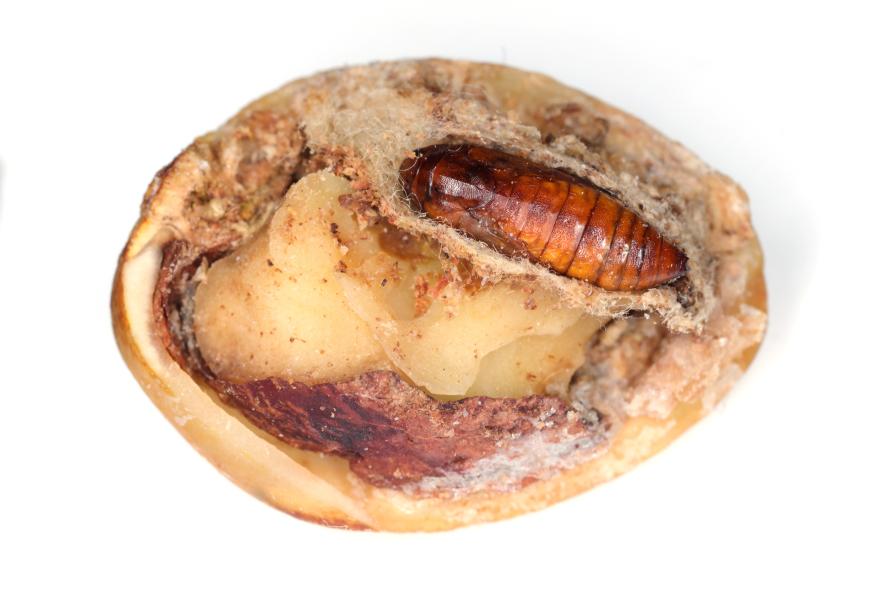
Up-close look at a navel orangeworm in pistachio. Keeping this pest under control involves knowing different management methods, including the right time for navel orangeworm sprays.
Photo: AdobeStock_Tomasz
As of early April, navel orangeworm (NOW) had been caught in multiple California counties, including Fresno, Kings, Madera, Merced, San Joaquin, and Stanislaus, according to the Semios blog. One location in Kings County reportedly peaked at 288 catches in a single day shortly after trap installation.
How the remainder of the nut-growing season plays out in the face of NOW will largely depend on what had (or had not) occurred during the winter sanitation season and what could still occur during the “May spray” season and through harvest.
Issa Qandah, Technical Service Manager with FMC, says growers should consider a pesticide application as early as April to combat whatever mummy nuts are still left on trees over the winter.
“Even as good a job of sanitation as we can do, we’re still going to have some mummies on the trees,” Qandah says. “For me to control it, it has to be an application during mummy time. We used to call it ‘May Spray,’ but now sometimes we go late April to mid-May. The reason why is because that is the first generation of navel orangeworm that is going to be flying in and laying eggs on those mummies.”
When hull split eventually arrives, Qandah calls it a “must” to spray back-to-back over two weeks. “We have to go with two applications. A single application and cutting back an application is not going to cut (NOW) off because we have four generations for this pest,” he says. “We need to hit them on every generation that we can.”
He recommends an insecticide that affects all three stages of the pest lifecycle: eggs (ovaricidal), larvae (larvicidal), and adults (adulticidal). “It kills male and female, and if you look at it, a single fertile female can lay between 100 to 300 eggs in its life cycle.”
The second application of that insecticide should occur 10 to 14 days later, according to Qandah. “After that, you come with your fourth insecticide application to manage the colonizers. That’s where you rotate to a different chemistry, different IRAC group to minimize resistance development.”
NOW BEST PRACTICES
Spraying is just one staple of NOW management. Houston Wilson, an Associate Cooperative Extension Specialist in the Department of Entomology at UC Riverside, expounds on six IPM tools he recommends for nut growers:
Mummy nut sanitation: “The foundation of NOW management … mow ’em, shred ’em, get rid of ’em.”
Biological control: “With the biocontrol situation, it’s difficult to produce reliable control at the level of control that we’re looking for with this pest.”
Mating disruption: “There’s nice data showing that (aerosol puffers, flowable microencapsulated sprays, and polymeric strips) can reduce your damage by navel orangeworm pretty significantly, and it’s kind of up to you to choose which one you like.”
Monitoring: “Monitoring is all about tracking insect phenology to determine spray timing.
I think this is more on an operation-by-operation basis. Folks can start making their own data sets, looking at, ‘Well, when flight 2 was like this, my crop damage tended to be here.’”
Spray timing: “You really want to time your pesticide applications for no later than 1% hull split in almonds and similarly in pistachios and walnuts. So, you start to see that process happening, you want to get out there and start getting these control measures applied, so, as that process continues, you’re able to get ahead of it.”
Early/timely harvest: “The longer that crop hangs out on the tree, the higher probability of infest and more mummies that are infested for the next year. Just be on top of this. If you have a custom harvester coming in, make sure you’re ready for them.”
Concludes Wilson: “I strongly recommend that you use as many of these as possible in conjunction. There really is no silver bullet, especially for a pest that you’re trying to drive down to a 2% level of infestation. So, the key is using multiple points of attack.”
NOW MANAGEMENT TIMELINE
Winter (January-March):
Mummy nut removal: Remove and destroy remaining nuts from trees by mid-March.
Trap placement: Place pheromone and egg traps in orchards by March 15 (or sooner in warmer years).
Spring (March-May):
Mating disruption: Hang pheromone dispensers to disrupt mating.
May sprays: Apply in orchards with high previous mummy nut populations or early-season pressure.
Summer (June-August):
Hull split sprays: Time sprays with the start of the third egg-laying period, typically around August.
Monitoring: Continue monitoring trap catches and degree-day models to track NOW populations.
Fall (September-October):
Harvest: Ideal timing helps prevent the development of a third generation of NOW.
Sanitation: Remove and destroy any remaining infested nuts.
Subscribe Today For
