



Auto Weeders Becoming Potent New Tools in Vegetable Fields

The recent loss of Dacthal was a blow to weed control programs in vegetable crops such as onion and brassica crops like Bok Choi. Vegetable crops need more options for effective weed control programs to maintain producer profitability.
There may be potential herbicide alternatives for vegetable crops, and we should continue to look for herbicide options where possible. But other options besides herbicides need to be considered.
Large herbicide markets like field corn are worth more than $5 billion annually in the U.S., while estimates of the tomato herbicide market in California are less than $20 million. Because herbicide sales markets in specialty crops are so small, they represent a challenge for registrants to justify the risk of liability for such modest sales volumes. For this and many other reasons, depending on herbicides alone to solve all of our vegetable weed control challenges is not likely to succeed.
Fortunately, new options for vegetable weed control are available. Several engineering companies have developed effective intelligent weeders during the past few years.
Many of these intelligent weeders are physical weed control tools like cultivators, flamers, or lasers, that are defined as pest control devices by the USEPA. Pest control devices do not require pesticide registrations; therefore, the technology can be brought to the marketplace much faster than herbicides. Here we will discuss the efficacy of three weed control devices: Laser weeder from Carbon Robotics, the Stout Smart Cultivator, and the FarmWise Titan cultivator.
Evaluation of the Carbon Robotics LASER Weeder for Weed Control in Spinach
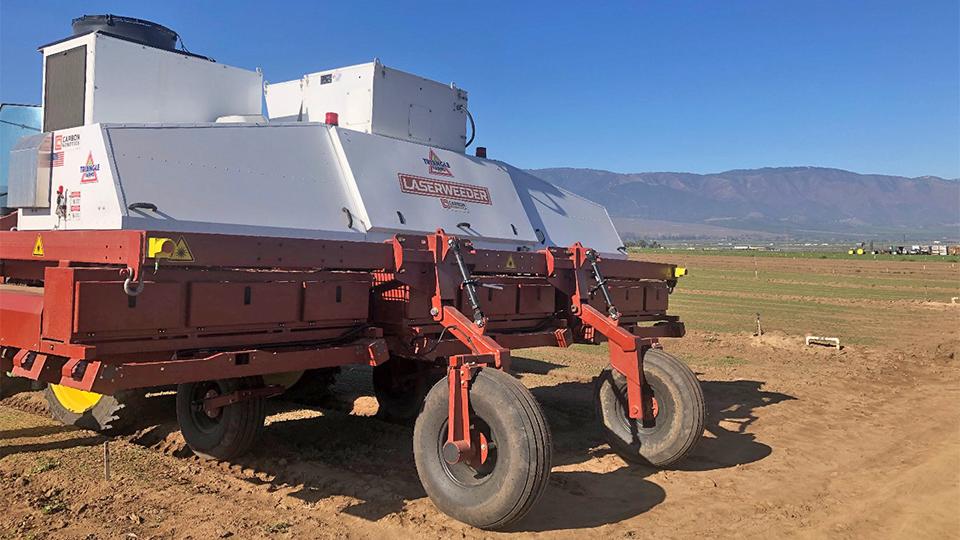
Carbon Robotics’ Laserweeder entering a field.
Photo by Steven Fennimore
Our team evaluated the impact on spinach in Salinas, CA, of various weed controls in 2023. We measured the effect of laser weeding alone, of RoNeet 6EC herbicide alone at 4 pints/A, and a combination treatment of RoNeet followed by laser weeding.
Timing. We seeded spinach on May 31, 2023, followed by RoNeet application on June 2, 2023. The Carbon Robotics laser weeding was conducted on June 13, 2023. Weed density counts were made before and after laser weeding to determine weeding efficacy. Hand weeding times were measured July 6, 2023.
Results. All treatments reduced the number of weeds and the hand weeding times relative to the control. The lowest number of weeds and the shortest hand weeding times were in the RoNeet followed by laser weeding treatment.
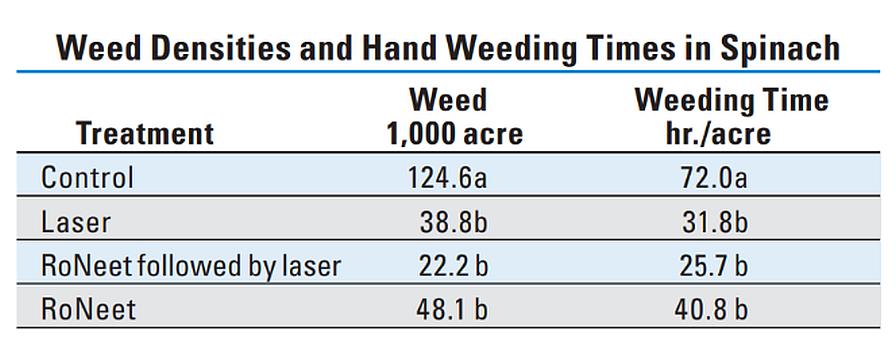
Summary. Because of the high densities at which spinach is grown, it is difficult to cultivate or hand weed this crop. Laser weeding and RoNeet were effective alone at reducing weeds and weeding times. However, the combination of RoNeet and laser resulted in the lowest number of weeds and the shortest hand weeding times.
Stout Smart Cultivator and FarmWise Titan Cultivator Evaluations in Lettuce
Automated cultivators that can remove weeds in the seedline, i.e., intra-row space, were evaluated in lettuce plantings. The FarmWise and Stout cultivators can differentiate between lettuce plants and weeds. Their control systems select lettuce plants for protection while simultaneously selecting weeds for removal which is the same thing a human hoe hand does.
Methods. Our team conducted trials with two automated weeder machines — three trials with the Farmwise Titan cultivator and four with the Stout Smart Cultivators equipped with knives that opened and closed around the crop. The intelligent cultivation took place following thinning and we compared the results with standard cultivation, which leaves a 4-to-5-inch-wide band around the seedline. We counted weeds before and after cultivation in a 6-inch-wide band centered on the seedline. We timed hand weeding by commercial crews to determine hours per acre to weed. The team also evaluated and harvest levels.
Results. The Farmwise Titan removed 32% to 69% of the weeds in the seedline compared to 0% for the standard cultivator on commercial farms. At Harnell Farm, we removed 91% of the weeds compared to 67% for the standard cultivator.
Weeding times with the Titan ranged from 9.8 to 10.9 hours compared to 11.2 to 23.4 hours for the standard cultivator.
The Stout cultivator removed 53% to 99% of the weeds. Weeding times following Stout cultivation ranged from 4.6 to 8.6 hours compared to 10.1 to 11.5 hours for the standard cultivator.
In the Hartnell field station study the Stout cultivator removed 89% of the weeds in the seedline compared to 0% for the standard cultivator. Hand weeding times on the field station were 30.4 hours for Stout compared to 78.3 hours for the standard cultivator.
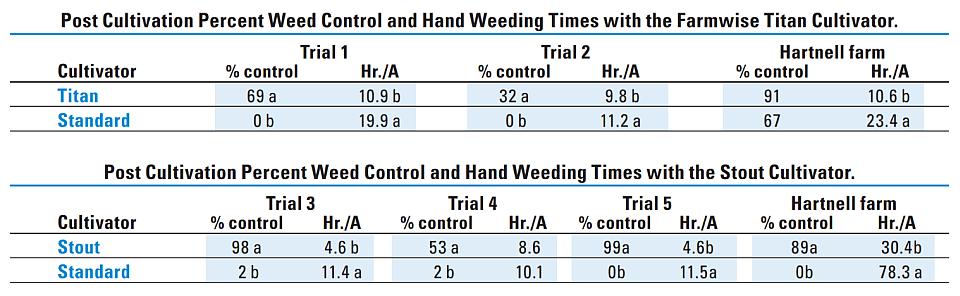
Summary. Both the Stout and Titan cultivators-controlled weeds better than the standard cultivators in on-farm and field station trials. Both cultivators are safe to lettuce and do not reduce yields.
Pronamide (Kerb from Corteva), registered in 1972, is the most widely used herbicide in lettuce. Despite 53 years passing since 1972, no herbicide has been developed to replace Kerb.
Intelligent weeders have been the most effective new weed control tools that have been developed in recent years. Intelligent weeders can continue to be developed and improved, while herbicide molecules cannot be changed. Intelligent weeders provide a reason for optimism among vegetable growers, that weed control problems can be solved and costs contained.
Subscribe Today For
