



What in the World Is Going On With Plant Diseases? Check Out This App
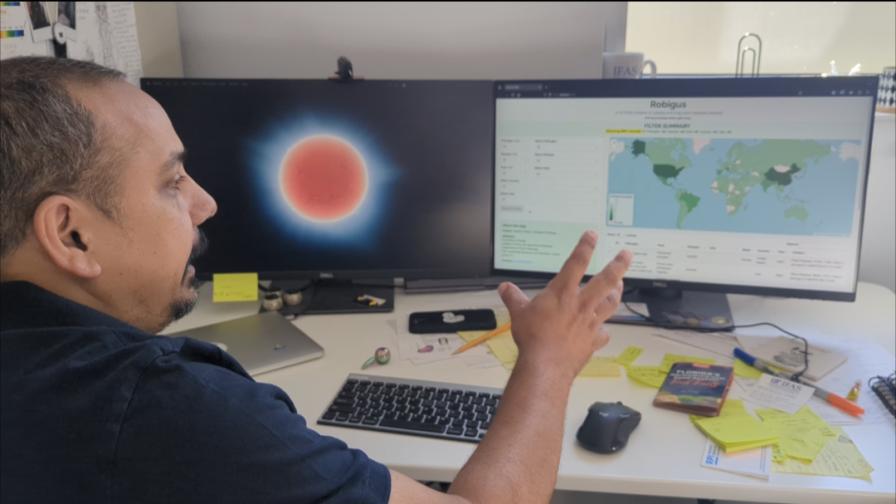
UF/IFAS scientist Braham Dhillon demonstrates the Robigus app.
Photo by Lourdes Mederos, UF/IFAS
Named after the Roman god who once guarded wheat fields from blight, Robigus is the newest tech ally in the fight against plant diseases. Developed by Braham Dhillon is a Molecular Plant Pathologist at the UF/IFAS Fort Lauderdale Research and Education Center, the app can help detect crop threats globally with the tap of a screen or keyboard.
The app, hosted on University of Florida’s supercomputer, HiPerGator, is available to growers, scientists, and others.
Dhillon’s research program combines basic and applied science to better understand how these pathogens infect and spread.
“Plant diseases don’t respect borders,” Dhillon says. “With Robigus, we now have a way to see them globally. That kind of knowledge is essential for protecting crops and food security.”
The creation of Robigus stemmed from a challenge Dhillon faced in his own research: While valuable plant disease data exists, it’s scattered across thousands of scientific journals and early or “first reports” documenting new disease outbreaks. These are often the initial records of emerging threats to crops — but they can be hard to find and access.
“A lot of labs around the world publish plant disease reports, but they often sit as individual articles on publishers’ websites,” Dhillon says. “There’s a tremendous amount of information — pathogen names, host plants, locations, years of discovery — but it’s locked in text. I built Robigus to bring that data together in a way that’s searchable and interactive.”
Robigus draws from 45 years of global plant disease records, collating reports from countries including the U.S., India, Brazil, South Korea, Mexico, and China. The interface allows users to filter by crop, pathogen, country or year. The result is a dynamic map and dataset that visualizes where diseases have been reported and when.
For scientists, Robigus offers a powerful tool to study pathogen activity, diversity, track the emergence of a disease and even anticipate disease risks.
“For Extension agents and growers, it’s a practical resource to answer questions like, ‘Has this disease been reported in my region?’ or ‘What threats exist for palms, mangoes, lychees or bananas?’” he adds.
For more information on the Robigus app, visit blogs.ifas.ufl.edu.
Subscribe Today For
