



ICYMI: 2025 Locks in as Earth’s Third Warmest Year on Record
 January 15, 2026
 Like most years, 2025 brought with it a fair share of weather extremes. From early-year winter blasts, to widespread drought, relentless atmospheric rivers, and much more, the climatologists at NOAA tracked it all. According to the government agency’s latest Global Temperature and Precipitation Analysis, 2025 ranks as the third-warmest year in its global temperature record. The records date back to 1850. This snaps a two-year streak of newly crowned record holders for heat. But 2025 wasn’t that far off the mark.
NOAA scientists note the annual global surface temperature in 2025 was 2.11°F above the 20th-century average, falling closely behind the record-setting year of 2024 (by 0.22°F) and the second-warmest year, 2023 (by 0.04°F).
And just in case you’re keeping score: The 10 warmest years in NOAA’s historical record all have occurred since 2015.
 Loading ...
While air temperatures were plenty hot in 2025, sea surface temperatures were off the charts. In fact, the global upper ocean heat content was a record high in 2025. Upper ocean heat content is defined as the total thermal energy stored in the ocean’s top layers, typically measured from the surface down to 700 meters (~2,300 feet).
Ocean heat content can influence weather patterns, including tropical cyclone development and intensity. And though the 2025 Atlantic hurricane season was considered relatively quiet since no hurricanes made landfall in the U.S. — the first time this happened since 2015, BTW — the hurricanes that did form were formidable. Out of the five hurricanes that came to life in the Atlantic basin during the 2025 season, four of them reached major category status. This included Hurricane Melissa, which caused catastrophic damage to multiple island nations in the Caribbean, especially Jamaica as a landfalling Category 5 storm.
RELATED CONTENT: Pre-Winter Weather Signals Farmers Should Know Now
During 2025, the La Niña Southern Oscillation (ENSO) climate phase prevailed. The same continues for 2026 so far. However, forecasts for Jan.-March 2026 onward are calling for a shift toward the ENSO-Neutral phase. This is expected to be the dominant phase through mid-2026 while chances increase for El Niño (La Niña’s climate sibling) toward the end of the year. Stay tuned for these developments as they will shape the upcoming long-range outlooks for the 2026 Atlantic hurricane season.
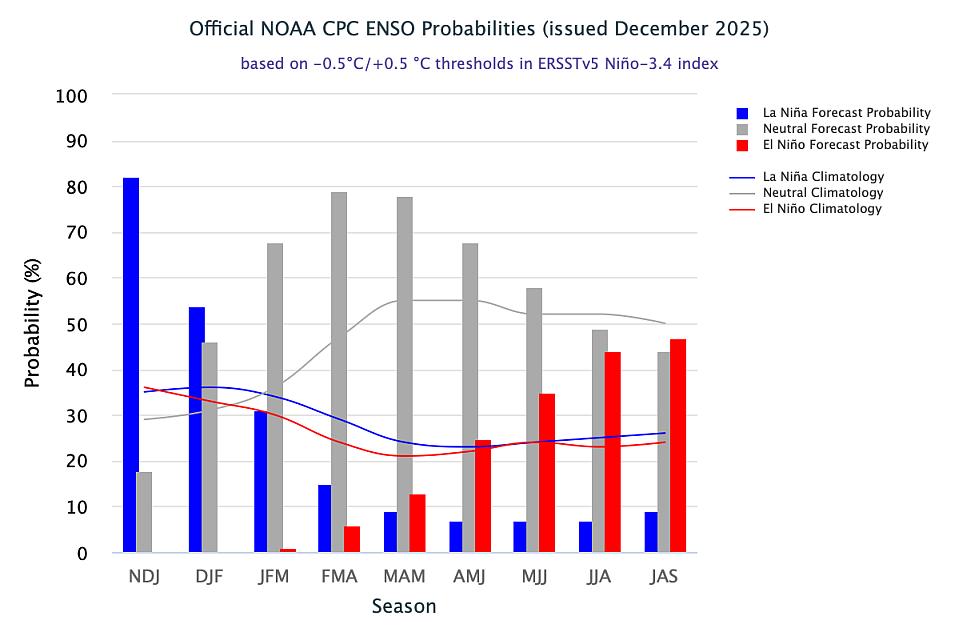
Graphic courtesy of NOAA Climate Prediction Center
Was your farm affected by extreme weather events during 2025? Leave a comment below.
Subscribe Today For
