CONCERNS over energy prices
are nothing new, and interest in renewable energy continues to grow, as is evidenced in USDA’s “On-Farm Renewable Energy Production Survey.” The survey, conducted by USDA National Agricultural Statistics Service, was the first nationwide survey to look at renewable energy practices on farms in the U.S. It found that 8,569 farming operations are now producing their own renewable energy.
This number sounds about right to National Farmers Union president Roger Johnson, who says he’s seen growers’ interest in alternative energy increase significantly over the last several years.
“A lot of our members are very interested in renewable energy for lots of reasons,” Johnson explains. “Energy is one of the largest costs that farmers have in their operation, whether it is in the form of fuel or fertilizer, or in the form of chemicals, most of which are made from petroleum products, or in the form of heating, cooling, or drying. Whatever farmers can do to reduce those energy costs or to offset energy costs is generally something they look at pretty favorably.”
According to USDA’s survey, the
number-one way in which growers are adopting alternative energy is in the
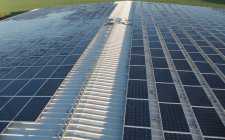
form of solar power or photovoltaic (PV) systems. Del Mar Farms in Westley, CA, is just one operation that recently installed a PV system. The farm, which grows everything from apricots to zucchini, went with a roof-mounted solar system from Cenergy Power (www.cenergypower.com) that spreads across three buildings and offsets the farm’s main energy meter by more than 90%, according to Del Mar’s Brian Wright. “The 25-year system will produce more than 660,000 kilowatt hours per year and pay for itself in about four years,” Wright says.
A Feel-Good Investment
Del Mar had been looking at investing in a solar system for years as part of its sustainability pursuits. With the operation’s recently expanded cooling capacity, Wright says this seemed like
the perfect time to invest.
“Today’s customers are asking how we are becoming more sustainable in our growing and packing practices,” he says. “Also, we are annually audited by a third party for sustainability practices. Installing solar gives us an advantage and appreciation from our customer base that sets Del Mar Farms apart from other companies.”
According to Wright, the thought process took more than a year, but once they broke ground on the project, it took less than three months to complete. “We were able to work with the contractors and continue conducting business as usual during the construction,” he adds. “The initial investment is expensive, but the overall return is attractive. We expect to receive full payback within four years.”
No Need To Go It Alone
Rogers points out that there are ways growers can invest in renewable energy without bearing the entire financial burden themselves. One way is to become a part of a business organization that is building a renewable energy project intended for commercial use.
“It’s not designed to put power back on their farm but rather to supply power to the grid,” he explains. Essentially, the grower enters into an agreement with someone on the other end of the deal who is going to buy the power being generated on the farm. This requires approval and oversight from grid operators, Rogers notes.
Some growers are also banding together to build wind farms, says Rogers. “We call them community wind projects, where the local folks get together and try to raise as much of the capital as they can, do the advance work, and get community support for the project,” he says. With this type of project, the growers are passive investors, leasing their land to house wind turbines, for example.
This approach may be more lucrative for a grower whose energy needs fluctuate significantly throughout the year. “You may be on a farm where your energy needs peak in the fall or spring, but they are really low during the rest of the year,” Rogers says. “In that circumstance, you’re probably not going to be as inclined to put an on-farm facility to use yourself, because you’re going to find large periods of time where you’re selling the power onto the grid for a below-market price.”
Rogers says he believes community wind projects are going to play a big role in renewable energy going forward. “More and more people want to do something to help clean up the environment in one way or another — to do their part,” says Rogers. “So I think you’re going to see a lot of focus on alternative energy sources in the future.”
For a map-based interface for
information about state, local, utility company, and federal incentives that promote renewable energy, go to
www.dsireusa.org
Concerns over energy prices are nothing new, and interest in renewable energy continues to grow, as is evidenced in USDA’s “On-Farm Renewable Energy Production Survey.” The survey, conducted by USDA National Agricultural Statistics Service, was the first nationwide survey to look at renewable energy practices on farms in the U.S. It found that 8,569 farming operations are now producing their own renewable energy.
This number sounds about right to National Farmers Union president Roger Johnson, who says he’s seen growers’ interest in alternative energy increase significantly over the last several years. “A lot of our members are very interested in renewable energy for lots of reasons,” Johnson explains. “Energy is one of the largest costs that farmers have in their operation, whether it is in the form of fuel or fertilizer, or in the form of chemicals, most of which are made from petroleum products, or in the form of heating, cooling, or drying. Whatever farmers can do to reduce those energy costs or to offset energy costs is generally something they look at pretty favorably.”
According to USDA’s survey, the number-one way in which growers are adopting alternative energy is in the form of solar power or photovoltaic (PV) systems. Del Mar Farms in Westley, CA, is just one operation that recently installed a PV system. The farm, which grows everything from apricots to zucchini, went with a roof-mounted solar system from Cenergy Power (www.cenergypower.com) that spreads across three buildings and offsets the farm’s main energy meter by more than 90%, according to Del Mar’s Brian Wright. “The 25-year system will produce more than 660,000 kilowatt hours per year and pay for itself in about four years,” Wright says.
A Feel-Good Investment
Del Mar had been looking at investing in a solar system for years as part of its sustainability pursuits. With the operation’s recently expanded cooling capacity, Wright says this seemed like the perfect time to invest.
“Today’s customers are asking how we are becoming more sustainable in our growing and packing practices,” he says. “Also, we are annually audited by a third party for sustainability practices. Installing solar gives us an advantage and appreciation from our customer base that sets Del Mar Farms apart from other companies.”
According to Wright, the thought process took more than a year, but once they broke ground on the project, it took less than three months to complete. “We were able to work with the contractors and continue conducting business as usual during the construction,” he adds. “The initial investment is expensive, but the overall return is attractive. We expect to receive full payback within four years.”
No Need To Go It Alone
Rogers points out that there are ways growers can invest in renewable energy without bearing the entire financial burden themselves. One way is to become a part of a business organization that is building a renewable energy project intended for commercial use.
“It’s not designed to put power back on their farm but rather to supply power to the grid,” he explains. Essentially, the grower enters into an agreement with someone on the other end of the deal who is going to buy the power being generated on the farm. This requires approval and oversight from grid operators, Rogers notes.
Some growers are also banding together to build wind farms, says Rogers. “We call them community wind projects, where the local folks get together and try to raise as much of the capital as they can, do the advance work, and get community support for the project,” he says. With this type of project, the growers are passive investors, leasing their land to house wind turbines, for example.
This approach may be more lucrative for a grower whose energy needs fluctuate significantly throughout the year. “You may be on a farm where your energy needs peak in the fall or spring, but they are really low during the rest of the year,” Rogers says. “In that circumstance, you’re probably not going to be as inclined to put an on-farm facility to use yourself, because you’re going to find large periods of time where you’re selling the power onto the grid for a below-market price.”
Rogers says he believes community wind projects are going to play a big role in renewable energy going forward. “More and more people want to do something to help clean up the environment in one way or another — to do their part,” says Rogers. “So I think you’re going to see a lot of focus on alternative energy sources in the future.
”For a map-based interface for information about state, local, utility company, and federal incentives that promote renewable energy, go to www.dsireusa.org.
0
1
5
Renewable Energy Practices On Farms
Ann-Marie Jeffries was managing editor of American Fruit Grower magazine, a Meister publication.
See all author stories here.




 January 13, 2012