


Why Digging Into the Limits of Simple Answers Is Fruitful for Produce Growers
 February 23, 2026
 Farming has never lacked complexity. What it lacks, at times, is clarity. That’s why guiding principles hold such appeal. Soil first. Prevention over reaction. Do fewer things well. These ideas don’t make farming simpler. But when decisions stack up and every option feels imperfect? They pull you through.
Larry Jacobs of Jacobs Farm del Cabo’s soil-first philosophy is a good example (click here to read our profile on him). It works not because it’s trendy or absolute, but because it gives him a consistent way to decide what to do. And just as important, what not to do. In a business where overreaction can be as costly as inaction, that kind of filter matters.
Guiding lights are most effective when they push thinking upstream. Prevention beats rescue. Design beats patching. Whether it’s disease management, irrigation uniformity, or labor planning, the best principles encourage growers to solve problems before they flare into crises. They don’t promise perfection; they reduce regret.
Trouble starts when a guiding light hardens into a rule.
Food Safety Challenges
Food safety is a familiar frustration. Protecting consumers is nonnegotiable. But the growing tangle of requirements — many disconnected from field-level science — has turned an admirable goal into a rigid checklist.
Growers aren’t rejecting food safety. They’re struggling with a system that leaves little room for judgment, context, or nuance. When principles stop guiding decisions and start replacing them, trust erodes.
Another pitfall is confusing transferable thinking with transferable practices. An obvious example is greenhouse versus field production, systems growers know are fundamentally different. The broader lesson still applies. What transfers are how decisions are made, not what those decisions look like. Borrowing outcomes without understanding the constraints that shape them is a recipe for frustration.
Even the best guiding lights come with tradeoffs. “No sprays” still require intense monitoring. “Prevention first” still costs time and money. “Technology saves labor” still demands training and trust. Simplicity is useful precisely because it ignores some complexity, but that doesn’t make the complexity disappear.
The goal isn’t to make farming simple. It never will be. The goal is to make decisions clearer when everything else feels noisy. Used well, a guiding light doesn’t eliminate complexity. It helps growers move through it with intention.
OH, ONE MORE THING…
Clear principles are meant to guide good decisions. But when those principles harden into layers of rules, complexity — and cost — can take over. Food safety is a clear example: an admirable goal that has become increasingly expensive to implement.
The Price of Compliance
The best national cost estimates we have were published before Produce Safety Rule compliance deadlines fully took effect. Even so, they offer a baseline — and strong hints that the real price today is higher.
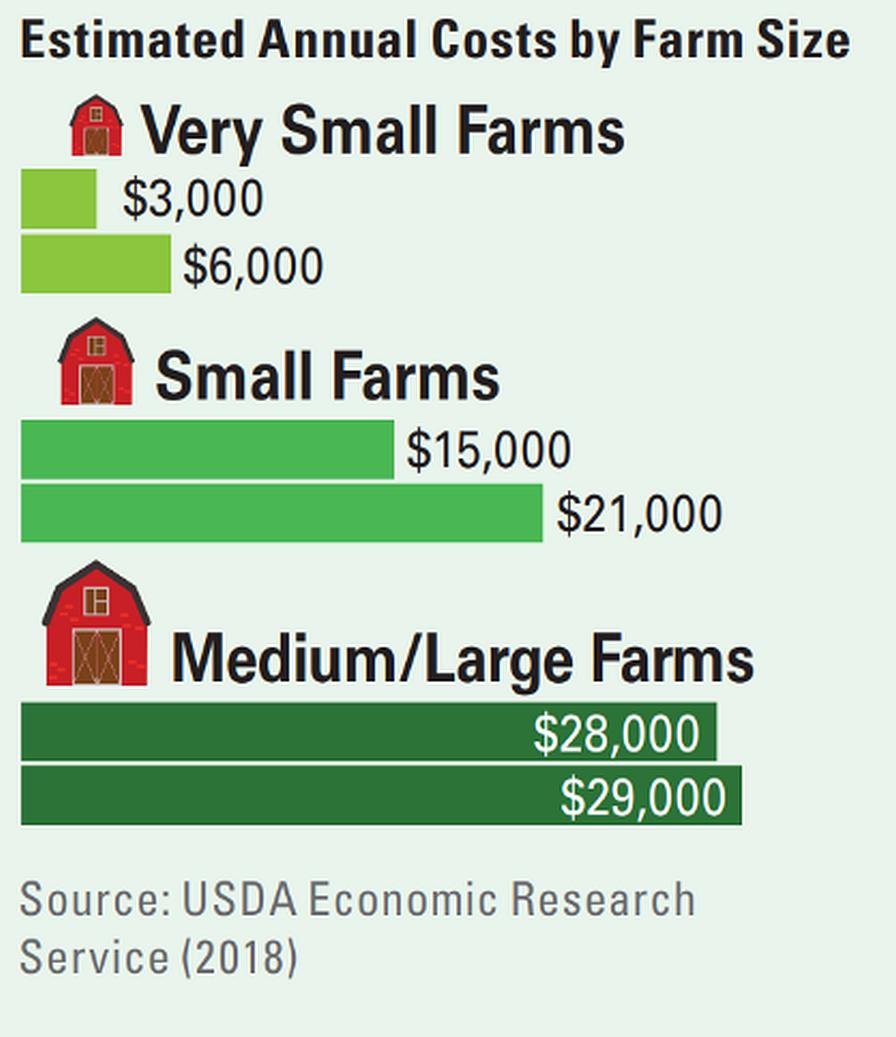
2018 Estimated Annual Compliance Costs
USDA estimates published before staggered compliance deadlines were fully reached to show compliance costs rising sharply with farm size. Other government data shows small farms pay more as a percentage of sales, however.
Subscribe Today For
