

Celebrating the 2026 Apple Grower of the Year Regional Winners
 May 12, 2026
 The Apple Grower of the Year award recognizes growers who have reached outstanding levels of success through their efforts in innovative production, marketing, horticultural, and management practices. These high standards have been in place for nearly four decades. We recently announced the 2026 Apple Grower of the Year overall winner as Robert (Bobby) Brown of Orchard Dale Fruit Co.
In addition to Brown, three apple growers also are recognized as regional winners by American Fruit Grower and Valent U.S.A. Each demonstrates the same qualities as our overall Apple Grower of the Year and remains eligible for that honor in the future. Let’s learn more about the 2026 Apple Grower of the Year regional winners.
East: Mark Russell and Jill MacKenzie, Two of Clubs Orchard, Appleton, NY
Mark Russell and Jill MacKenzie prefer to think big — as big as their behemoth counterparts out West; and at the very least bigger than anyone might expect from a 60-acre operation tucked in the corner of western New York state. Nothing less flies at Two of Clubs Orchard, a high-density (tall spindle) operation in Appleton, NY, that serves the fresh fruit market.
Since the husband-wife team of Russell and MacKenzie purchased the land more than two decades ago, theirs has been a story of evolution, fueled by never-ending education, including more than a few tours with the International Fruit Tree Association (IFTA).
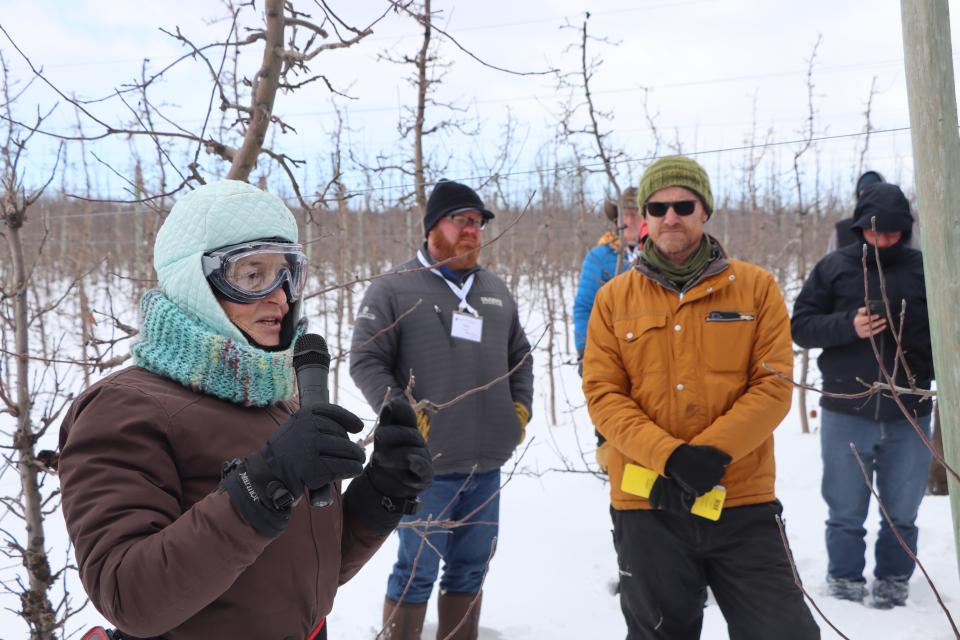
Jill MacKenzie and Mark Russell, co-owners of Two of Clubs Orchard in Appleton, NY, hosting an IFTA tour stop in 2025.
Photo by Thomas Skernivitz
“I’ve gone to so many IFTAs out West, where those guys just always pound you about how expensive their land is and say, ‘We have to be great horticulturists; we have to be as efficient as we possibly can because our land costs are so high,’” Russell says. “And I’m like, Well, I have the cheapest land cost in the apple business in North America, out in the backwater of Niagara County. That’s beautiful country out here, don’t get me wrong, but this is keep land, especially for apples, right next to a lake. And I decided if I spun a watch in front of my face and hypnotized myself into thinking my land cost $30,000 or $40,000 an acre instead of what it actually costs, I would really have to efficiently use that land. So I just decided to do that. I decided to behave as if I had those kind of performance pressures — and it leads to better horticulture.” Pausing, Russell adds, “I should have been even more aggressive in the bottom line.”
Russell and MacKenzie have graduated from 12-foot spacing to 11-foot spacing.
“When we first started planting, we thought we were being brave to go to 12,” Russell says. “Once Jill made the trees the way she wanted to make the trees, we realized all this space we had in the middle.”
In any case, Two of Clubs is doing OK as is. Its evolution has also revolved around the “varietal revolution” that began with the debut of Honeycrisp in the late 80s/early 90s and accelerated in the 2000s.
“We immediately set out to realize a vision that was based on opportunities with new varieties,” Russell says. “We were believers in the new varieties and proprietary varieties and what I like to call the post-Honeycrisp varieties — the whole new varietal revolution, where you just breed Honeycrisp with, as Dennis Courtier once said, everything that’ll sit still. Over two-thirds of our acreage is Honeycrisp or Honeycrisp parentage.”
The operation’s No. 1 variety is Sweet Tango, while other varieties include Gala, Fuji, Pink Lady, Snapdragon, Wild Twist, and Rave. “We’re a small operator, so not all efficiencies of scale are available, but at 60 acres, we’re at least at scale,” Russell says. “We’re like Unit 1. I’ve been out to farms 10 times my size, tours to farms five times my size … and we like to think of ourselves at the scalar level but at a scale of 1.”
Midwest: Allen Teach, Sunrise Orchards, Gays Mills, WI
Industry attention infrequently turns to Wisconsin for apple production. The state ranks just outside the top 10 in the United States. But at least one person never takes his eyes off the 225 acres of apple trees that comprise Sunrise Orchards in Gays Mills, WI.
“One practice — if not most the important practice — that has helped me over the years is paying keen observation of one’s own orchard,” Allen Teach, the Owner of Sunrise Orchards, says. “While travel to other growers’ operations is very useful, one’s observation with a critical eye of your own orchard from top to bottom is extremely important.”
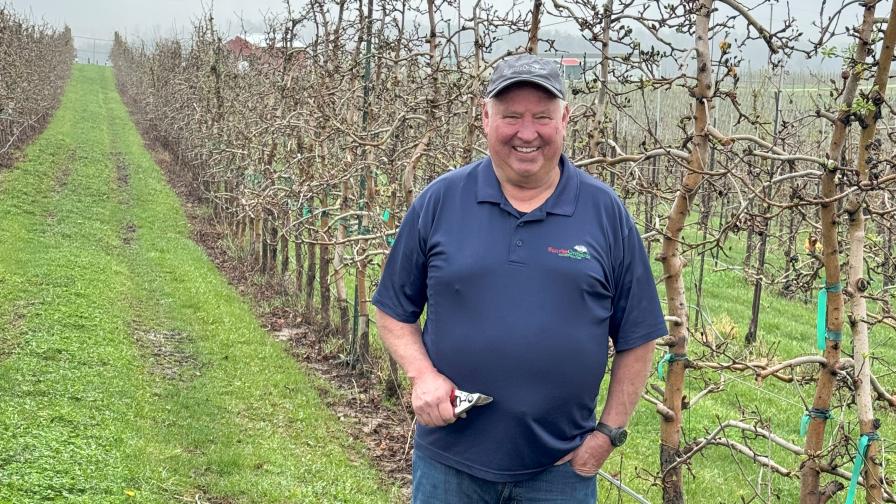
Allen Teach of Sunrise Orchards.
Photo: Sandra Jeffers
Located in southwestern Wisconsin, in the steep and hilly Driftless Region, Sunrise Orchards is far from unknown to “locals” — which includes customers from Minnesota, Iowa, and northern Illinois.
“The nearest big town to us would be La Crosse, WI, or Dubuque in Iowa, and they’re over an hour away. So, if somebody wants to come here and buy apples, I mean they really have to want to come,” Teach says. “Yet we do a sizable retail business. Our main goal here is to sell apples.” Dollar-wise, Sunrise Orchards benefits equally between its retail and wholesale businesses. Last year it produced 177,000 bushels across 20 varieties, largely Honeycrisp, McIntosh, and Cortland.
“Production has shifted a lot to Honeycrisp in the last two decades or so,” Teach says. “It’s the apple that will generate the most excitement of them all, especially retail-wise. Probably three weeks before we have them, it’s just phone call after phone call: ‘When will they be ready?’”
Teach, who turns 70 in September, still walks his rows after 60 years in the business.
“I’ve been spraying trees since way younger than I should have been probably,” he says. “I have given that up this year to the younger generation, but I still enjoy it. My favorite jobs in the orchard are to prune, and I love to thin or to make the thinning decisions with my nephews and try to train them on the thinning. There’s not a job here that I haven’t done.”
A third-generation farmer, Teach has successors in nephews Brent Seiser, Kraig Oppriecht, and Chris Pettit. “I served as president of the Wisconsin Apple Growers Association. My father was on the board. My mother was president for a while. I had a brother-in-law that served as president. And then my nephew (Seiser) is on the board right now,” Teach says. “So we’ve been quite active in Wisconsin apple growing. It’s a very interesting place to grow apples.”
West: William and Angell Clark, Diamondback Acres, Chelan, WA
When the all-about worlds of “location, location, location” and “Honeycrisp, Honeycrisp, Honeycrisp” collide, good things can happen to an apple grower. Such has been the case the last 25 years for William and Angell Clark of Diamondback Acres. Farming in the eastern shadow of the Cascade Mountains and above Chelan Lake, the Clarks first planted Honeycrisp — certified organic — in 2001.
“Most people had not heard of Honeycrisp at that time,” William says. “And that, of course, is a variety that, in our location, has been very kind to us. We’ve got cooler, higher sites, where it more mimics Minnesota’s climate, where it came from.”
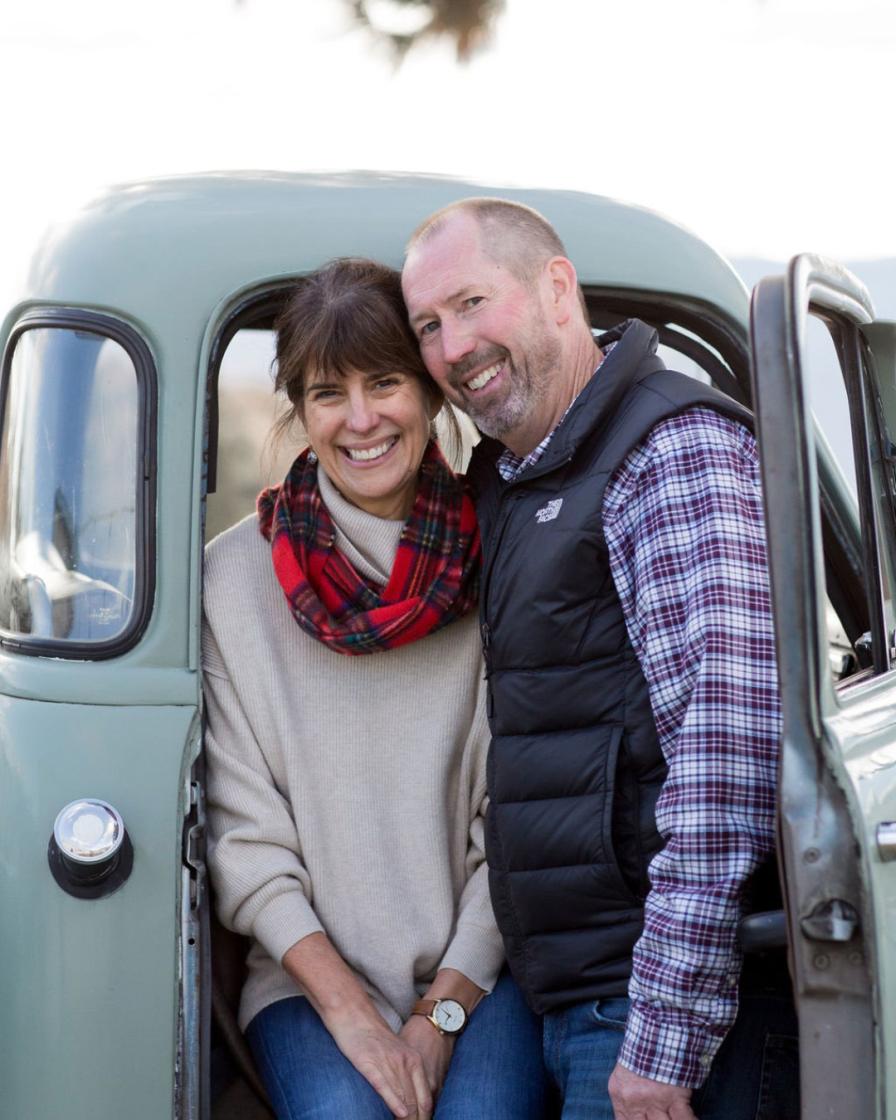
William and Angell Clark of Diamondback Orchards.
Photo: Pinehurst Photography
The Clarks had previously banked on Red Delicious, but the heat units and growing days in the Chelan Gorge were too short to mature the Reds. “So we said, ‘We need an apple with a shorter growing season, like a Golden Delicious or a Gala. And we need an apple that grows big because typically in cold climates you get a smaller apple. The bigger money is in bigger sizes. We had a block that was Galas that we grafted to Honeycrisp, and the production is consistently way better than the Gala production because the Galas were so small. We peaked on 113s and 125s.”
A grower/packer friend, Harold Ostenson, recommended Honeycrisp. “What’s that?’ William responded. “And he said, ‘Well, it’s an apple that grows really big, it harvests about Golden time, it mildews like crazy, it likes to bitter pit, it sunburns.’ He named all these things that sounded like a nightmare.”
The Clarks knew they could handle the sunburn and size based on their location. In retrospect, bitter pit has not been a significant problem. And while mildew has been a constant management struggle, the Clarks have kept the issue at bay. “It’s a lesson in matching a fruit variety to the location rather than trying to say, ‘Hey, this is what I want to grow; I’ve got this ground that I want to grow it in regardless of where it’s at or if it’s too hot or too cold.’ So, it’s just like with other businesses, where they say, ‘Location, location, location.’ Well, it’s pretty important for us, too.”
Subscribe Today For
