


Made in the Shade: Protecting Raspberries From Extreme Heat
 June 18, 2026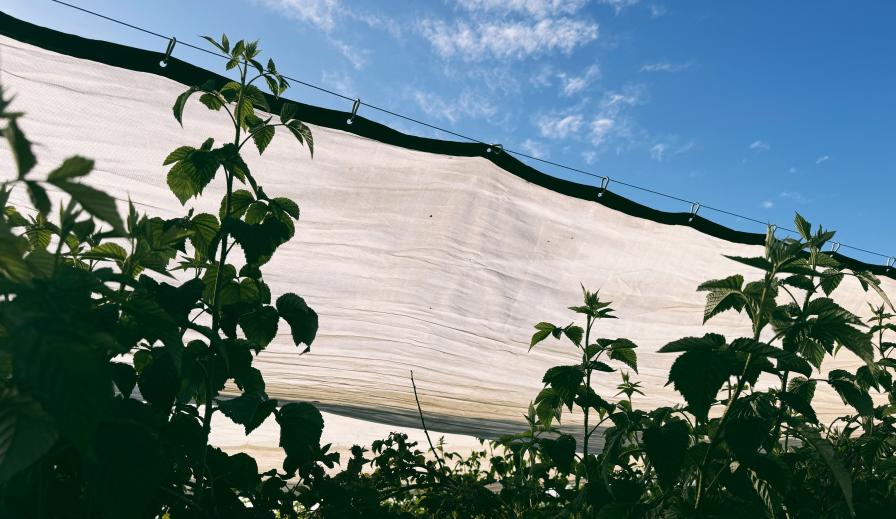
Shade cloth effectively reduces raspberry fruit temperatures and increases yields during periods of extreme heat, according to Washington State researchers.
Photo: Ashley Fincham

As heat waves become more frequent across traditional raspberry-growing regions, researchers are evaluating practical ways to protect yields and fruit quality. New research led by Lisa Wasko DeVetter at Washington State University suggests both overhead microsprinkler cooling and shade cloth can help raspberries withstand extreme temperatures, but shade cloth may offer the greatest economic return under increasingly constrained water supplies.
DeVetter — presenting on climate adaptation strategies for small fruit production on behalf of WSU Extension’s Regional Small Farms Program — shared results from a two-year study conducted in Prosser, WA, where researchers compared overhead evaporative cooling and 40% shade cloth in a young raspberry planting exposed to high summer temperatures. The project evaluated two commercial cultivars, Meeker and Wakefield, along with advanced breeding selections from WSU and the USDA.
“Raspberries have traditionally been grown in cooler climates that are not prone to heat stress,” DeVetter said. “But we’re starting to see that more frequently, and we know more frequent and intense heat is projected under climate change scenarios.”
KEEPING FRUIT COOL
Researchers monitored berry surface temperatures during a July 2024 heat wave that pushed air temperatures to approximately 100° F. Untreated fruit temperatures frequently exceeded ambient air temperatures by more than 10 degrees, a range associated with heat damage.
Both mitigation strategies reduced fruit temperatures. Shade cloth consistently maintained berry temperatures near ambient air temperature, while overhead microsprinklers provided effective cooling when water was available. However, mandatory irrigation shutdowns during portions of the heat event temporarily prevented cooling in sprinkler-treated plots.
The findings highlight a growing challenge for growers considering evaporative cooling systems.
“It’s an important story as we think about mitigation,” DeVetter said. “How available is water, and how much water will these mitigation practices consume?”
YIELD GAINS FROM BOTH APPROACHES
The cooling benefits translated into improved production.
Across both years of the study, shade cloth and overhead cooling increased yields compared with untreated controls. In 2024 the two technologies performed similarly. In 2025, however, shade cloth produced significantly higher yields than the untreated control and slightly outperformed overhead cooling. Researchers believe increased irrigation restrictions limited the effectiveness of evaporative cooling that season.
Fruit quality remained largely unaffected by either treatment, but overhead cooling increased postharvest mold development in certain cultivars, particularly Meeker and the USDA selection, ORUS 4715. The additional moisture associated with cooling likely increased disease pressure during storage.
The results suggest cultivar selection will be an important consideration for growers adopting overhead cooling systems.
ECONOMICS FAVOR SHADE CLOTH
An economic analysis conducted by agricultural economist Suzette Galinato found both technologies improved profitability compared with no heat mitigation. However, shade cloth generated the greatest added income because of its larger yield benefits.
The systems carried different costs.
Shade cloth required significant upfront investment and ongoing labor for deployment and repairs, particularly following wind events. Installation costs ranged from roughly $9,880 to $12,000 per acre.
Overhead cooling required less infrastructure investment but generated higher weed-management costs because additional moisture promoted weed growth. Researchers observed significantly greater weed pressure in cooled plots.
TRADEOFFS REMAIN
Each technology presents unique advantages and challenges.
Shade cloth not only reduced heat stress but also lowered ultraviolet exposure and offered potential hail protection, a benefit already being utilized in parts of Europe. However, current shade structures can interfere with over-the-row mechanical harvest systems commonly used by processing raspberry growers.
Overhead cooling remains less expensive and may provide additional flexibility for chemigation or foliar nutrient applications. Yet its effectiveness depends on access to adequate irrigation water, and some cultivars may experience increased postharvest rot.
SMART COOLING SYSTEMS NEXT
DeVetter said future research will focus on refining cooling strategies through automation and improved heat-tolerant genetics.
Researchers are testing sensor-based cooling systems that use temperature and leaf-wetness measurements to determine precisely when sprinklers should activate and shut down, reducing unnecessary water use. At the same time, breeding programs are identifying physiological markers associated with heat tolerance.
“Smart technology, such as sensors that are really effective at deploying cooling technology so we’re not over-applying water, as well as breeding for resilience, are going to become increasingly important,” DeVetter said.
The research is part of a broader effort by DeVetter’s program to develop practical climate adaptation tools for small fruit growers facing hotter growing seasons and more frequent extreme-weather events.
Subscribe Today For
