



Cheers to Berry Breeding as It Enters the Data Age
 June 25, 2026
 Recently, I had the honor of visiting Vance Whitaker and his team and viewing the University of Florida strawberry breeding program based just south of Tampa, FL. Whitaker and assistant breeder Cheryl Dalid showed me several of the newest varieties released from the program, including ‘Ember’ and ‘Encore’. These new advances continue to support and build the Florida strawberry industry, which is largely based on UF variety developments.
FROM MARKERS TO MAINSTREAM BREEDING
In 2019, I featured Whitaker in a column for American Fruit Grower where he explained how his program was implementing new breeding technologies. He provided detail to me on how marker- assisted selection had been fully implemented in his program in collaboration with Seonghee Lee, and he was expanding the use of genomic selection in his program approach to crossing and selection. My goal was to try to explain technologies for a broad audience and grow in my understanding of the new advances also.
Here we are six years later, and I checked with Whitaker on how new technologies continue to be implemented in his program. He and his team shared some exciting expansions in molecular breeding advances.
In 2019, the UF strawberry program was screening for just a handful of traits in seedlings, using DNA markers. Today they are using 14 different markers to screen for disease resistance, flavor, fruit color, and photoperiod response. These markers are linked to genes (loci) that have pretty large effects on the target trait. On average, the team screens approximately 70,000 seedlings from 170 different cross combinations each year, retaining a total of about 12,000 seedlings with the desired traits for further evaluation. ‘Ember’ and ‘Encore’ are both products of this process. It is exciting to hear that products — in this case commercial varieties — all were developed using these new methods.
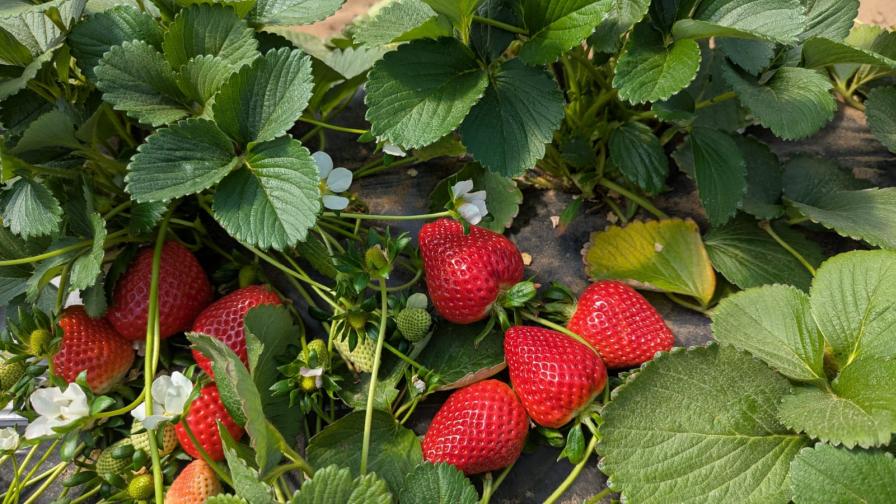
Encore strawberry, a new variety developed using new innovative molecular breeding techniques at the University of Florida.
Photo: UF/IFAS
GENOMIC SELECTION SPEEDS THE BERRY BREEDING CYCLE
Genomic selection (GS) has allowed the program to predict the performance of individual selections — plants that are chosen from seedling populations or families — for any trait, no matter how genetically complex, using genome-wide marker data. They use genotypic and phenotypic data — phenotypic data being items that can be observed in ratings or data, etc. — to build predictive models, which are then applied to newly advanced breeding materials and seedlings that have not been phenotyped.
In 2019 GS was utilized mainly for parent selection and for about five different traits. Today the UF program uses GS at every level of the program, including in seedling selection, for more than 30 traits. The program also updates the predictions throughout the season, as new field data is analyzed and new marker data is generated from the weekly selections.
One of the outcomes is that it is increasingly common for the program to make crosses with first-year seedlings if both the field evaluations and the predictions agree. This is very noteworthy achievement, as traditional fruit-breeding methods often require selections to be evaluated one or more years before their breeding potential can be assessed. This process is a key aspect of speeding up the breeding process, something all breeders are acutely interested in.
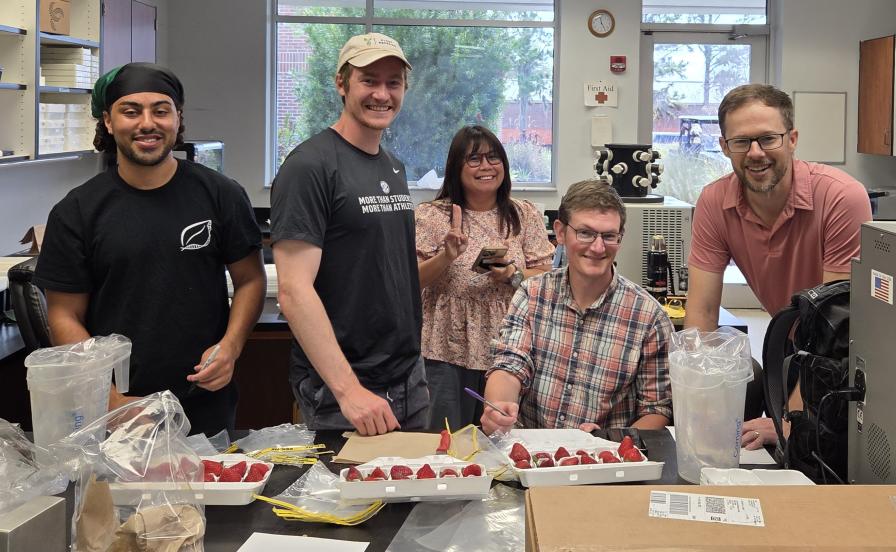
Members of the strawberry breeding team at the University of Florida. From left to right: Xavier Tacker, Dr. Mark Porter, Dr. Cheryl Dalid, Dr. Josh Sleper, and Dr. Vance Whitaker.
Photo: UF/IFAS
DIGITAL TOOLS AND DATA-DRIVEN FLAVOR SELECTION
One advancement in the program is the implementation of digital phenotyping, which uses imaging technologies, sensors, and automated data collection to quantify traits with high throughput. These technologies allow the team to measure traits that have not been studied on a larger scale in strawberries, such as fruit color and plant biomass. For example, the program uses drones to estimate the biomass and canopy area of strawberry plants each week of the season without having to destroy and weigh the plants. Previously it simply took too much labor and trial space to get such measurements.
One of the questions the UF team has asked itself is whether or not GS can be effective for sensory traits, such as texture and flavor based on weekly breeder evaluations in the field. Would the breeder ratings reflect the more rigorous taste panel data, and would they be accurate enough to use in breeding? Would the data be too sparse?
Mark Porter, a recent graduate of the program, has tasted thousands of seedlings and selections to try to answer these questions. His work has shown that with a large enough sample size, simple 1-5 breeder ratings of sweetness, flavor, sourness, and other flavor attributes are quite useful in breeding. Not only that, but they can also be used in a GS approach to predict what will perform well in the more rigorous taste panels that take place at later evaluation stages.
Porter is now working with doctorate student Xavier Tacker and quantitative geneticist Josh Sleper to add fruit chemistry data, such as sugars, acids, and volatiles, into the mix to see if flavor can be predicted with even more accuracy. This is particularly exciting, as traits such as flavor and texture can be impacted to a great degree by environment (rainfall, temperature variations, etc.), and any breeding methodology that can tackle these complex traits is very exciting news.
As I have the opportunity to visit fruit breeders in various programs across the U.S., it is exciting to see the expanded implementation of molecular breeding methods. Being able to move from mostly publication-result-oriented products in earlier years to now variety development contributions is a huge achievement. The University of Florida strawberry breeding program is a perfect example.
Let the berry good times roll!
Subscribe Today For
