



2010 Apple Crop Forecast
 September 13, 2010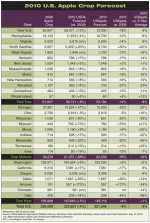
For the apple growers, packers, and marketers who met in Chicago in August for the U.S. Apple Association’s Apple Crop Outlook and Marketing Conference, it was not only a time to make their predictions for this year’s crop forecast. It was also an opportunity to address where the industry is headed in the future, in terms of technology, communication, and marketing.
USDA’s 2010 apple crop forecast, which was released August 12, calls for 226 million bushels, which is down 4% from 2009 and down 1% from the five-year average. The East and Midwest sections of the country will see smaller crops, while Washington’s apple crop is expected to increase from 2009. Gala continues to gain market share, and export market share and value once again reached new highs.
USApple members differed slightly in their prediction, calling for a total U.S. apple crop of 221.5 million bushels, down 6% from 2009. The following is a brief summary of the 2010 apple crop broken down by region. For a detailed look at crop sizes compared to last year, check out the chart to the left.
– East. The two words that best summarize Eastern growing conditions this year were “hot” and “early.” New York is expecting to harvest 10 days earlier than normal. Despite some frost damage, ample rain means more apples should be going to the fresh market. Further south, a season of mostly hot, dry weather will also mean an early harvest.
– Midwest. Most of the Midwest production comes from Michigan, where the crop estimate varies based on region. The number will certainly be down from last year’s record crop, but up from 2008. Some early varieties may be affected by a late freeze, while Gala is poised to surpass Red Delicious in overall production.
– West. Cool, windy conditions during bloom in Washington made pollination difficult. There have been mixed reports on sizing, but the quality looks good. Harvest is expected to be seven to 10 days later than normal.
Looking Abroad
As usual, this year’s Outlook Conference also included crop estimates from some of the world’s leading apple producing regions.
– Europe. The total apple crop forecast for the European Union countries is 9.79 million metric tons, which is down 11% from 2009 and down 7% from the three-year average. Almost every country reported a drop in production, as a cold, wet spring limited pollination and increased scab damage in many areas. Fuji was the only variety to show an increase in production.
– China. Total Chinese apple production is expected to reach 30.8 million metric tons, down 3% from 2009 and up 10% from the five-year average. Fuji production has risen 40% in the last five years and now has a 69% market share. Fresh apple demand is rising, leading to an increase in both pricing and acreage, while processing and apple juice concentrate demand has slowed due to high food prices.
– Mexico. Frost damage is likely to result in a crop that will be down 10% from 2009. Golden Delicious continues to be the top variety. There was a bit of controversy concerning the Mexican government’s recent decision to assess a 20% tariff on fresh and dried apples, as well as some other agricultural products. The tariff comes in response to an ongoing dispute related to cross-border trucking. “American apple growers are disappointed and frustrated by the Mexican government’s decision to assess this unwarranted, unfair duty on apples,” stated USApple President and CEO Nancy Foster. Mexico is the largest export market for U.S. apples. Last year, Mexico imported 11.5 million boxes of fresh U.S. apples, worth $207 million, and dried apples valued at $23 million.
– Canada. The Canadian apple crop estimate is 21 million bushels, down 1.1% from 2009 and down 5.4% from the five-year average. British Columbia and Quebec will see higher crops, while Ontario and Nova Scotia will likely drop thanks to scattered frost damage.
Subscribe Today For
