



Picking the Right Way To Farm at Terhune Orchards
 May 19, 2026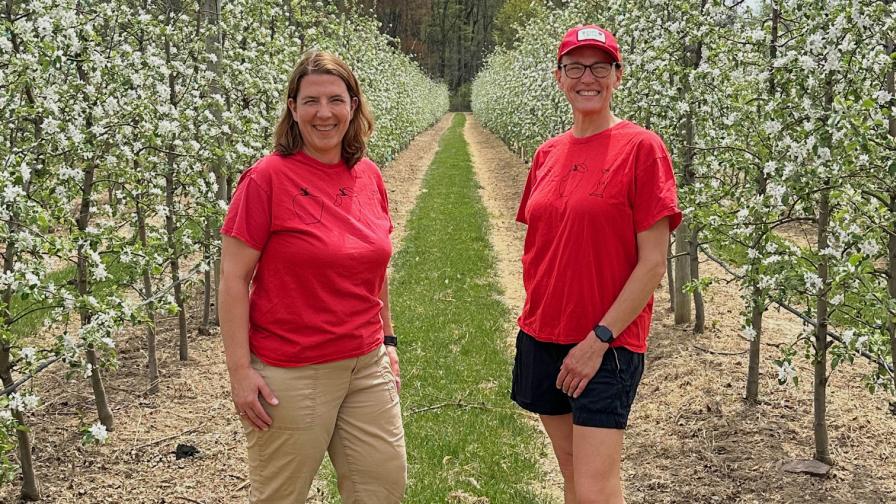
Sisters Tannwen Mount (left) and Reuwai Hanewald co-own Terhune Orchards in Princeton, NJ.
Photo courtesy of Reuwai Hanewald
In central New Jersey, just outside Princeton, surrounded by malls and highways, Reuwai Hanewald is quietly reshaping what a family farm can look like in 2026. Hanewald, a 10-generation grower, co-owns Terhune Orchards with her sister Tannwen. The 250-acre, female-run operation blends heritage with modern economics. Their father, the legendary Gary Mount — who spent decades advancing fruit tree research and serving the International Fruit Tree Association (IFTA) — gave them one crucial piece of permission growing up: “This farm does not need to look the same when you and your sister take it over.”
That freedom now underpins every decision Hanewald makes. Heritage matters, but economics rules.
Speaking to attendees at the IFTA conference in Fresno, she stressed how data, margins, and hard choices guide her leadership, an example of the growing spotlight on women in agriculture, highlighted in 2026 as the International Year of the Woman Farmer.
FROM WHOLESALE APPLES TO RETAIL LEADERSHIP
Terhune Orchards has deep roots in wholesale apples. A hand-drawn plan of her great-grandfather’s 1927 farm shows traditional varieties, including Pippin, Rome, and Winesap, alongside the names of horses and even an old Studebaker. Today that original farm on state Route 1 is “covered in malls.”
To keep the farm viable, Hanewald and her sister built a diverse, retail-first model: a year-round farm store, farmers markets, a vineyard and winery, a bakery, greenhouses, and extensive pick-your-own and agritourism operations.
“Bottom line, this is a business,” Hanewald says. “My farm is not a public park.”
EVERY CROP ON TRIAL
Her approach is blunt: Every crop must justify its place economically.
Asparagus, for example, is reliable and profitable early in the season. When an aging field declined, Hanewald replanted, accepting a short-term hit for long-term gain. Flowers taught her another lesson: simplify to multiply. By offering only zinnias, only pick-your-own, and selling in standardized cups, revenue on the same two acres jumped sharply.
Cherries, by contrast, are the glamorous but fragile crop. Opening-day lines and high prices bring excitement, but the costs, which include tunnels, plastic, bird pressure, weather risk, and labor, make margins tighter than asparagus or flowers. “They stay for marketing and customer excitement, but I don’t pretend they’re my best earner,” she admits.
INVESTING IN PEOPLE AND TECHNOLOGY
Hanewald’s most valuable asset is her long-tenured crew, some of whom have worked the farm for 30 to 40 years. To make labor viable, she invests in technology that increases the value of every hour: drip irrigation across all acres, high-density trellis plantings, an FMA hedger to reduce pruning time, electric pruners, and a self-navigating orchard platform that allows workers to focus on picking rather than driving.
“I don’t want to pay someone to drive down a row,” she says. “I want to pay them to pick.”
She also installed on-farm controlled atmosphere storage — the only one in New Jersey — enabling year-round apples and cider, and, importantly, year-round jobs.
RULES, PRICING, AND CUSTOMER EDUCATION
Economics extend all the way to the farm gate. “My orchard is for pickers, not tourists,” Hanewald says. Traffic is carefully managed, and crops that cannot carry their labor and opportunity costs are removed from rotation.
She recalls a father balking at paying $1.50 for an apple but happily buying a bag of donuts instead. After realizing she was undercharging for those donuts, she raised prices. “I make so much more off the donuts,” she laughs. At the same time, she uses these moments to educate customers about the effort behind the produce.
DATA-DRIVEN LEADERSHIP
During her Fresno presentation, Hanewald laid out detailed economics for just three crops, representing 10 of 250 acres. To better understand the entire operation, including a newly purchased 60-acre parcel, she hired a financial consultant. She continues to trial new varieties like ‘EverCrisp’ and ‘Aztec Fuji’, scale back underperformers, and partner with researchers, even when some experiments yield no sellable crop.
Her leadership shines not in slogans, but in spreadsheets, numbers, and decisions grounded in evidence. She leans on a network of growers willing to share failures and successes, modeling collaboration and thoughtful risk management.
“I can’t force people to come to my place,” she says. “What I can do is make sure that if they come, they have a high-quality experience and high-quality produce.”
It’s a fitting vision for a woman farmer in a high-cost corridor: rooted in family history but relentlessly focused on the economics that will keep that history alive, and thriving, for generations to come.
Subscribe Today For
