


Are Birds Raiding Your Fruit Crops? Experts Explain How to up Your Protection Plan
 April 6, 2026
 Principals with three companies — Avian Control, Wild Goose Chase, and Reed-Joseph — discuss their approaches to bird control in orchards and vineyards, from repellents to lasers to pyrotechnics. Here is the Q&A.
We had asked growers in our State of the Fruit Industry survey to rate the impact of weighty agricultural issues, such as input costs, labor, and climate. One respondent wrote in “birds” as his biggest problem. Can we assume such a comment doesn’t surprise you?
Carla Wagner (Director of Solutions, Wild Goose Chase): “That doesn’t surprise us at all. USDA estimates that birds cost U.S. fruit growers tens of millions of dollars each year in fruit loss due to feeding and damage caused by pecking.”
Jon Stone (President, Avian Control): “We have customers that tell us that, if they didn’t have a product like ours, they would lose their entire crop. There are some growers — for instance, wine grape growers — that can lose easily 85% of their crop if they don’t take mitigation steps early before veraison. It’s the same thing with blueberries and cherries. It’s hit or miss, but some growers report that they could lose absolutely their whole crop.”
Barthell Joseph (Owner, Reed-Joseph): “Not [surprising] at all. Depending on the year, we can be overwhelmed with orders from berry and grape producers.”
What can you tell us about the technology you offer growers?

Jon Stone, Avian Control
Stone (Avian Control): “Our technology is the active ingredient methyl anthranilate combined with our inert ingredient. The combination of both lengthens the effectiveness time for the repellent to be able to condition the birds to stay away. So, instead of the older-generation methyl anthranilate repellents working for a day or two, this new-generation methyl anthranilate product with the inert ingredient allows it to last up to 10 days without biodegrading in any serious fashion. What ends up happening is that the birds are trained or conditioned to stay away. It’s considered a smell and taste irritant. The birds don’t have to taste a food crop to be affected, they just have to inhale it. A lot of times when birds are flying, they’re breathing heavy as they fly, and as they fly through areas that have been fogged or sprayed, they become irritated right away. When birds land on fruit that has been sprayed, their first peck they’re immediately affected as well. But they don’t have to peck to become affected. They can smell the product on the fruit or vegetable, and they’re affected.”
Wagner (Wild Goose Chase): “One of the solutions we’ve found to be most effective at keeping birds at bay is automated bird lasers. Automated bird lasers work by projecting a beam of green light that birds perceive as a physical threat. When installed and programmed correctly, one automated laser can effectively protect up to 10 acres of land from small birds and up to 100 acres of land from large migratory birds like Canada geese and snow geese. Research has shown that lasers can reduce wild bird presence by up to 70% to 90%. Most importantly, birds do not habituate to lasers because lasers can be programmed to move in variable patterns that remain unpredictable to birds. That said, there are no silver bullet solutions. No single product or service can get rid of bird presence completely. Depending on the species present and the environment, several different solutions — or combination of solutions — may be required to offer maximum protection.”
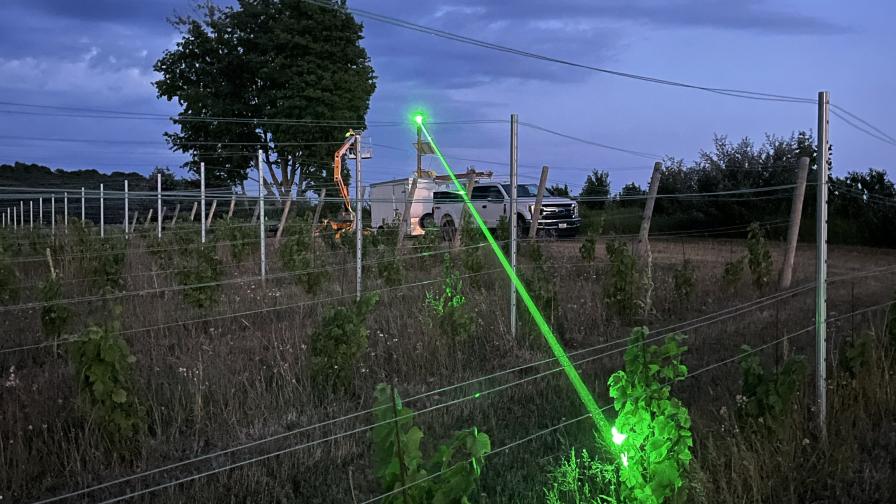
Photo: Wild Goose Chase
Joseph (Reed-Joseph): “Our best-selling products for the ag sector are our 15 mm Bird Banger and Screamer Siren pyrotechnic cartridges. Our Scare-Away LP gas cannons are also widely used by berry, grape, and nut producers.”
What specific crop types are prone to attract bird damage?

Carla Wagner, Wild Goose Chase
Wagner (Wild Goose Chase): “Birds are drawn to fruit with high sugar content, bright colors, soft skin that’s easy to puncture, and dense plantings that offer efficient foraging. This means that certain crop types such as berries, cherries, and grapes are particularly vulnerable to bird damage. Peaches are also susceptible as they ripen. Nuts are not immune from bird damage, either. Birds love nuts because they are packed with energy and fat, making them a high caloric meal for birds. Crops like almonds, pecans, walnuts, and pistachios are frequent targets, with crows, jays, and woodpeckers often the biggest offenders. What makes nut damage especially tricky is that some birds don’t just eat the nuts on the spot. They hoard and carry them off, hiding the nuts for later. This means farmers can lose large amounts of inventory without even seeing it happen.”
How important is timing?
Stone (Avian Control): “If the birds can be treated early on in the growing season, if they can be exposed to it before the scout birds tell the rest of the flock to come eat, and if they can be persuaded at that point in the season, it can be extremely effective.”
Wagner (Wild Goose Chase): “Each crop has its own vulnerable window. In general, damage tends to peak in late summer and fall, when fruits and nuts reach maturity. When a crop hits peak ripeness, birds key in quickly, often within days, drawn by detections in crop color changes, softening skin, and increased sugar content.”
And are their regional nuances?
Wagner (Wild Goose Chase): “There are certainly regional nuances when it comes to bird issues. Geography can impact the type of bird species present and the timing of the damage. That said, at a local level we’ve often found that the habitat offered by the area surrounding the orchard or vineyard also largely contributes to the species, distribution, flock size, and feeding habitats of the birds targeting the farms. Farms across the U.S. will face different bird issues, but even two farms in the same region may have different issues depending on each farm’s surrounding environment.”
What specific types of birds do you manage most often? Our readers make multiple mentions of starlings, crows, and robins.

Barthell Joseph, Reed-Joseph
Joseph (Reed-Joseph): “All those, and don’t forget the cedar waxwing.”
Stone (Avian Control): “The cedar waxwing is primarily the most stubborn we’ve seen. The more stubborn the bird, the more aggressive and higher concentration of product is needed as well as starting very early.”
Wagner (Wild Goose Chase): “When it comes to fruit farms, European starlings, crows, and various species of blackbirds are among the most common species that Wild Goose Chase is called in to manage. These species tend to form large flocks that can descend on a crop and cause massive amounts of pecking and feeding damage in a very short amount of time. We’ve had grape growers report complete crop loss in less than a week near harvest time. Cedar waxwings, robins, and flickers are also frequent contributors to crop damage, but they tend to form smaller — though no less destructive — flocks.”
What bird is your most interesting or unique challenge? We always receive mentions of turkeys.
Wagner (Wild Goose Chase): “Turkeys are definitely an interesting challenge when it comes to bird control. In fact, they almost act more like deer and rabbits when it comes to how they approach and damage fruit crops. Many of the traditional bird management tools and techniques have a hard time reaching where turkeys approach and feed from. When dealing with turkeys, outside-the-box thinking and custom applications designed for a farm’s particular environment are almost certainly required.”
Joseph (Reed-Joseph): “Good question. We find birds in flocks are more easily deterred than individual birds. Also, smarter birds are typically more easily deterred. For example, it’s far easier to scare a crow than a killdeer.”
How do you handle protected species, such as the tricolored blackbird, which is nonetheless recognized as a pest by some of our readers?
Wagner (Wild Goose Chase): “Nearly all bird species are protected under federal law, and many have additional protections at the state and local level. Beyond legal protection, some birds also carry a strong emotional attachment for the public, and any control program that’s seen as harming beloved species can create real reputational risks for a grower. That’s why our approach always starts with humane, non-lethal methods first. We can often reduce the amount of damage created by birds to a tolerable level with non-lethal techniques alone, including deterrents, exclusion, and habitat modification. In rare cases where non-lethal methods aren’t enough, lethal control may be considered — but only for certain species, only when absolutely necessary, and always with the proper permits and documentation in place.
What other relevant species are protected?
Wagner (Wild Goose Chase): “99.75% of birds in the United States are protected by the Migratory Bird Treaty Act. The only species that are not protected include house sparrows, European starlings, and rock pigeons. This means for most farms that have a nuisance bird problem it’s always important to start with species identification because chances are the bird problem they’re facing is related to a protected species.”
Joseph (Reed-Joseph): “Cormorants are a big challenge for the aquaculture industry, and they are protected.”
Any other thoughts you’d like to add?
Wagner (Wild Goose Chase): “One of the most challenging aspects of working in bird control is that there are so many pseudoscientific solutions on the market that don’t actually work. Not only are most birds protected by law, but they are also incredibly intelligent and quickly learn to habituate against most deterrence mechanisms. In fact, even solutions like bird lasers that are proven to work can be ineffective if they’re not installed and programmed accurately by technicians who can identify the bird species present and understand that species’ flocking behavior. Timing can also be critical when it comes to fruit farms. Putting up a laser right when crops ripen will not have the same efficacy as installing a laser several months in advance to condition birds to avoid the property in the first place. When solutions do not work, it erodes trusts with farmers who have invested in solutions only to be outsmarted by birds. That’s why we always caution that when dealing with nuisance birds, prevention is key to success, and working with professional bird experts will always give farmers the biggest return on their investment.”
Joseph (Reed-Joseph): “Start your bird mitigation program early in the cycle. Scare away the scouts, and the flock might find another spot to feed.”
Stone (Avian Control): “One of our customers who grows blueberries had a tremendous bird problem for many years. He started using Avian Control, and it pretty much pushed all of his birds to a neighboring farm that also grows blueberries. When we got the call from the neighboring farm, they told us that they had never had a bird issue until just after their neighbor started using our product. So we were able to get two customers using our product because all the birds left from the first customer to go to the second. Which shows you the opportunistic nature of the birds.”
Subscribe Today For
