



Ways To Protect Honeyberries From Hungry Birds

Honeyberries, also known as Haskap berries, are a promising high-value, cool-climate crop, well suited for cultivation in the country’s Intermountain West region. After a decade of research, Zach Miller, Superintendent and Associate Professor of Horticulture at Montana State University-Western Ag’s Western Agricultural Research Center, shares his expertise here on cultivating these berries.
Miller and his team launched an extensive cold-hardy berry evaluation in 2015 to help growers capitalize on the expanding superfoods market. After examining nearly 50 berry types, the research revealed that multiple types of berries, honeyberries in particular, offer higher antioxidant potential than blueberries while not requiring acidic soil, and are significantly more cold hardy.
“Of the berries we’ve evaluated, honeyberries may be easiest to market since they can be sold fresh or frozen for processing,” Miller says.
While the commercial potential for honeyberry production has only emerged in the last 15 years, Miller says birds (along with deer and elk) are a main pest threat to honeyberry production and growth.
“Honeyberries turn blue well before they’re ripe,” he says. “They’re more like grapes [and] they’re not like strawberries or raspberries, where the color tells you something about the ripeness. If you’ve tried them and they taste bad, you just need to keep the birds off of them for two to three weeks, and then they will taste much better.”
When growing honeyberries, one of the most critical challenges is bird protection. Honeyberries ripen early in the season, making them a prime target, and Miller has witnessed cedar waxwings decimate an entire crop. Therefore, exclusion with bird netting is the most reliable method for protecting a honeyberry crop.
According to Dr. Miller, birds are too smart for scare tactics like cannons, shiny objects, or decoys. While these may work for a few weeks, birds quickly learn they’re not a threat. The best strategy involves physical barriers, such as netting systems, and Miller says there are two primary approaches growers can consider:
Over-the-row Netting: This is the affordable and standard option for commercial growers that does require a significant “do-it-yourself” effort, Miller says. These systems use wires suspended over tall posts to hold the netting, creating a protective enclosure above the plants. A key step in their construction is ensuring the wires are smooth where they pass over the posts to avoid damaging the net. This setup prevents birds from landing directly on the net and pecking at the fruit.
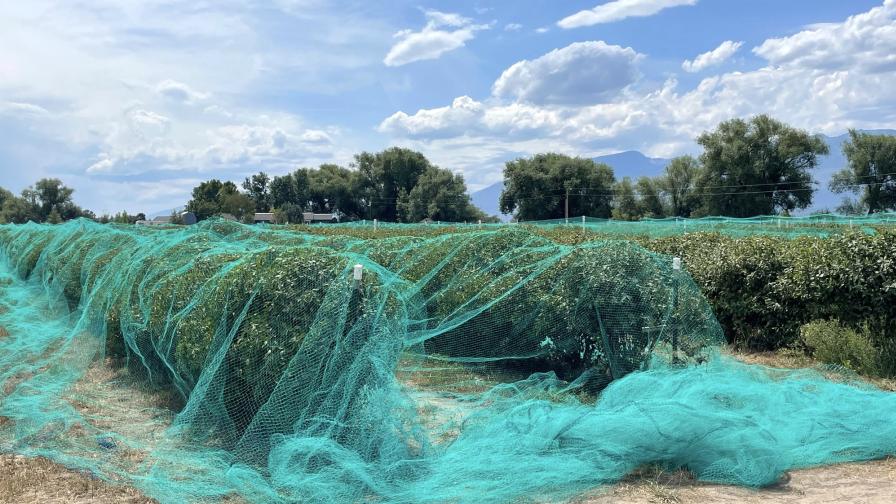
An example of over-the-row netting. Photo by Zach Miller
Alternatively, Dr. Miller describes a more straightforward, affordable method where nets are draped directly over the rows of plants. This approach is compatible with mechanical harvesting, but it comes with a few trade-offs. Birds can peck through the net if fruit is pressed against it, and workers cannot operate underneath. For smaller operations, a low-net system is a good compromise. This method uses T-posts with safety caps and a wire to suspend the net, which avoids the issue of the net catching on the plants, and still allows for mechanical harvesting.
Overhead Netting: This system, which the Western Ag team uses for nearly 2 acres, is more expensive but offers considerable protection. It involves installing tall posts and wires to create a physical ceiling and walls over the entire growing area. According to Miller, a significant benefit is that birds cannot land on the net and peck at the fruit, as the net is held well above the plants. This system also allows growers to work and harvest under the nets, which is a considerable advantage for u-pick operations or mixed orchards. The main drawbacks, though, are the high cost (approximately $4,000 per acre) and the installation of posts, which makes using over-the-row mechanical harvesters difficult.
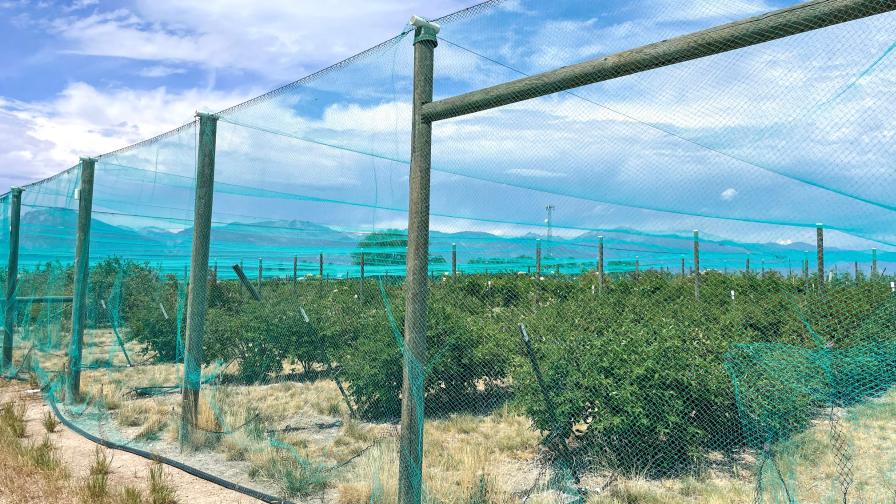
Over-the-row netting and overhead netting (with PVC waterline anchoring it) are two successful approaches to managing bird damage in Mountain States honeyberry fields.
Photo by Zach Miller
Sealing the Perimeter: From experience, Miller’s team has learned that sealing the perimeter of any netting system is crucial. After failed attempts with landscape staples that tore and damaged nets, they discovered a more effective method. By using an inch-and-a-quarter PVC waterline with valves, they fill the pipe with water to create a weighted, flexible seal around the perimeter of the net. This waterline conforms to the ground’s shape, eliminating gaps that birds could exploit. The netting is wrapped under the pipe and clipped back on itself every four to six feet.
“It’s really easy to install and tuck the net under and untuck the net because it is smooth,” he adds. “And that water hose is just heavy enough that there’s no berry-eating bird that’s strong enough to be able to lift it up.”
Miller’s complete presentation can be viewed for additional information on addressing weed pressure, honeyberry harvesting and storage techniques, effective pruning and training methods, and the top-performing varieties, including where interested growers can acquire them.
Subscribe Today For
