


Expert Advice To Help Stop Spider Mites in Their Tracks
 May 1, 2025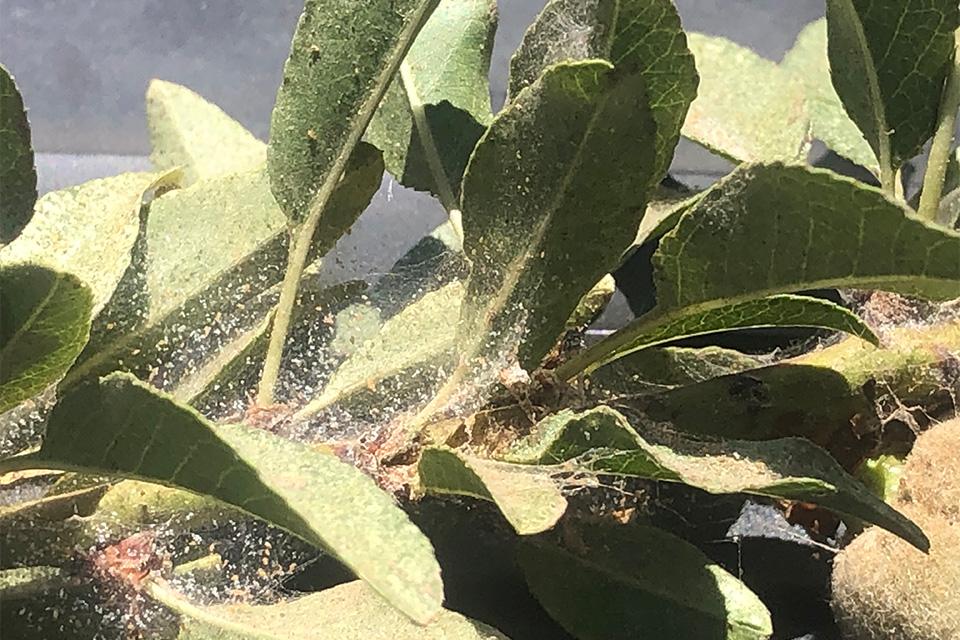
Got mites? This almond tree is infested with spider mites.
Photo courtesy of Valent USA LLC.
As invisible as they might be, mites are hardly unnoticed by some of the country’s top crop protection suppliers. Here, four of them — Valent USA, Kemin Crop Technologies, Gowan USA, and BASF — educate growers in their attempts to manage the tiny but destructive pests:
What mites are most problematic for tree nut, grape, and tree fruit crops, and how do mites impact those crops?
Todd Burkdoll (Regional Manager, Field Market Development, Valent USA): Tetranychus spp. are the main mite pests, with two-spotted spider mite and the Pacific mite being the two main species that can damage crops to the point of defoliation. Reduced canopy/leaf area from mite feeding impedes photosynthate accumulation and affects the overall health of the trees. This can have long-term effects on subsequent crops, and the stress caused by mite feeding can also open the door for disease and dieback.
Bridget Hatfield (Technical Services Manager, Kemin Crop Technologies): Two-spotted spider mites and European red mites are problematic species for tree nuts, tree fruits, and grapes. Mites feed on leaf sap, causing tissue damage, discoloration, and stress to the plant. Heavy mite infestation can lead to decreased photosynthesis, leaf drop, and reduced yield. Spider mites can produce webbing across the leaf surfaces, which creates an even more favorable environment for mites and makes the mites more difficult to treat as the webbing is a form of protection.
Anna Howell (Field Development Rep, Gowan USA): Spider mites (family: Tetranychidae), also called web-spinning mites, would be the most problematic mite pests in tree nut, stone fruit, and grape. Though there are several species, they share similar damage patterns and management approaches. When spider mites feed, they puncture individual cells and suck the contents out, leading to a decrease in photosynthesis and an increase in transpiration, causing plants to further lose water. Feeding also causes yellow stippling or bronzing of leaves, leaf drop, defoliation, and stunting growth. High populations can decrease yields and fruit quality.
Sidd Tiwari (Product Manager, Specialty Crops, BASF): Two-spotted spider mites are the most problematic for tree nut, grape, and tree fruit crops. These mites feed on leaves, rapidly multiply, and can significantly reduce crop yields. Their feeding damages plant cells and leads to leaf discoloration, reduced photosynthesis, and overall plant stress. Furthermore, severe infestations can cause defoliation, weakening the plants and making them more susceptible to other pests and diseases.
What mites are most problematic for vegetable and berry crops and how do mites impact those crops?

Todd Burkdoll
Burkdoll (Valent): Pacific and Two-spotted spider mites are most prevalent in berry and veg crops. If ideal conditions for mite growth and reproduction become prevalent and left unchecked, mites can cause severe feeding damage on the leaves, which leads to defoliation and the aforementioned effects on overall plant health.
Hatfield (Kemin): Similarly to tree nut, tree fruit, and grapes, Two-spotted spider mites and European red mites are going to be the most problematic species in vegetable and berry crops. Cyclamen and broad mites can also be present in berry crops. Mites can be destructive in vegetable and berry crops, causing plant stress from feeding damage, stippling from mite feeding, yellowing and loss of leaves, decreased photosynthesis, webbing, decreased yield, and even death in extreme infestations.
Howell (Gowan): Spider mites get another mention here, causing damage similar to that seen in tree nuts, tree fruits, and grapes. The second most problematic mite is broad mite (family: Tarsonemidae). This tiny pest affects a variety of vegetable crops, including fruiting vegetables like peppers and eggplants, as well as berries such as blackberries. Though much smaller than spider mites, broad mites induce distinct symptoms. Their feeding leads to leaf curling and distortion — which can resemble leaf burn — along with fruit blemishes characterized by silvering or rusting on fruit, which decreases your marketable yield.
Tiwari (BASF): Several types of mites can damage vegetable and berry crops; however, spider mites are among the most significant. These pests suck the cell contents from leaves, causing the leaves to yellow and reducing photosynthesis. In large numbers, spider mites create enough webbing to reduce plant growth. Strawberries are particularly vulnerable to spider mites, especially carmine spider mites and strawberry spider mites. These mites can cause substantial yield loss and weakened plants.
Nealta Miticide by BASF is effective against a variety of mites, including spider mites, European red mites, and citrus red mites. Most recently, Nealta Miticide was approved for the suppression of flat mites in citrus for use in Arizona, California, Florida, and Texas.
What’s the best strategy for crafting a miticide program?
Burkdoll (Valent): The best strategy for crafting a miticide program is the same for any other pest that damages or destroys a crop. Scout the field(s) regularly — especially when temperatures start to rise in the late spring and early summer. Along with regular scouting, a protective or preventive approach is recommended at the first sign of mite activity or presence. “An ounce of prevention is worth a pound of cure,” said Benjamin Franklin. Choose a product that affects multiple life stages of the mites you want to control. Using a miticide like Zeal MVP is an effective approach to controlling and managing mites early due to its broad activity on eggs, nymphs, and sterilization of adult females.

Bridget Hatfield
Hatfield (Kemin): The best strategy for crafting a miticide program begins with understanding your pest pressures, seasonality, timing, and resources available. These items will help to guide chemistry choices. For instance, if it is early in the season, you may have more flexibility vs. late in the season, where preharvest intervals may be a concern. Once you understand what control options are available, you can begin to craft an IPM program suited for your crop and pressure needs. Preventive measures are also key in mite management. A good mite management program will include preventative sprays, tank mixes, and chemistry rotations between singular molecule chemistries and biological chemistries like botanical oils. Kemin Crop Technologies FIFRA 25(b) Exempt miticide products are a great option for inclusion in a miticide program. TetraCURB MAX, Romivex DIP, and AlliCURB MAX all have 0-REI, 0-PHI, are MRL exempt, and minimal PPE requirements which means that they are a safe and effective option for mite control at any point in the growing season.
Howell (Gowan): Selecting the most appropriate and effective miticides is essential for the success of your miticide program. There are several factors to consider when crafting your miticide program.
First, know what type of mite you have. If you cannot identify the species, at least know the family of mite, e.g., is this a spider, broad or eriophyid mite. Not all mites are the same, and the same applies to miticides. Some miticides are effective against a broad range of mite families and species, and others are limited to a family.
The second question to ask is, “What is the predominant mite life stage?” Some miticides are more effective on specific life stages. For example, mite growth inhibitors are only effective against eggs and nymph, so knowing the predominant life stage you are targeting will help in selecting the right miticide.
Compatibility with biological control agents (beneficial arthropods) is another factor to consider. Some miticides are more compatible with BCAs than others. Some products are selective and are compatible with some BCAs, while other products are not compatible with any. The life stage of the BCA during application is also relevant, as some products are more harmful to specific BCA life stages and not others.
Resistance management is a crucial factor when developing your miticide program. Mites, especially Two-spotted spider mites, are known for rapidly developing resistance to certain chemistries. To reduce the risk of creating resistant populations, it’s important to rotate between miticides that have different modes of action. Additionally, applying miticides at the right time plays a significant role in effective resistance management.
Remember, there is not a ‘one size fits all’ miticide program. Every program should be customized to fit your unique circumstance.
Tiwari (BASF): At BASF, we recommend following the principles of IPM, which emphasizes a multi-faceted approach rather than relying on a single method. The key components include:
- Maintaining good sanitation around the field to reduce pest pressure
- Implementing effective weed control, as weeds can serve as reservoirs for mites and other pests
- Choosing a miticide that is safer for beneficial insects, allowing natural enemies to help control mite populations
- Combining chemical, natural, biological, and cultural control measures
Unlike most miticides on the market, Nealta Miticide is unique because it is beneficial-friendly, it controls mites at all life stages, and it provides long residual control. We recommend contacting your local BASF representative to support you in developing a comprehensive miticide program.
What chemistries do you recommend?
Burkdoll (Valent): Depending upon the crop, I recommend Zeal MVP or Zeal WDG Miticides because the active ingredient in Zeal products is a mite growth regulator, affecting all mite growth stages, which helps provide long-lasting control. Zeal is an excellent fit in resistance management programs — be sure to include a rotation or combination of different classes of miticide chemistries.
Hatfield (Kemin): I would recommend Kemin Crop Technologies OMRI-listed rosemary oil-based miticide-insecticide, TetraCURB MAX. TetraCURB MAX has high levels of control against a variety of mite species, is safe to use with minimal PPE requirement, has 0-REI, 0-PHI, is MRL exempt and approved for use on all crops. TetraCURB MAX is an emulsifiable concentrate that includes an adjuvant, soap and emulsifier in the formulation allowing optimal contact for excellent efficacy. TetraCURB MAX has multiple modes of action making it highly effective against small soft-bodied insects and two-spotted spider mites. These modes of action include paralysis (a neurotoxic effect that impacts octopamine receptors); suffocation (blocking air from entering the spiracle); desiccation (waxy cuticle disruption that leads to water loss and death); and repellency (hyperactivity and avoidant behavior result from the monoterpenes impacting mite sensory systems).
In addition to TetraCURB MAX, Kemin Crop Technologies also produces Romivex DIP, an OMRI-Listed insecticide-miticide product targeted at dip applications. Romivex DIP is a high rosemary oil content at 50% and can be used as a dip to help transplants and cuttings with a clean start. Romivex DIP can also be used as a synergist in combination sprays with TCM as a tank mix partner.
AlliCURB MAX is another OMRI-listed insecticide-repellent product produced by Kemin Crop Technologies. AlliCURB MAX is garlic oil-based, and its primary MOA is through repellency. If you are looking for an alternate biological based chemistry, AlliCURB MAX could be included in an IPM program for mite control by adding its potent repellent and antifeedant modes of action.

Anna Howell
Howell (Gowan): The type of chemistry used will depend on the mite species or family, mite life stage, and compatibility with BCAs. Hexythiazox (Onager Optek, Onager, Savey), spirodiclofen (Envidor), and etoxazol are mite growth inhibitors that only have efficacy against eggs and nymphs. These products are compatible with many beneficials and are a good choice if your population is predominantly eggs and nymphs. If your population is increasing and will continue to increase, you will more likely need chemistries that have efficacy against all life stages. Fenazaquin (Magister SC), pyridaben (Nexter SC), bifenazate, acequinocyl, abamectin, and cyflumetofen are miticides with efficacy on all life stages. If you have mixed mite life stages and mixed mite types, you will want to choose a miticide with efficacy against a broad range of mite types. These include fenazaquin (Magister SC), pyridaben (Nexter), and abamectin. Remember to rotate modes of action.
Tiwari (BASF): We recommend a chemistry that is safer for beneficial insects, does not target arthropods, and allows for effective mite management. Additionally, growers should seek a chemistry that is designed to meet the highest standards of efficacy, have the least possible impacts to non-target or beneficial organisms, and meets Maximum Residue Limits (MRL) requirements, giving growers the flexibility to export their crops anywhere they choose.
How do you get the most out of a miticide program?
Burkdoll (Valent): In short, coverage and timing. Coverage is absolutely essential to any miticide program, and the degree of coverage correlates to the degree of kill with a contact miticide like Zeal MVP. Sprayer travel speed across the field should be optimized for good coverage. In this case, speed does NOT kill, so slow down to get the best coverage. Treat as populations are building. When weather forecasts predict hot and dry conditions, spray sooner instead of later. And mite thresholds should drive application timing, not calendars. Plus, I recommend applying a miticide that has translaminar activity to help reach the undersides of leaves, where mites hide. Click here to learn more about other best practices.
Hatfield (Kemin): The best advice I have about getting the most out of a miticide program is to stay on top of your treatments. Mites reproduce quickly and can take over a field “in the blink of an eye.” It is important to walk your fields and monitor your mite pressure regularly. Preventive and maintenance sprays are important. The IPM program should include products that kill mites at all life stages: eggs, larvae, nymphs, and adults. Growers should program the spray application at the right frequency, with the right chemistries, and at the proper rates to target mites at all life stages. For example, if TetraCURB MAX is used, we recommend spraying every five to seven days for two to three weeks to combat all mite life cycle stages. Another component of a good miticide program is to ensure that you have good spray coverage as a lot of products rely on contact with the mites for control. Be willing to adjust your treatment program as needed. Adjustments to your program might include alternating applications with a variety of chemistries or trying tank mix solutions.
Howell (Gowan): Implementing the following can help maximize your miticide program:
Scout! I can’t stress enough how crucial it is to implement a regular monitoring program. Early detection and application will save you a headache later in the season.
Selecting the appropriate miticide and rate based on your current mite situation. Choose miticides specifically effective against the mite species you’re targeting and the predominant life stage. Remember to rotate modes of action for resistance management. Application timing can affect the efficacy of your miticide. Applications should be made as soon as mites are detected. Depending on weather, their populations can increase rapidly so it is better to stay ahead of the population growth than try to put out a fire.
Use proper application techniques such as adequate volume and pressure, proper nozzles, and thorough coverage. Use of a surfactant or adjuvant can help with coverage. Coverage is a function of volume, pressure, application speed, and nozzle configuration. You want to displace all the air within the canopy to get good coverage.
Monitor and evaluate post-application. Take notes on the efficacy of your treatments e.g. adults, nymphs, or healthy eggs still seen seven to 10 days after treatment. Make notes on environmental conditions or if there are specific areas or pockets where mites are still healthy and active. The product may not be the problem; it may also be application technique and timing. This is where having details notes can help.

Sidd Tiwari
Tiwari (BASF): To get the most out of a miticide program, it is essential to combine multiple control methods — cultural, biological, and chemical — while following IPM recommendations. It’s important to rotate miticides with different modes of action to prevent resistance in mite populations and prioritize products that control mites at all life stages. Also, choosing a product that is safer on beneficials, offers long-lasting residual control, and delivers consistent, reliable results year over year is key. Nealta Miticide has shown excellent results in minimizing the need for a second spray, and it is a prime example of a product that provides both efficacy and long residual control, while being gentle on beneficials.
What is the effect of climate change on mite prevalence?
Burkdoll (Valent): Mites like heat, and their fecundity or ability to reproduce increases with rising temperatures >90ºF, thus as summer temps rise, so does the population of mites if left unchecked.
Hatfield (Kemin): Mites, especially spider mites, which are problematic on most tree, vine, vegetable, and fruit crops, thrive in warm and dry weather. I would expect climate change to increase spider mite prevalence and prevalence of other mites with similar life cycle preferences. Extended and shifting seasonality for crops and pests will require close monitoring for plant health and to watch for unexpected or prolonged mite outbreaks.
Howell (Gowan): Climate change can affect mite prevalence in the following ways:
Rising temperatures can accelerate mite development and reproduction, leading to faster population growth and earlier appearances than anticipated. Conversely, an increase in unusually hot days — particularly when temperatures exceed 105°F — can slow or halt mite reproduction, causing populations to decline as these extreme conditions persist.
Additionally, altered rainfall patterns can either trigger outbreaks or provide relief for growers. Insufficient rainfall can stress crops, making them more vulnerable to infestations, while excessive rainfall can limit the presence of certain mite species. Extreme weather events may favor some mite species while displacing others. Continuous adaptation will be key.
Tiwari (BASF): Climate variability has made it harder to predict when mite pressure will peak, so growers should be prepared to act at any time. Due to natural fluctuations in the climate, the historic spray window in May has stretched, and if a grower has a mild or dry winter, mites may appear as early as March. Therefore, growers should be prepared to act as early as April.
What biological and/or OMRI Listed products are available?
Burkdoll (Valent): There are no biological products that I know of, but there are botanicals that are OMRI Listed for organic production. Azadirachtin and neem oil extracts like those found in Debug Tres and Debug Turbo are effective at controlling mites but may need multiple applications to keep populations under control.
Hatfield (Kemin): There are a variety of biological and/or OMRI listed product available for use against mites. I would recommend Kemin Crop Technologies essential oil-based products TetraCURB MAX and Romivex DIP. These products could be used stand-alone or in combination within a tank mix. Kemin Crop Technologies also has another insecticide, AlliCURB MAX, which could be used as a repellent/deterrent if situations occur where you are looking for something new to incorporate into your program. All three of these products have unique and synergistic modes of action, including paralysis, desiccation, suffocation, antifeedant, behavioral disruptors, and repellency. Additionally, all of these products are formulated with Kemin Crop Technologies’ unique smart blend technology and have excellent worker safety via their 0-REI, 0-PHI and MRL exempt status.
Howell (Gowan): There are several different types of biological control agents that can be used for mite control. Each may be a specialist on a specific mite family or species and others are generalist predators on any small soft bodied arthropod. Some BCAs are better on certain crops and not others. An example of BCAs used for mite management are predatory mites.
There are several OMRI, biological or botanical insecticides on the market. Some examples are insecticidal soaps (M-PEDE), horticultural oils (Trilogy, Omni Oil, JMS Stylet Oil); botanical insecticides (Aza-Direct), bioinsecticides (Venerate, Grandevo, and BotaniGard ES, and Spinosad). Similar to conventional miticides and insecticides, consult the label for best use rates and application timing.
Tiwari (BASF): Several species of natural enemies can be used as biological control options, such as the western predatory mite, six-spotted thrips, and minute pirate bugs (Orius spp.). When selecting an appropriate miticide, it is important to choose one that is complimentary with natural enemies both naturally occurring and supplementary releases.
How do I avoid developing resistance to miticide chemistries?
Burkdoll (Valent): Resistance management is optimized by using labeled rates, getting complete coverage at the time of application, and alternating modes of action with different chemistries. Knowing your available tools and when and how to apply them is key to good resistance management.
Hatfield (Kemin): To avoid developing resistance to miticide chemistries, follow label guidelines on use rates and timing. Some chemistries can only be used so many times without the risk of resistance becoming too high. One tip to avoid resistance evolution is to use chemicals with a wide variety in their MOAs and to incorporate biological based pesticides into your IPM. Explore tank mixing or alternating chemistries so that mites have less chance to develop resistance to a singular chemistry. Essential oil products, such as TetraCURB MAX, Romivex DIP, and AlliCURB MAX produced by Kemin Crop Technologies, have multiple MOAs like membrane disruption, paralysis, suffocation, and repellency often also have synergistic effects from being formulated with whole essential oils and are ideal for incorporation into an IPM program to aid in avoidance of resistance development.
Howell (Gowan): Take an integrated approach to managing your target mite pest. Make sure to monitor and treat before exponential mite growth. Mites, especially the Two-spotted spider mite, are known for developing resistance to many active ingredients on the market. Take an integrated approach to managing your target mite pests. Monitor and carefully assess application decisions. Preserve beneficial arthropods and use miticides that are compatible with your BCAs. Proper timing (mite life stage and environmental conditions) and thorough coverage is important for resistance management. Use the most effective rate and rotate between several different modes of action.
Tiwari (BASF): To avoid developing resistance to miticide chemistries, it is essential to rotate modes of action. Using miticides that leave natural enemy populations intact helping to maintain a balanced ecosystem where beneficial insects contribute to pest control. Practicing responsible stewardship of every mode of action ensures long-term effectiveness and sustainability in mite management.
Subscribe Today For
