



Exploring Deep Sea Solutions for Better Plant Health
 March 8, 2026
 Crops constantly sense and respond to their environment. Long before visible symptoms appear in the field, shifts in temperature, moisture or salinity trigger physiological adjustments that influence growth, water, and energy capture. These early responses determine whether yield potential is preserved or compromised as stress intensifies. Biostimulants derived from Ascophyllum nodosum seaweed are uniquely positioned to interact with these early signaling pathways. These extracts influence internal processes, helping crops adapt more efficiently to challenging conditions.
As climate variability increases, understanding and leveraging these interactions is becoming an essential component of crop management.
SUPPORTING BALANCE WHEN WATER IS LIMITED
One of the first responses to water limitation is reduced transpiration. Crops conserve moisture by closing stomata, but this also restricts carbon dioxide uptake, limiting photosynthesis and growth. Managing this trade-off between water conservation and carbon assimilation is critical during drought.
Research has shown that Ascophyllum nodosum biostimulants can help maintain a more favorable balance. By modulating stomatal behavior, treated crops sustain sufficient gas exchange while minimizing excessive water loss. This regulation allows photosynthetic activity to continue even as soil moisture declines.
Field evidence supports this response. Acadian Plant Health has been researching abiotic stress in crops for over 40 years. Trials conducted in 2025 on table grapes showed vines treated with Ascophyllum nodosum technology had more consistent flowering, better fruit set, and notably higher berry retention — even under 40° C heat and reduced irrigation by 30%.
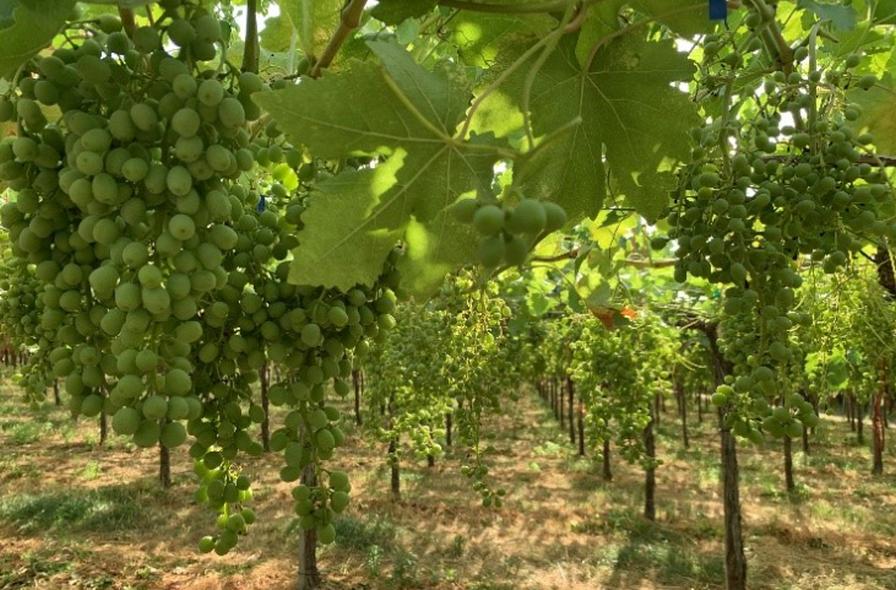
At left, table grape vines treated with Acadian Plant Health’s Abiotic Stress Management and, at right, untreated vines under the same environmental conditions.
Photo: Acadian Plant Health
In a multi-year study conducted by the University of California, Davis, almond trees treated with an Ascophyllum nodosum extract were evaluated under both full and deficit irrigation regimes. Treated trees exhibited improved midday stem water potential — a direct indicator of internal water status — demonstrating enhanced ability to maintain hydration under stress. These physiological improvements translated into yield benefits, with dry kernel weight increasing by 9% under full irrigation and 2% under water-limited conditions compared to untreated controls.
Non-stressed and stressed almonds treated with biostimulants had 9% and 2% higher dry kernel weights than their non-treated counterparts.
PRESERVING PHOTOSYNTHESIS UNDER STRESS
Water balance is only part of the stress response. Abiotic pressure also disrupts photosynthesis, particularly chlorophyll content and efficiency, which directly affects biomass accumulation and productivity.
Greenhouse research published in the Journal of Applied Phycology evaluated tomato crops treated with Ascophyllum nodosum extract under varying moisture levels. The study reported higher stomatal conductance, increased chlorophyll content, and greater biomass accumulation at 100%, 50%, and even 25% of field capacity. These results indicate that treated crops retained photosynthetic function despite severe water limitation, supporting continued growth when conditions would normally suppress metabolic activity.
Together with the almond findings, this work highlights how seaweed-based biostimulants help safeguard the core physiological processes that underpin yield formation during stress events.
STRENGTHENING CANOPY DEVELOPMENT
In perennial systems, maintaining vegetative vigor under chronic stress is essential for sustaining long-term productivity. Trials conducted at the UF/IFAS Citrus Research and Education Center (CREC) examined the impact of Ascophyllum nodosum biostimulants on vegetative and reproductive growth of citrus trees affected by Huanglongbing (HLB), a disease that severely compromises canopy health and carbohydrate balance.
Treated trees exhibited increased vegetative growth without negatively affecting fruit set, resulting in stronger canopy structure capable of supporting heavier crop loads.
Yield responses were substantial, with up to 40% higher production compared to untreated trees and those receiving alternative treatments. These results suggest that by stabilizing internal physiological processes under compounded stress, biostimulants improve how resources are allocated between growth and reproduction.
Biostimulant-treated trees produced a 40% higher yield compared to untreated trees and those subjected to other treatments.
PROACTIVE STRESS MANAGEMENT
Across diverse crops and growing conditions, the evidence points to a common outcome: Ascophyllum nodosum biostimulants enhance tolerance to abiotic stress by supporting crops under drought conditions, preserving photosynthetic performance, and strengthening canopy development.
For growers facing increasing variability in rainfall, temperature, and salinity, this represents a shift from reactive responses to proactive stress management. When applications happen ahead of or during stress periods, crops can be better equipped to adapt, maintaining productivity and resilience throughout the season. As weather challenges continue to intensify, integrating biologically based tools that work with crop physiology will be key to sustaining performance in fruit and nut production systems.
Subscribe Today For
