


Putting Bronze Muscadine Grape Varieties in the Spotlight
 November 15, 2024
 Every August the University of Georgia’s Tifton Campus hosts a field day at its muscadine test vineyard. Professor Patrick Conner, who has led UGA’s muscadine grape breeding program since 2004, facilitates the event.
“This is the absolute best event you can come to in the country if you are looking for information about muscadines and you want to talk to professionals,” muscadine grower Matt Dean, of Dean Family Acres in South Carolina, says.
Here are Conner’s thoughts on the 13 bronze cultivars of muscadine (as opposed to black and purple varieties) displayed at the field day:
“‘Scuppernong’ was by far the most planted muscadine for a couple hundred years. It became so popular that a lot of people call all bronze types ‘scuppernongs,’ but the true ‘Scuppernong’ is a single cultivar that was isolated from the wild. For now I don’t see a compelling reason to grow it unless you’re a very strong muscadine enthusiast that just wants the original variety.”
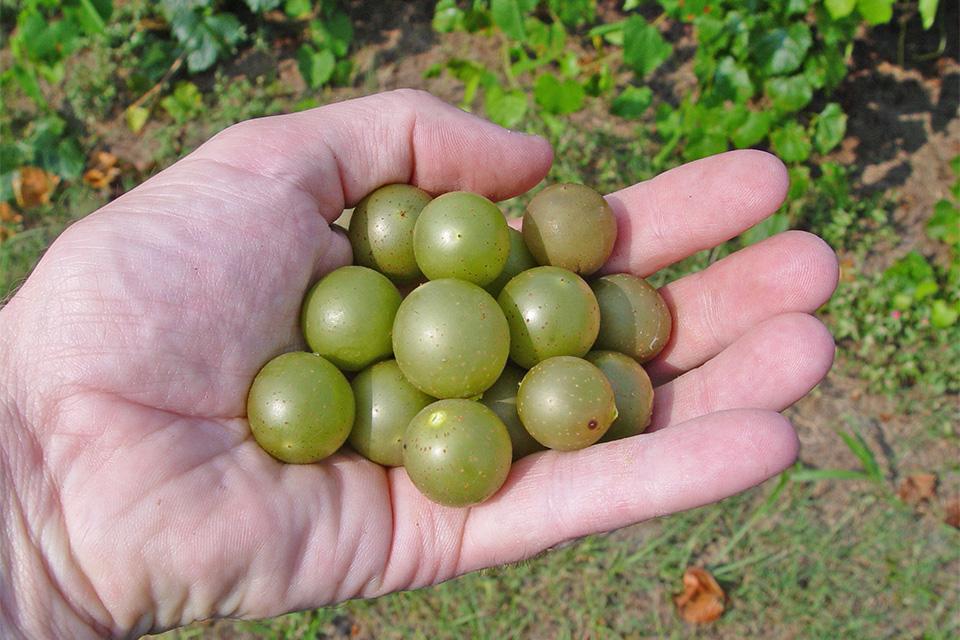
‘Scuppernong’ bronze muscadine grapes
Photo by Patrick Conner
“‘Higgins’ is a University of Georgia release that was quite popular in the ’50s and early ’60s. It was the next size bigger from ‘Scuppernong’ and was used extensively in breeding. You’ll still see this in some of the older vineyards, but, again, there’s better varieties out there.”
“‘Fry’ was released in 1970 and was the backbone of the fresh market muscadine industry. One of the big advantages with ‘Fry’ is you could pick it a little bit immature, so it would be firm, and yet you still have a pretty good flavor in it. That allows them to get a firmer berry through the marketplace.”
“‘Summit’ is used to some extent in commercial vineyards. I think the smaller size and pinkish color have limited its use in the commercial industry to some extent. But if you wanted a good female variety that has good flavor for the midseason, it’s not a bad choice.”
“‘Triumph’ is a sister seedling to ‘Summit’. It’s a softer berry. Fairly pink. Used a little bit commercially. A lot of people really like the flavor. It’s kind of the favorite of several of my technicians. Again, it’s got that standard muscadine soft flesh.”
“‘Tara’ is a progeny of ‘Triumph’. It was planted to some extent for the industry, but over time it kind of got rejected because the flavor was inconsistent. Sometimes it’s very good, and sometimes it kind of has an off flavor; what some people describe as a dirty flavor.”
“’Hall’ is one of my releases. The idea was to get a little bit better flavor from the ‘Fry’ in there and keep the good earliness of the ‘Tera’. In my opinion it does better in north Georgia and North Carolina than it does in south Georgia. It’s a bright color, but it can be difficult to get clean berries if you get a rainy July and August like we’ve had the last two years.”
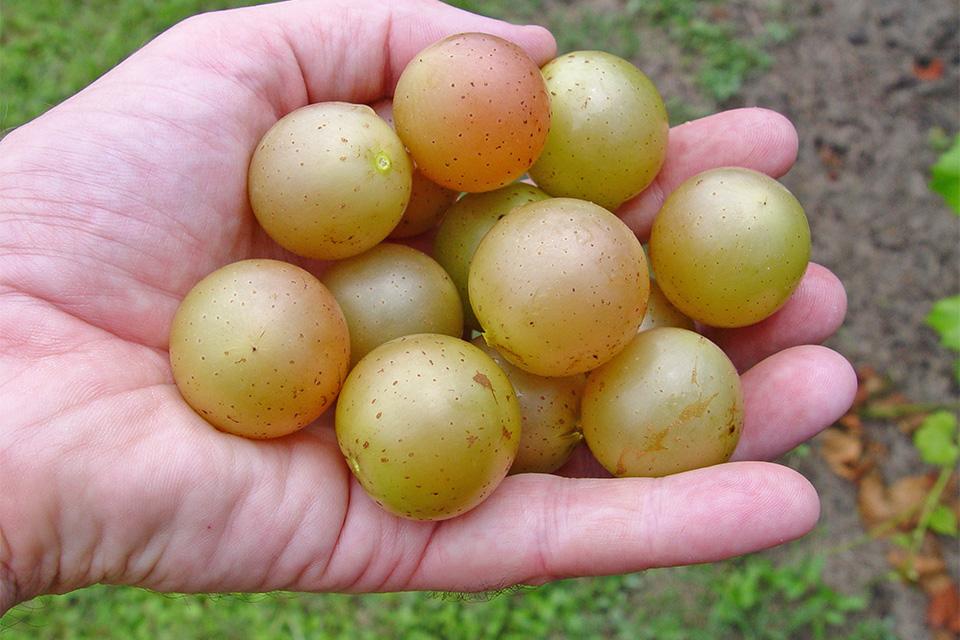
‘Hall’ bronze muscadine
Photo by Patrick Conner
“’Early Fry’ has been one of my favorites. The productivity is not as high as a self-fertile cultivar. It’s a little hard for me to judge the productivity of females because we have a few females surrounded by a lot of perfect varieties, and so they’re getting optimum pollination. When you get whole rows, some growers have had good yield with it; for other growers, it has not yielded as well as they would like.”
“’Oh My!’ was bred by a private breeder and is sold by Gardens Alive. It is one of the few truly seedless muscadine varieties. I think, long term, seedlessness will be important for muscadine in terms of getting the crop out so that is known throughout the country instead of just the Southeast. When I tell anybody I’m a grape breeder, a muscadine breeder, invariably the first question they ask me is, ‘Do you have any seedless ones?’ So while muscadine enthusiasts may not mind the seeds, the general public really does prefer to have seedless types.”
“’Granny Val’ is very productive and can still be at times over-productive, but usually it has the vigor it needs for the crop it sets. In Tifton, usually ‘Granny Val’ is coming off the vine in late August. It is a little bit later than ‘Late Fry’.”
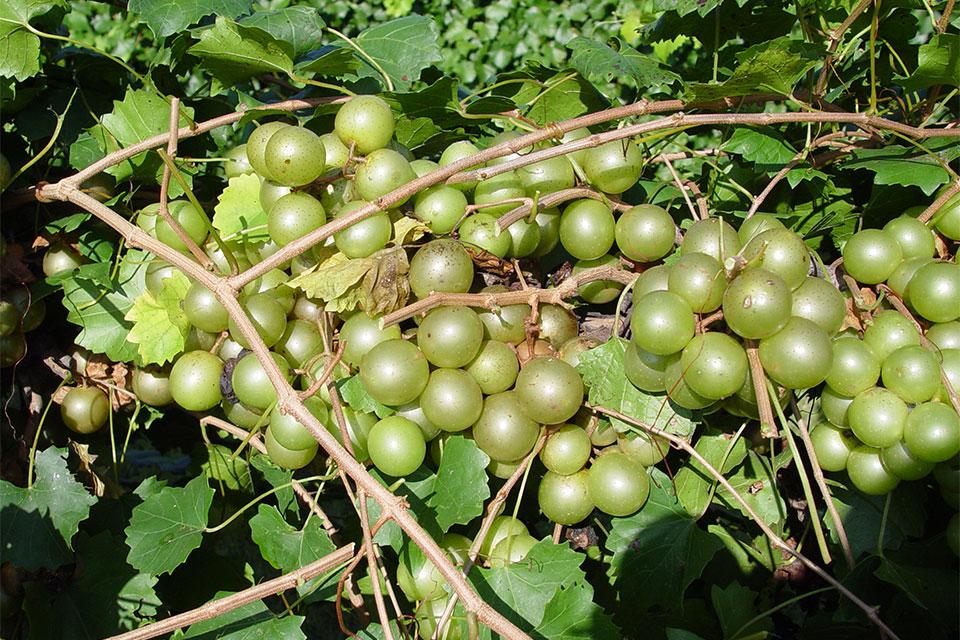
‘Granny Val’ bronze muscadine grapes
Photo by Patrick Conner
RELATED CONTENT: Grape Expectations Thriving on the Vine for Growers in Florida
“’Late Fry’, the biggest problem I have with it, is that I don’t think it picks as well. It’s a very soft fruit. Oftentimes you’ll tear the skin when you pick it. For personal use that’s not a big deal, but if you’re trying to sell and put it in clamshells and its starts tearing and leaking, that can be a real problem.”
“’Pam’ has been one of the more productive female varieties we’ve had. It has been used commercially to some extent because it is big, it’s fairly pretty. It’s mid- to late-season for us, and it’s a very strong vine, so it’s one you might want to consider for something like pick-your-own.”
“’GA 6-1-269′ is still being evaluated for release. This is its seventh year in here. What we’re hoping for out of this is a self-fertile large cultivar that could maybe replace ‘Fry’ in the midseason bronze market. This year we’ll get the last of our yield data and quality data, compare it with the standards, and then make a decision on release of this one.”
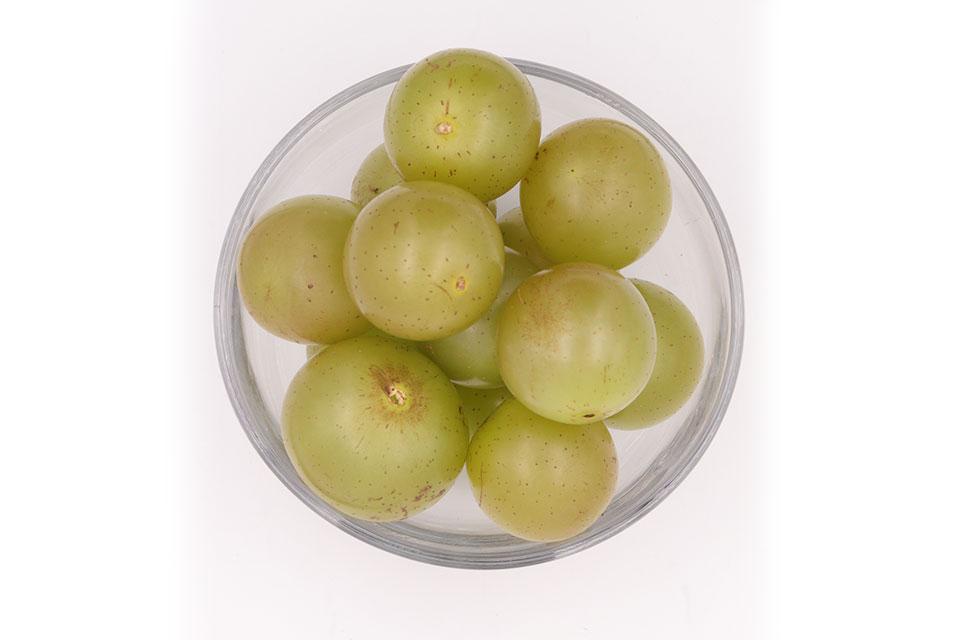
‘Ga.6-1-269’ bronze muscadine grapes
Photo by Patrick Conner
Subscribe Today For
