


Hurricane Recovery Starts Sooner for the ‘Luckier’ Farmers
 December 16, 2024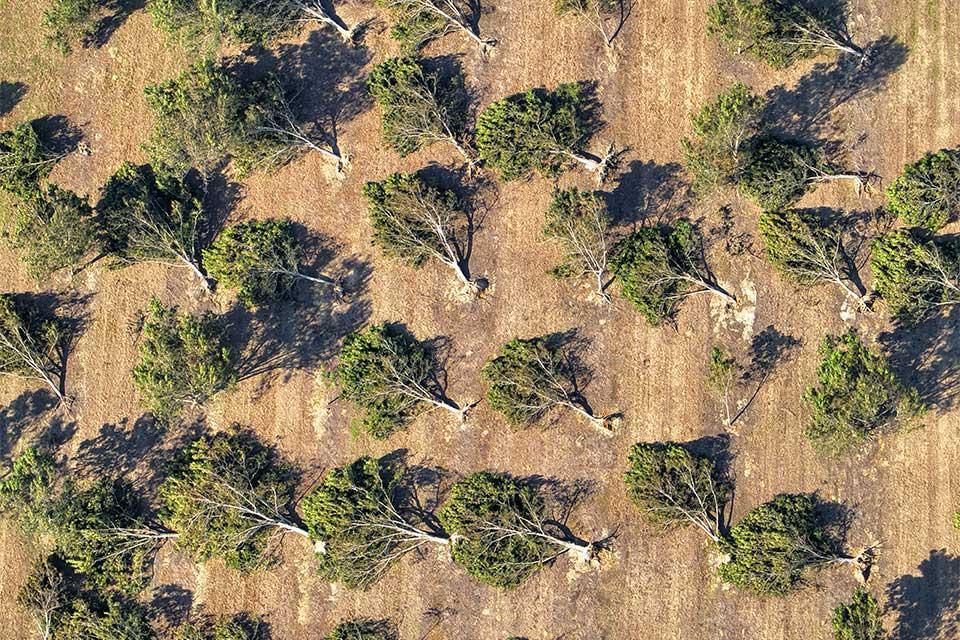
A drone view of the aftermath of Hurricane Helene at Moses Pecan in Uvalda, GA. Scores of pecan trees lay over in the wake of the storm. Hurricane recovery is a huge priority for many farmers and will be for some time to come.
Photo courtesy of Arren Moses
While western North Carolina entered November still reeling from the devastation Hurricane Helene had inflicted a month earlier, three growers from Georgia, having recovered enough, relatively speaking, shared their encounters with the disaster.
Wherever you call it your dirt, life could be a lot worse these days:
Arren Moses (Moses Pecan, Uvalda, GA)
“We’re in east central Georgia, and our experience was pretty horrible. We didn’t experience the loss of life like the folks in the Carolinas did, but we did experience what I’m afraid could be a loss of a way of life for many in our area and our industry. From Valdosta to Augusta and 30 to 50 miles wide, there’s a path of destruction in the pecan growing areas that’s unsurpassed even by Hurricane Michael standards. Areas 200 to 250 miles inland with 110 mph winds and 90 to 95% tree loss aren’t uncommon sights. I’d say the pecan crop in those areas, depending on whether you were on the edges of the area or in the middle, range between 50% and 100%. The 30- to 50-mile strip I spoke of has what will approach 100% crop loss and 50% tree loss for the industry. Overturned pivots and destroyed barns are the norm on most farms. If a barn is standing, it is probably red iron, and it’s guaranteed to be missing the rollup doors. I’m not sure there is a roll up door left in Montgomery County anywhere.
The storm came through Friday morning, and from 3 to 3:45 a.m. I wasn’t sure the house wasn’t going to collapse. The wind was howling so hard, and that house was rattling so loudly that the 300-year-old white oak in our yard that wasn’t 30 feet from our bedroom blew over, and we never even heard it. The family house in our backyard, built in 1848, collapsed, and we never even knew until daylight. It took us 3 hours that Friday morning, with 3 chainsaws and a huge wheel loader, to cut half a mile from our house to our farm to find the destruction. I’ve still never seen anything like it other than where Michael hit on the coast of Florida. We lost probably 80% of our trees and 100% of our crop. I’m not sure we will have a single acre left that will be eligible for crop insurance once the cleanup is done. Current estimated losses calculated by Dr. Lenny Wells, UGA pecan specialist, are standing around $650 million for now.
Stephen Batten (5 Generations Farms, Pearson, GA)
“Our farm was on the northeast side of the storm in southeast Georgia, which produced severe damage. Our cold-hardy citrus took a big hit due to it being our growing season, and trees were heavy with fruit. We had trees broken down, uprooted, laying on their side, and at 45 degrees. We lost a lot of fruit being blown from the trees and some damaged fruit still on trees. A majority of all our buildings were destroyed along with hardwood and pine timber. We will recover slowly from this devastating storm. Farmers are resilient! Especially when it comes to land that’s been in a family for generations.”
David Lillard (Mercier Orchards, Blue Ridge, GA; apples, peaches, berries)
“Mercier Orchards is located in the top dead center of the state of Georgia. As you are aware, the storm turned east, which spared us the punishing winds. We received about 8 inches of rainfall but no winds. I will not say we were blessed, because our friends in North Carolina were not spared, and we are all one big family down here. Our customer base dropped off for about two weeks either from the fear that we were not open or maybe just guilt of spending money and having a good time. We picked back up about the second week in October and have held steady. We have been making as many donations as possible to our other grower friends and have been buying whatever they can sell us, so they have a little money coming in up there.”
 Loading ...
Subscribe Today For
