



Insect Invaders From The East
 August 5, 2013
Globalization has changed everything. Most people think about it in economic terms, but it’s changed the world of insects, too. Just think of all the global travel. There are teenagers today who make Christopher Columbus look like a homebody.
Very few parts of the planet are unreachable, notes Elizabeth Beers, an entomologist at Washington State University’s Tree Fruit Research & Extension Center. If the U.S. exchanges goods of any kind with other countries, we are in some way vulnerable to the pests that inhabit those areas, just as they may be vulnerable to the pests that originate, or have become established, in North America.
“I don’t remember using or hearing the term ‘Invasive Species’ before about three or four years ago, but a watershed moment came when we created a new section in the Western Orchard Pest and Disease Management Conference: the Invasive Species session,” says Beers.
“Here’s a list of new pests that graced that initial session — spotted wing drosophila (SWD), brown marmorated stink bug (BMSB), light brown apple moth, and European grapevine moth. These pests are very much a sign of the times.”
While SWD and BMSB top the list of invasive species of concern in eastern Washington, the list of potentials is long and getting longer, says Beers. There are a number of species that are known economic pests in their area of origin, primarily Europe, that have been found in western Washington, and could potentially hike over the Cascades to the orchards of eastern Washington.
The person who knows more about eastern Washington’s potential invaders than anyone else, says Beers, is Eric LaGasa, chief entomologist for the Washington State Department of Agriculture. LaGasa provided the following information on these insect pests.
Apple Leafcurling Midge
Dasineura mali
An exotic fly with several generations per season of tiny larvae that cause apple leaves to curl inward as they develop, stunting growth. Also found in New England, the exotic species was first found in Western Washington in 1991, in Whatcom County. It’s not a direct fruit pest, it’s a tree pest. But it can just hammer apple trees. It can also be multigenerational in a given season. New leaves are attacked, and as they curl up tight, the midge can defoliate the early growth. It’s more of a nursery pest or a topworking pest. Young stock and top worked trees can be hit hard. As with many pests, we got it from Canada. A new attractant just came out of England, so we can monitor for it now. A similar pest, the pear leafcurling midge, causes the same problems, but only on pears.
Apple Clearwing Moth
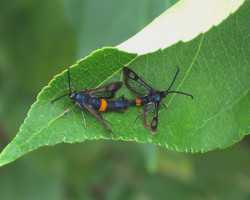
Synanthedon myopaeformis
The first established population of this pest in North America was identified in 2005, in British Columbia (BC), Canada. Since then, it’s been found in areas east and west of the Cascade Mountains in southern BC as well as in Whatcom County in northwestern Washington. A European pest of apple and other Rosaceous trees, it damages host plants via larval feeding in the bark on the trunk and branches. Attacks are usually associated with entry sites around pruning wounds, mechanical damage, or graft unions. Reports from Canadian entomologists are that nearly every tree in BC is infested. U.S. entomologists have traps out to detect the inevitable spread of the exotic pest into the apple growing areas of eastern Washington.
Apple Tortrix
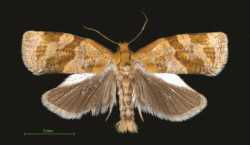
Archips fuscocupreanus
An exotic leaf-rolling defoliator, it was first found in North America in Western Washington in 1995, and it also was recently found in New England. One of the most abundant defoliators in the Puget Sound area, larvae from one generation per year feed on a wide variety of deciduous trees and shrubs in spring. It’s super-abundant in the Seattle-Tacoma-Olympia area. It is incredibly prolific, and can be found in all kinds of ornamentals as well as fruit trees. It is the most abundant leafroller on the west side of Washington. It doesn’t occur east of the Cascades yet. Entomologists are certainly trying to keep an eye out. Another much less damaging pest, the European leafroller, looks very similar to apple tortrix and is commonly found in eastern Washington.
Dogwood Borer
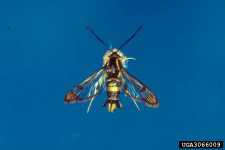
Synanthedon scitula
This native to eastern North America was not known to occur in the west. However, LaGasa was doing a survey for apple clearwing moth in eastern Washington and found dogwood borer in Wenatchee in 2008. It’s considered the worst pest of its kind in the world. It attacks a huge variety of trees and shrubs and is an opportunist. It will infest a tree wherever there is damage to bark. In New England and other
places where they have gone with high-density, more mechanized orchards, the equipment is prone to nick the trees. Those nicks give the dogwood borer a clear path.
Dark Fruit Tree Tortrix
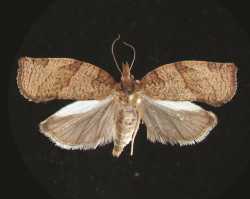
Pandemis heparana
A long-established exotic defoliator, it is found in North America only in the Puget Sound region. It generally has two generations per year and overwinters as larvae. It is one
of a complex of pandemis moths. This tortrix is an infamous leafroller defoliator in different parts of the world. In India, it can be a real problem on tea. It has the potential to become
an outbreak-type pest. A similar pest, Barred Fruit Tree Tortrix, caused problems in Vancouver, Canada. In sum, it is another of the many leafrollers found in western Washington.
Large Fruit Tree Tortrix
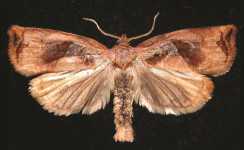
Archips podana
The first U.S. occurrence of this European leafroller pest, which was previously known to be in BC, Canada, was reported in 2002. The current distribution in Washington is limited to part of Whatcom County, which is adjacent to BC. In Europe, it is one of the primary apple pests.
Tufted Apple Bud Moth
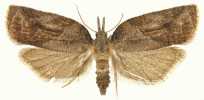
Platynota idaeusalis
This, the number-one leafroller on the East Coast, isn’t thought to be a pest of the West. However, it turns out that it does occur in the Pacific Northwest. It has a unique range. If you draw a line from Vancouver, Canada to Texas, you find it east of that line. That means while you would certainly not find it in California, it might be found in other parts of the West, including part of eastern Washington. Those in the fruit industry haven’t noticed it in eastern Washington, says LaGasa, but in some areas populations are high.
Cherry Bark Tortrix
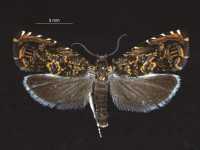
Enarmonia formosana
Another pest that is found in Washington, but only on the west side. Most ornamental cherry trees in the Bellingham area were killed at least in part to this totrix. It has a devastating effect on cherry trees, and is the most significant bark feeder found in western Washington. It is analogous to the apple clearwing moth and the dogwood borer. Trees can decline quickly after an infestation, becoming too weak to resist diseases. The good news is this pest is controlled fairly easily. They defecate in silken tubes outside the bark, and when they come out to defecate they are very susceptible to pesticides. A trunk drench once a year will control them. It’s hard to tell if it will move into eastern Washington, but it has become a serious problem in Portland, OR.
Cherry Blossom Moth
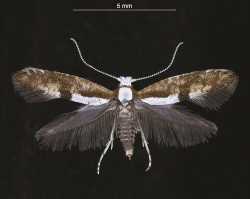
Argyresthia pruniella
In 2011, the WSDA pest program detected this pest for the first time in the U.S., in Whatcom County. It is a fruit pest in its native Europe, and the Washington tree fruit industry has expressed concern over its detection here. CBM larvae are active early in spring and feed in developing buds; in outbreak years they can destroy up to 90% of cherry buds. In Europe, where it is called cherry fruit moth, the chronic pest ravages untreated trees. But if growers are doing prebloom sprays, it can be controlled. This is a pest that makes many entomologists nervous, says LaGasa, in part because it’s not known how widespread it is in British Columbia.
Brown Marmorated Stink Bug
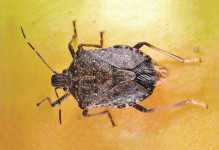
Halyomorpha halys
This headline-grabbing pest became established in the PNW, in BC and Oregon, in 2004. It’s now established in western Washington. It has been found in eastern Washington, but they were isolated finds. For example, there was a catch in Yakima, but that may well have been a hitchhiker. Entomologists know that they are in fact moving around the country in vehicles. Portland, OR, is seeing more and more. Many entomologists believe it’s just a matter of time until the pest makes its way into eastern Washington. And everywhere else.
Light-Brown Apple Moth
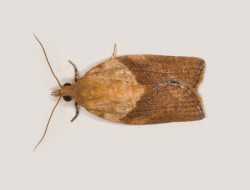
Epiphyas postvittana
Another well-known pest, especially in California. Native to Europe and Asia, the light-brown apple moth (LBAM) is a highly polyphagous foliage feeder that attacks many ornamental plants as well as grapes, apple, pear, and other fruit trees, damaging leaves and developing fruits. To date LBAM has not made its way very far north; introduced populations haven’t been found in the Pacific Northwest.
Subscribe Today For
