Invading Pest Intercepted At Gulf Port

Invading Pest Intercepted At Gulf Port

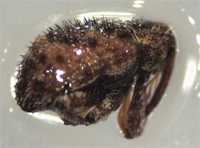
Inspectors at the Port of Gulfport, MS, recently discovered a tiny hitchhiking pest in a shipment of bananas, which they said could have caused big problems to U.S. agriculture. According to a report last week in the Sun Herald of Biloxi-Gulfport (MS), during a routine inspection, agricultural specialists for U.S. Customs and Border Protection were checking over a shipment of organic bananas last month that came into the port from Colombia when they found an insect they had never before spotted.

The small, hairy, wormy-looking creature was so unfamiliar that Customs and Border Protection officials turned over a sample to experts at USDA, where it was identified as Faustinus rhombifer Champion (Curculionidae). Customs and Border Protection told the newspaper the insect is part of a species that feeds on vegetation, stems, and leaves “of a multitude of plants.” In other words, had the insect gotten into the U.S. through Gulfport, it eventually could have spread and devoured plants.

Officials at Customs and Border Protection declined to identify the shipper or fruit company involved, or the size of the banana shipment in which the pests were found. The agency did say the shipper was notified that the entire shipment had to be sent back out of the country.

This apparently was the first time the pest had been found in a shipment to the U.S. “The significance of this is that it’s a pest that has not been identified before,” Virginia Dabbs of U.S. Customs and Border Protection told the Sun Herald.

At the Mississippi Department of Agriculture and Commerce, questions about the Faustinus rhombifer raised curiosity, but little concrete information. Sandy Havard, at the department’s Forestry Museum in Jackson, asked pest experts in the department for a rundown on the creature Thursday. “The only references they could find to it were in Spanish,” Havard said. “It’s not found in (North) America.”

0

Leave a Reply

Avatar for Anonymous Anonymous says:

The country of origin need’s to be made financially responsable for the cost of fumigation and imediate incineration of the entire infected container. These introduced pests have no imediate preditor in this country to help control infestation. no time for spell/check sorry

Avatar for Anonymous Anonymous says:

This is one of the great problems with imported foods. So many of these imports fail to be inspected and often are not subject to the same standards that American farmers must comply with.

Avatar for Anonymous Anonymous says:

We are a large producer of walnut trees for commercial orchard plantings; we have worked for years advocating for the retention of Methyl Bromide ( USDA is largest user )for soil and container fumigation…it is extremely important that all containers entering our ports be fumigated with MeBr to kill the “hitchhikers”…it doesn’t have to be ag produce they stowaway on…it can be the packing materials for non-ag products…insist that USDA continue their use of methyl bromide.

Avatar for Anonymous Anonymous says:

Chances were that if this was a non-organic product that the pests would not have been a problem. The lack of pesticide usage on these organic practices provide additional dangers to all types of farming practices, especially the non-organic, which provide the bulk of our foodstuff. This is another reason why non-Organic should be embraced and trumpeted up as superior.

Avatar for Anonymous Anonymous says:

Jo ann make a good point. However there is a very viable alternative to Mbr that is EPA registered. It is Methyl Iodide. It is more efficient that Mbr on a molar basis. In Japan ALL bananas are fumigated at the arrival port.
Nigel

Avatar for Anonymous Anonymous says:

What happens to the organic certification when produce is fumigated?

Oh, and who is checking the organic certification of imported produce? We have no sure way of knowing what pesticides have been applied to imports without expensive testing and the same applies to organic produce that supposedly has not been exposed to labeled pesticides.

Avatar for Anonymous Anonymous says:

I have several questions for Nigel on Methyl Bromide vs Methyl Iodide for commodity fumigation:(1) who is the world uses mole weight to determine efficacy?(2) What are the rates of usage in pounds per 1,000 cu ft of Me I (3) what is the cost as it is MUCH more expensive than MeBr ( 4)Does Me Iodide have a label for all crop uses (5)What about Me Iodide’s phytotoxcity issues and (6) is Methyl Iodide a mutagen?

Avatar for Anonymous Anonymous says:

The country of origin need’s to be made financially responsable for the cost of fumigation and imediate incineration of the entire infected container. These introduced pests have no imediate preditor in this country to help control infestation. no time for spell/check sorry

Avatar for Anonymous Anonymous says:

This is one of the great problems with imported foods. So many of these imports fail to be inspected and often are not subject to the same standards that American farmers must comply with.

Avatar for Anonymous Anonymous says:

We are a large producer of walnut trees for commercial orchard plantings; we have worked for years advocating for the retention of Methyl Bromide ( USDA is largest user )for soil and container fumigation…it is extremely important that all containers entering our ports be fumigated with MeBr to kill the “hitchhikers”…it doesn’t have to be ag produce they stowaway on…it can be the packing materials for non-ag products…insist that USDA continue their use of methyl bromide.

Avatar for Anonymous Anonymous says:

Chances were that if this was a non-organic product that the pests would not have been a problem. The lack of pesticide usage on these organic practices provide additional dangers to all types of farming practices, especially the non-organic, which provide the bulk of our foodstuff. This is another reason why non-Organic should be embraced and trumpeted up as superior.

Avatar for Anonymous Anonymous says:

Jo ann make a good point. However there is a very viable alternative to Mbr that is EPA registered. It is Methyl Iodide. It is more efficient that Mbr on a molar basis. In Japan ALL bananas are fumigated at the arrival port.
Nigel

Avatar for Anonymous Anonymous says:

What happens to the organic certification when produce is fumigated?

Oh, and who is checking the organic certification of imported produce? We have no sure way of knowing what pesticides have been applied to imports without expensive testing and the same applies to organic produce that supposedly has not been exposed to labeled pesticides.

Avatar for Anonymous Anonymous says:

I have several questions for Nigel on Methyl Bromide vs Methyl Iodide for commodity fumigation:(1) who is the world uses mole weight to determine efficacy?(2) What are the rates of usage in pounds per 1,000 cu ft of Me I (3) what is the cost as it is MUCH more expensive than MeBr ( 4)Does Me Iodide have a label for all crop uses (5)What about Me Iodide’s phytotoxcity issues and (6) is Methyl Iodide a mutagen?