



SWD is a Looming Menace
 February 24, 2011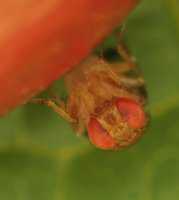
Note: This is a special report sponsored by Dow AgroSciences.
One year ago, sweet cherry growers and researchers alike were caught off guard by the Spotted Wing Drosophila (SWD) because the pest was still relatively new to the U.S., and much of the literature on the pest was exclusively written in Japanese. The first infestations were along the California coast, but then it was increasingly found inland, especially in the sweet cherry districts around Stockton and Hollister. “That’s when the wheels came off the wagon and a lot of people got hurt very badly,” says University of California Cooperative Extension Specialist Robert Van Steenwyk. “Then it raced up and down the West Coast.”
Van Steenwyk says some of the recommendations made by researchers were wrong, such as the idea that growers only needed to look for the males, which are much easier to find because they have the spotted wings. The females look much like the many other drosophila species that are found hovering around rotting fruit. Those species, however, will only contaminate damaged cherries, notes Oregon State University Entomology Professor Peter Shearer. SWD will go after not only rotting fruit, but also ripening fruit. The SWD do the damage themselves.
What researchers didn’t know was that the sex ratios were extremely variable. Some growers got hit with bad infestations because while they were looking for spotted wings, female SWD were attacking their fruit. Females are more difficult to spot, says Van Steenwyk, but they are detectable with the aid of magnification, such as a hand lens that many of those who scout for pests carry.
Shearer said growers in his region — he works out of the Mid-Columbia Agricultural Research and Extension Center in Hood River — didn’t get hit with infestations last year. He is still very concerned, however, because last autumn and early winter SWD populations exploded. “This year we have high overwintering populations for the first time — and we found them virtually everywhere we looked,” he said, adding that they were still trapping 100 or more per week in the Willamette Valley and the state’s southern pear district near Medford. “I want to make sure the growers still keep thinking Spotted Wing Drosophila, because if we don’t do anything we’re going to get nailed.”
As sweet cherry growers head into the 2011 crop year, there are several things they can do to help protect their crop from SWD. Dow AgroSciences Field Scientist Barat Bisabri notes that the bottom line is to deliver clean fruit to packers. “How do you accomplish that? You must know if you have a pest problem,” he says. “So you need to start with a good monitoring program, because you can’t get behind the 8-ball on this one.”
The Science Of Trapping
SWD are so small that dry traps don’t seem to work; the insects just dry up to practically nothing, says Van Steenwyk. He advises using a trap with apple cider vinegar, which is convenient and is attractive because the scent copies what fruit is like when it rots. It’s also critical to add a drop or two of unscented liquid dish soap to break the surface tension and allow the SWD to sink, because the pests are so light they can virtually walk on water.
The traps should be put out before the fruit becomes susceptible, says Shearer, just prior to when the cherries turn straw-color. “Better to be a few days early than a few days late,” he says, adding that in The Dalles they put the traps out just before they make gibberellin applications.
That advice, that earlier is better, also generally applies to picking, says Van Steenwyk. However, he emphasizes that they have found that SWD will not go after green or even straw fruit, but when it starts to pink up. “When you have the choice, pick as early as possible,” he says. “I know one Hollister grower who got them off with minor damage, but two weeks later, all the cherries left in orchard were infested. We’re just learning all these little things.”
Trap placement is critical, says Van Steenwyk, because SWD prefer cool, shady areas in summer. If you put the trap in direct sun, you probably won’t catch flies. They also generally hover about 3 to 4 feet off the ground, so place the traps low in the tree and in the shade in the coolest part of orchard. He’s also observed that orchards that are very dry and in the open generally don’t get hit as hard. “We think it has to do with humidity of the orchard,” he says.
Shearer further recommends that growers put traps on the orchard border as well as inside. The border traps tell what is coming in, and the ones inside will tell you whether your management practices are working.
Van Steenwyk agrees that it’s important to keep trapping after you begin spraying, because it shows you the efficacy of your spray program. “Some guys say ‘I spray, I’m OK,’ but even if it is more work, keep trapping,” he advises. “If the counts go down you will go to sleep at night.”
Success With Spraying
Researchers have a much better handle on what works and what doesn’t, but it’s important to note that Van Steenwyk and Shearer got different results on several materials. For example, Shearer found that newer pyrethroids worked well, but Van Steenwyk had variable results. They also got mixed results on neonicotinoids. They agree that organophosphates like malathion have great knockdown. That was welcome news in the Northwest, where they apply it aerially for western cherry fruit fly.
There were also mixed results with the Dow product GF-120, which was originally thought to be a key product. However, Bisrabi says GF-120 has a place in management, but not as a stand-alone product. Growers who have relatively clean orchards will especially like it because it is such a soft product, based on an attract and kill philosophy.
“GF-120 is not a kill-them-all product, but it can be inserted into a program,” he says. “You have to rotate products anyway.”
There was complete agreement, however, on three other Dow products, Entrust (See “An Organic Answer”), its conventional counterpart, Success, as well as Delegate. All are in the spinosyn class, with Entrust and Success being spinosads and Delegate a newer and more advanced member with the active ingredient spinetoram. Bisrabi says the only reason to choose Success over the newer Delegate is in the case of a Maximum Residue Limit (MRL) issue. Besides being extremely effective, the three products have the added advantage of being softer on most beneficial insects. In addition, they are members of an entirely separate Insecticide Resistance Action Committee (IRAC) classification, which means their unique mode of action will aid in preventing the development of insecticide resistance.
In sum, cherry growers need to fasten their seat belts. Make sure you are aware of what’s happening not only in your orchard, but your neighbors’. SWD can move a lot more than originally thought, Bisrabi notes. “Talk to your neighbors and make sure they don’t have the infestation, and have your ear to the ground,” he says. “Those flies won’t stay in your neighbor’s orchard, so make sure you have a program in place before they arrive.”
Subscribe Today For
