



Stone Fruit Growers Finding New Success Through Resiliency
 May 20, 2026
 Ask growers what made last season rewarding, and the answers often sound surprisingly hopeful: a beautiful crop, strong sales, a long-awaited breakthrough year, or simply seeing customers leave the orchard smiling. Those moments of satisfaction stand out even more against a backdrop of rising costs, unpredictable weather, and structural change across the fruit industry.
Nowhere is that contrast more visible than in the stone fruit sector.
California’s San Joaquin Valley hardly fits the image of a struggling fruit region. As Kevin Day, Pomology Advisor emeritus at University of California Cooperative Extension, reminded growers during the International Fruit Tree Association (IFTA) conference in Fresno, winter in the Valley is almost a formality.
“The most it’s ever snowed in Fresno is 2½ inches,” Day said, recalling a 1930 storm that melted by noon. Frost events severe enough to materially damage stone fruit production have been essentially a once-in-50-years occurrence. Combined with fertile soils and developed irrigation infrastructure, that climate helped build one of the most productive stone fruit regions in the world.
Yet Day’s message was clear: favorable weather alone no longer guarantees stability. Even in ideal growing conditions, the industry is undergoing profound change, forcing growers to rethink how success is defined and how decisions are made.
Fewer Acres, Bigger Players
Over the past two decades, California has lost an estimated 5,000 to 8,000 acres of peaches, plums, nectarines, and related stone fruits. That contraction helps explain declining per capita peach consumption in the U.S.
“The consumer story is part of it,” Day said, “but we just have fewer acres in production than we used to.”
At the same time, consolidation has reshaped the grower landscape. When Day attended winter grower meetings in Dinuba in the late 1970s and early 1980s, 500 to 600 people filled the Memorial Hall. By the time he retired, attendance had dropped to about 20.
But acreage represented in the room told a different story. Early meetings captured perhaps 40% of regional acres; later gatherings, though far smaller, represented 80% to 90%. The industry’s middle tier has narrowed as growers scale up, diversify, specialize — or exit entirely.
For many remaining operations, survival has meant becoming more strategic rather than simply larger.
Land, Water, and Volatile Returns
The economics behind that strategy are daunting. Day estimates prime stone fruit ground with reliable water now ranges from $37,000 to $42,000 per acre. Without secure water, land values can drop to roughly $12,000 per acre; a stark reminder that water access has become inseparable from land value itself.
Despite those costs, 2022 through 2024 delivered some of the strongest returns many growers have seen, with five-figure net profits per acre in fully bearing blocks.
Then came 2025.
Ill-timed rains triggered fruit quality problems such as inking and staining. In some late-season blocks, bins that historically yielded more than 30 boxes fell into the mid-teens. High fixed costs magnified the financial impact.
Such volatility increasingly explains why growers describe diversification as both a risk-management strategy and a source of optimism. Nearly every stone fruit grower Day works with now produces citrus, particularly mandarins, while many have added persimmons or pomegranates. Spreading harvest windows and market exposure helps stabilize income, though it also adds complexity to already demanding operations.
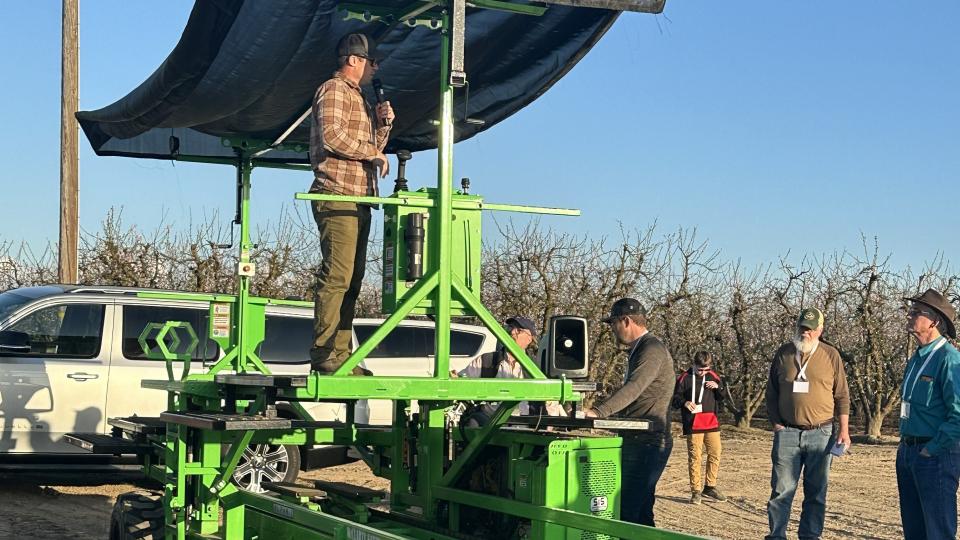
HMC Farms in Kingsburg, CA, has a harvest machine with a moving platform that helps reduce physical strain by keeping employees off ladders.
Photo: Melinda Taschetta-Millane
Labor and System Design
Labor instability remains another defining pressure. Crews that once viewed farmwork as a long-term profession are less predictable today. A 20-person crew may arrive with 17 workers — or eight — the following day.
That uncertainty is accelerating adoption of labor-saving production systems: shorter trees, reduced ladder use, dwarfing rootstocks, higher-density plantings, mobile platforms for pruning and harvest, and increasingly sophisticated optical sorting technology.
But Day cautioned growers, especially those outside California, against copying West Coast systems without understanding local risk factors. California’s minimal frost exposure makes low, ladderless systems attractive. In frost-prone regions, those same systems may increase vulnerability.
Light conditions add another layer of complexity. California’s intense, direct radiation creates canopy dynamics distinct from regions with more diffuse light. Varieties and training systems successful in the Valley may perform very differently in the eastern U.S. or Europe.
“What works here isn’t automatically transferable,” Day emphasized.
Varieties and the “Hollywood Effect”
Access to new varieties is also changing. Where breeding programs once offered relatively open access, many new releases are now tied to exclusive or semi-exclusive agreements.
Growers may evaluate nursery selections without knowing whether superior genetics are already committed elsewhere. Day described one grower who spent 15 years trialing five nectarine replacements for a specific July harvest window, never matching the performance of a 20-year-old variety he initially hoped to replace.
He compared the excitement surrounding new systems and varieties to a Hollywood premiere: the perfect lighting, curated conditions, and carefully managed expectations. Trial blocks often represent ideal scenarios rather than commercial reality.
“Don’t get so caught up in the glitz and glamour of any one thing that it becomes the driving force,” he advised.
From Recipes to Reasons
Ultimately, Day urged growers to move beyond copying production “recipes” and instead understand the reasons behind decisions.
The most successful operators he has observed share a common habit: relentless curiosity. Why does a pruning system succeed here? Why does a variety thrive under certain conditions? Why is a nutrient deficiency appearing in one block but not another?
In an era defined by consolidation, high land and water costs, tightening labor supplies, and restricted varietal access, that mindset may be the industry’s most valuable asset.
And while acreage numbers and economic pressures tell one side of the story, growers themselves continue to point to moments of pride, such as a strong crop, a successful innovation, or a hard-earned improvement, as proof that progress is still possible.
Those experiences, echoed throughout this year’s State of the Fruit Industry survey, suggest that the future of peaches, plums, and nectarines will not be defined solely by challenges, but by how thoughtfully growers respond to them. For stone fruit producers, success increasingly comes down to understanding the “why” … and using it to shape whatever comes next.
Subscribe Today For
