



Legacy and Innovation Drive Successful Formula at Gemperle Family Farms
 November 26, 2025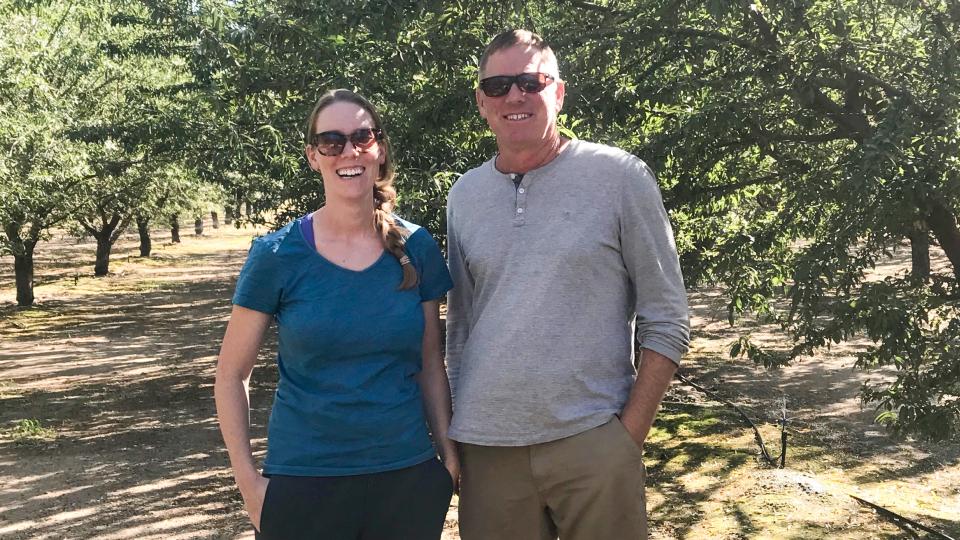
Richard Gemperle and his daughter Tanya Gemperle-Goncalves in the almond orchard at Gemperle Family Farms.
Photo courtesy of Richard Gemperle
In California’s Central Valley, where drought cycles, labor shortages, and regulatory scrutiny loom large over agriculture, one family farm has quietly developed a model of innovation rooted in tradition. Gemperle Family Farms, headquartered in Turlock, CA, blends three generations of stewardship with a deeply analytical approach to modern almond farming that is anchored in regenerative practices, poultry-almond integration, and data-driven decision making.
At the heart of it all is Richard Gemperle, a trained hydrologist and engineer who now oversees over 2,000 acres of almonds in Stanislaus and Merced counties, including 250 acres of organic production. His path back to the family business was as circuitous as a river meander, shaped by geology, European engineering projects, and a quiet conviction that farming could, and should, do more than just grow crops.
“We’re not just farming almonds,” says Gemperle. “We are farming soil, water, and future potential. That means thinking long term and making decisions today that will hold up 30 years from now.”
An Egg and Almond Synergy
The story begins in 1950, when Richard’s father, Ernie Gemperle, started the operation with a focus on egg production. In 1960, Ernie’s brother, Walter, joined the business and planted the farm’s first almonds, a diversification that now defines the modern operation. Today, both divisions of the company have grown substantially and are the cornerstones of the farm’s revenue and sustainability initiatives.
Richard returned to the farm in 1999, after about 10 years working on tunnels and dams in Switzerland. His brothers are responsible for poultry and construction, while Richard focused entirely on tree crops, expanding the operation to include walnuts and a pending 30-acre olive planting scheduled for 2026.
“It’s still very much a family affair,” he says. “But we operate with a corporate level of rigor when it comes to sustainability and innovation.”
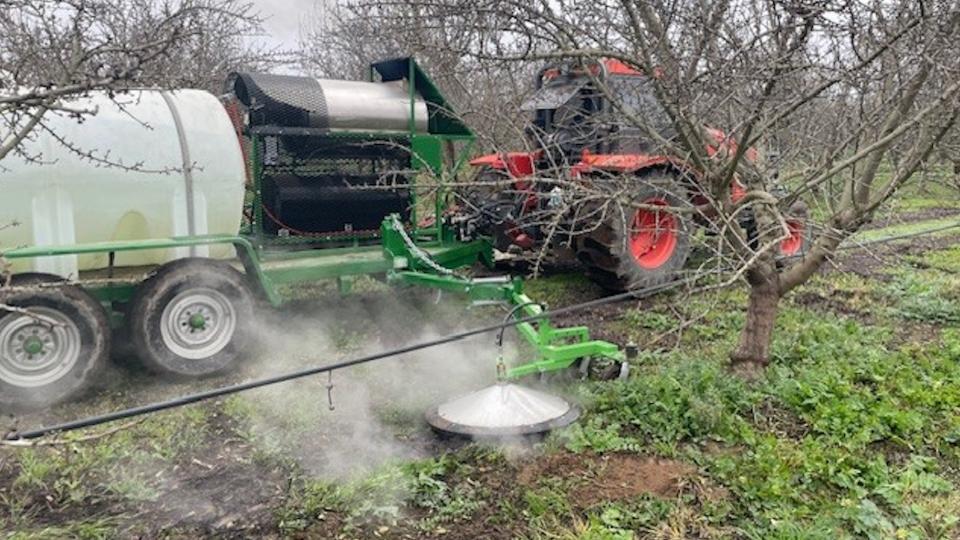
Steam weeding, a sustainable practice used at Gemperle Family Farms, is an eco-friendly and chemical-free method of controlling weeds and soilborne pathogens. Photo by Richard Gemperle
Turning Waste Into Yield
One of the most unique aspects of Gemperle’s operation is its biological loop between the egg and almond divisions. The farm generates 99% of its NPK fertility through compost produced from poultry byproducts, transforming what would be waste into a high-value soil amendment.
That synergistic loop is about to get tighter. A new 30-acre composting yard will come online soon, and Gemperle Farms has plans to build organic fertilizer pelletizing plants in Stanislaus County and the Pacific Northwest, reducing dependency on petrochemical fertilizers and increasing fertility customization across their orchards.
“We’re not just composting for the sake of organics. It’s about building long-term soil health, reducing runoff, and avoiding harsh synthetic inputs that disrupt microbial activity,” says Richard.
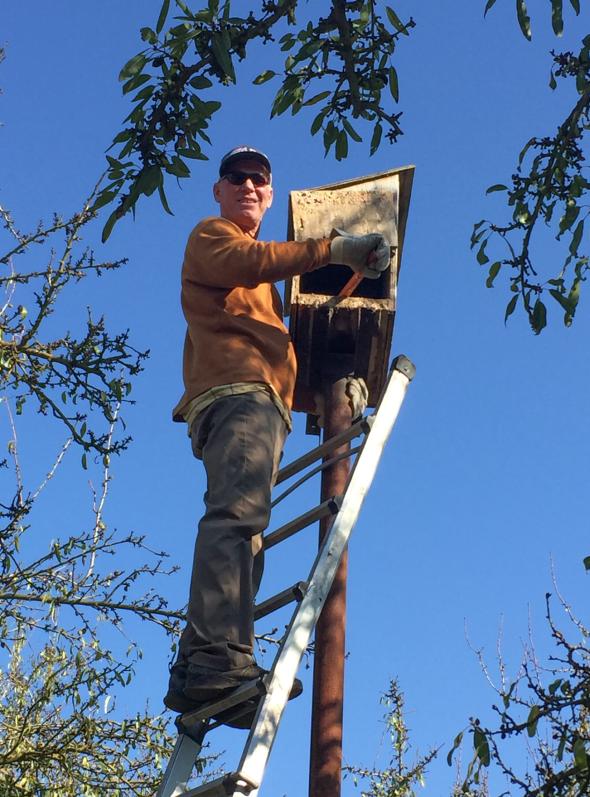
At Gemperle Family Farms, rodents are controlled by owl predators in both their almond fields and outside of the egg barns. Here, Richard Gemperle tends to one of the more than 40 owl boxes installed in their ranches and orchards.
Photo courtesy of Richard Gemperle
Farming by Data
Though steeped in tradition, Richard brings a scientist’s mindset to almond production. Trained in geological engineering and hydrology, he approaches agriculture as a system of interrelated variables, with soil structure, water availability, pest pressure, and crop nutrition all feeding into his models.
The farm conducts tissue testing throughout the year, fine-tuning foliar micronutrient applications accordingly. Gemperle partners with John Fassler at Wilbur-Ellis for pest and nutrient consulting, but Richard always asks for data-backed solutions.
“We’re experimenting with soil inoculants too,” he says, “but only those that pass scientific scrutiny and independent field trials.”
Building the Next Generation Orchard
Automation has become a critical component of Gemperle Family Farms’ growth strategy. Labor costs and availability remain top-tier concerns, pushing the farm to explore autonomous equipment, particularly in harvesting.
Conventional almond harvest creates significant dust through ground-shaking, sweeping, and pickup. In response, Gemperle is trialing off-ground harvest systems, which catch almonds before they hit the ground, reducing dust and improving food safety.
“We’re looking at systems similar to pistachio harvest,” says Richard. “We might still windrow almonds for drying, but the initial catch would be off ground. It’s cleaner, and it’s where the industry is heading. I rely heavy on my lead mechanic Juan Cisneros to turn innovative farm equipment concepts into reality.”
The farm is also investing in autonomous tractors through Bonsai Robotics, which has partnered with Orchard Machinery Corp. (OMC). Gemperle sees autonomy not just as a labor solution but as a future cornerstone of efficient almond production.
Strategic Water Use in a Drought-prone World
California’s unpredictable water future is front-of-mind for every grower, and Gemperle Family Farms is no exception. Despite enjoying relatively secure water rights in its district, Richard takes a long view, planning for multi-year drought resilience. “We’ve had three great rainfall years,” he says, “but we’ll be prepared for the next drought cycle.”
The orchards utilize micro-sprinklers and double-line drip systems, and frost protection is integrated through the irrigation network. Water decisions are informed by soil moisture monitoring, and every new acre is planted with water efficiency in mind.
“Our expansion plan includes 100 new almond acres,” says Richard. “That means new pump stations, filtration systems, and emitter lines built from the ground up with conservation in mind.”
The Hybrid BIOS Model
Although not all of Gemperle’s ranches are certified organic, the farming practices in “conventional” orchards tick nearly every box: composting, low-input fertility, minimal tillage, cover cropping, border hedgerows, and the use of biological pest controls. The operation draws inspiration from the incipient BIOS (Biologically Integrated Orchard Systems) program and incorporates elements of conventional, organic and even biodynamic practices into what Richard calls “BIOS 2.0.” It’s a hybrid model, built on pragmatism over purity.
For example, instead of full no-till, a light rotary tillage on rotating sections of fields is used to incorporate compost and increase nitrogen uptake efficiency. “One of the more insane ideas we’ve put to the test is mowing under full moon conditions for rodent control,” says Richard. “Apparently surface activity of rodents increases under a full moon; so far the results are inconclusive, but my field workers surely think I’ve lost my marbles.”
Likewise, while they’ve considered integrating livestock into orchards, Richard believes using poultry compost is a more scalable approach. “We believe in the principles,” he says, “but we tailor them to the realities of our soils, crops, and markets. The way I look at it, if you have bald eagles deciding to build a nest in the middle of your ranch, you must be doing something right!”
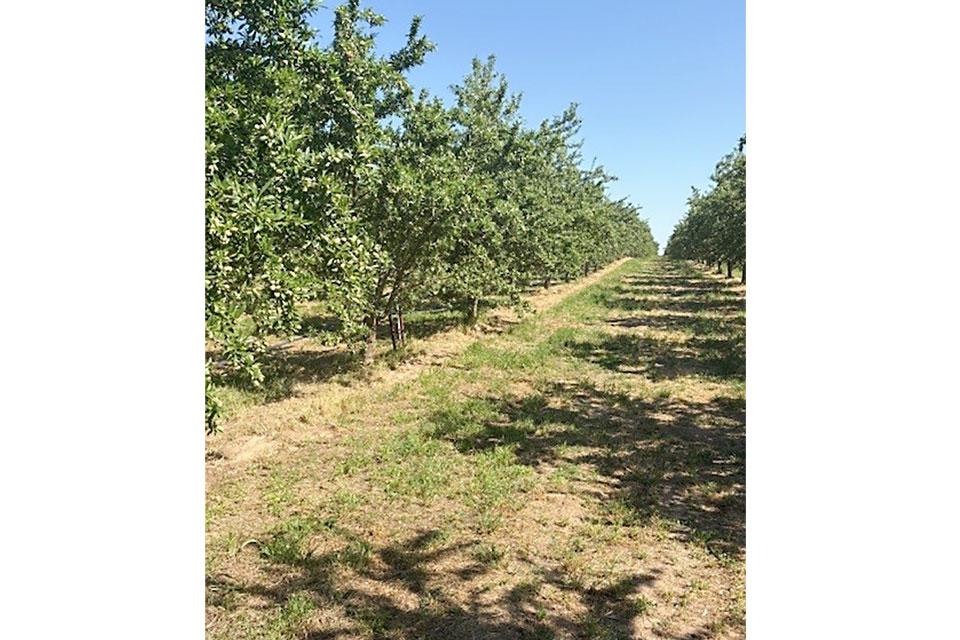
Organic pre-harvest at Gemperle Family Farms.
Photo by Richard Gemperle
Organic Almonds: The Growth Engine
With 250 acres of certified organic almonds, Gemperle Family Farms has carved out a strong niche in California’s competitive almond landscape. All organic nuts are marketed through Baugher Ranch, a specialized organic processor known for its quality and transparency.
Challenges remain, particularly with weed and pest management in organic systems, but Richard views these as solvable through technology and collaboration. “We’re always looking for better organic fungicides, weed control options, and insecticides that are effective and cost-efficient,” he says. “This is an area where the industry needs innovation. We are currently experimenting with saturated steam for weed control.”
Growing Toward the Future
Gemperle Family Farms is not standing still. The next decade includes:
- 100 new almond acres
- Expanding olive oil production with a new 30-acre grove
- Pelletizing plants for poultry waste processing
- Expanded solar installations
- Continued investment in automation and precision ag
All of it, says Richard, is underpinned by a singular goal: “Make the farm better than we found it.” It’s a philosophy that connects three generations — and is now being carried forward by Richard’s daughter, Tanya Gemperle-Goncalves, whose doctoral work at UC Davis focuses on regenerative almond systems.
“She brings academic rigor to what we do in the field. And she holds us accountable,” Richard laughs. “She’s the future.”
In a state where the almond industry is under pressure to do more with less, Gemperle Family Farms is showing how integration, innovation, and intentionality can keep family farms not only afloat, but ahead. Their success isn’t rooted in shortcuts or slogans. It’s rooted in the soil and in a long view of stewardship that stretches from the 1950s into the future.
At a Glance: Gemperle Family Farms
Founded: 1950
Owners: The seven children of original founders Annemarie and Ernie Gemperle: Richard, Heidi, Anita, Susan, Pete, Steve, and Mike
Location: Turlock, CA
Size: 2,000 acres (almonds)
Crops: Almonds and eggs
Customers: Blue Diamond cooperative, local community
Organic Certification: Certified organic through CCOF (California Certified Organic Farmers)
Subscribe Today For
