



The Role of Fertilizers in Tree Nut Crop Salt Burn
 September 16, 2025
 The hot long days of mid to late summer can be an especially tough time for orchard trees. Aging canopies often begin to show signs of stress from extreme heat, irrigation deficit, pests, disease, nutrient deficiencies, and salt burn during this time. However, it can sometimes be challenging to definitively identify the root cause of these symptoms with visual diagnostics. One important but often overlooked factor is the potential relationship between these symptoms and fertilization practices.
Nitrogen and potassium are among the most critical nutrients for perennial tree crops. Despite efforts to maximize uptake through fertigation injections and foliar applications, most crops assimilate only around 70% and often less of applied nutrients. Uptake efficiency depends on various factors, including fertilizer type, application method and timing, and the environmental conditions, like relative humidity, temperature, and wind speed. Soil texture, organic matter content of the soil, and water availability also significantly influence how effectively nutrients are absorbed. As a result, fertilizers are sometimes overapplied to ensure trees receive sufficient nutrition to support growth and crop development.
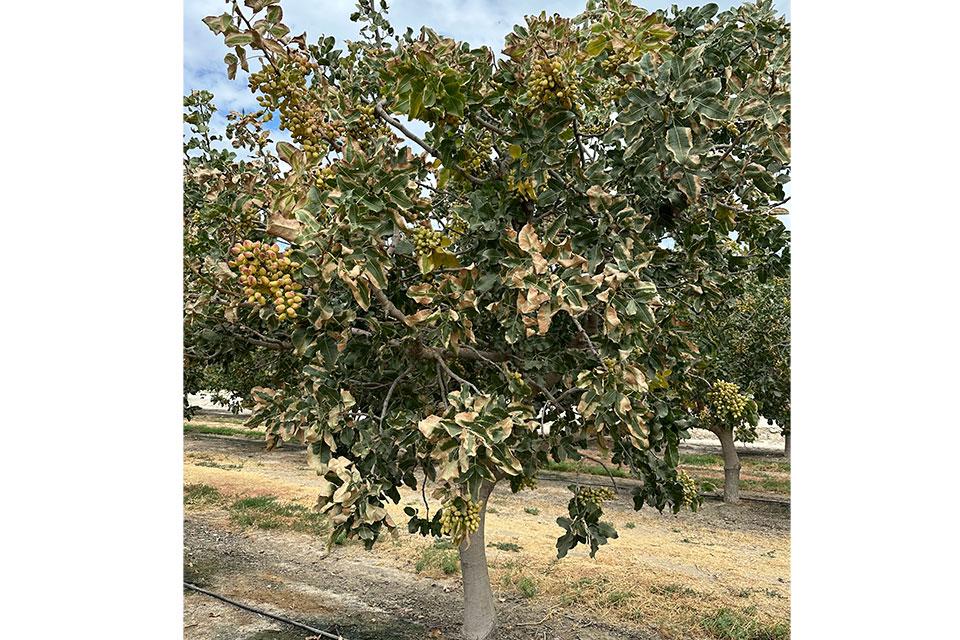
Pistachio canopy damage following a suspected over application of potassium thiosulfate.
Photo by Mae Culumber
SALT ACCUMULATION ISSUES
While synthetic fertilizers are relatively low cost, many are high in soluble salts. When applied in excess, these salts can dehydrate and damage root systems. Impaired roots are less able to absorb water and nutrients, resulting in visible symptoms, such as wilting and marginal leaf necrosis, that are sometimes attributed to nutrient deficiency or bacteria leaf scorch. Additionally, dry hot weather with high evapotranspiration rates that exceed irrigation inputs are another potential source of salt accumulation. This explains why these symptoms are commonly seen in areas not typically known for salinity problems.
After fertigation, excess nitrogen not taken up by growing trees becomes vulnerable to loss through volatilization, runoff, leaching, and denitrification. Nitrogen fertilizers high in ammonia can move easily through cell walls and become toxic to plant tissues. Ammonium-based fertilizers also contribute to ammonia volatilization, especially in high pH, alkaline soils commonly found in the Central Valley. These soil conditions promote the conversion of ammonium to ammonia gas, which can further damage plant tissues or escape into the atmosphere, reducing nutrient availability to trees.
Fertilizer induced salt damage is particularly problematic in sandy soils where low moisture retention limits salt diffusion, and where reduced organic matter content and low cation exchange capacity (CEC) limit the soils ability to bind with salt ions. This leads to salt accumulation in the soil solution near the roots of growing trees.
SALT INDEX TOOL
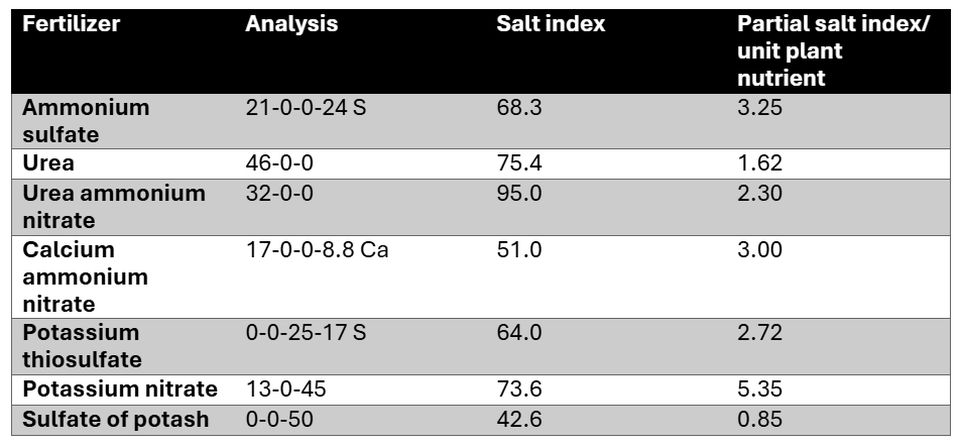
There are no specific guidelines for how to determine what rate of a specific fertilizer will induce salt injury. However, the salt index is a useful tool for comparing the potential risk of salt concentration increases that could lead to injury with different fertilizer types. The index (see Table below) quantifies how a fertilizer raises the concentration of salts in the soil solution relative to a standard, typically sodium nitrate. For fertilizers containing multiple nutrients, the partial salt index is the sum of the salt index values for each nutrient per unit (20 pounds) of plant nutrients applied. While the salt index does not provide a precise threshold for fertilizer-induced injury, it offers valuable insights for assessing and comparing the relative risks of different fertilizers. To minimize the risk of salt burn, split applications or more frequent lower-dose fertilizer applications are recommended.
Graphic courtesy of Mae Culumber
Soil amendments that increase organic matter content may help reduce the risk of salt burn from fertilization. Organic matter improves the biological, chemical, and physical properties of the soil. Like a sponge, organic matter improves the soils’ ability to hold water. The improved moisture retention can help dilute salt in the soil solution, potentially reducing their concentration. Organic matter provides a source of energy and habitat for soil microorganisms that break down and release nutrients into the soil. An increased supply of nutrients may offset the need for conventional fertilizers that contribute to salt build up. However, while soil amendments are generally considered beneficial, some sources including manures and some composts can be high in salts like phosphorus. Therefore, it’s important to obtain an analysis for these amendments prior to use to determine the appropriate application rate and minimize the risk of salt contamination.
Subscribe Today For
