



Cheers to 10 Years of Growing Hops in Florida
 June 14, 2025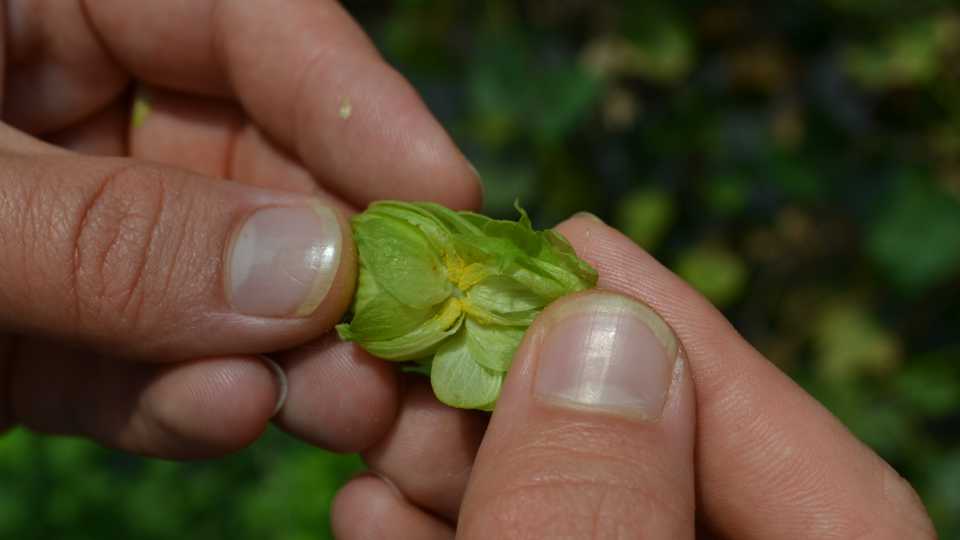
Growing hops in Florida has been a work in progress over the last decade. Unique sensory components of Florida-grown hops help craft beers made with them stand out.
Photo by Paul Rusnak
Time flies! Seriously. It’s now been a solid decade since I’ve started following Florida’s journey into growing hops for the burgeoning local craft beer market. Back in 2015, the possibility of actually growing hops in Florida’s less-than-hospitable environment was still a question. Since then, that question has been answered and then some — thanks in huge part to researchers at University of Florida.
According to UF/IFAS, 19 microbreweries have brewed more than 5,000 gallons of beer using hops grown at the Gulf Coast Research and Education Center (GCREC) in Balm, FL. “With almost no local commercial hops production, we are most likely the largest supplier of Florida-grown hops,” says Shinsuke Agehara, UF/IFAS Associate Professor.
Feedback from brewers has been helpful to Agehara and his fellow scientists. Local brewers are keyed in on the unique aromas of hops that are grown in Florida. Agehara says hints of sweet melon, honeydew, and pineapple have been detected. These are in contrast to similar hops grown in more traditional production areas like the Pacific Northwest.
To take advantage of this, Agehara says he and his team are now analyzing the essential oil composition of Florida-grown hops. In particular, they are looking at terroir.
In addition, researchers have been working on ways to supply locally-grown hops in a more efficient manner.
“One of the past limitations in distributing our hops was that we could only provide whole cones — either fresh or dried — rather than pellets,” Agehara adds. “Since most brewers prefer using pellets, being able to supply hops in the form of pellets would certainly help the use and recognition of our hops by local brewers. Pellets have several advantages over whole dried cones.”
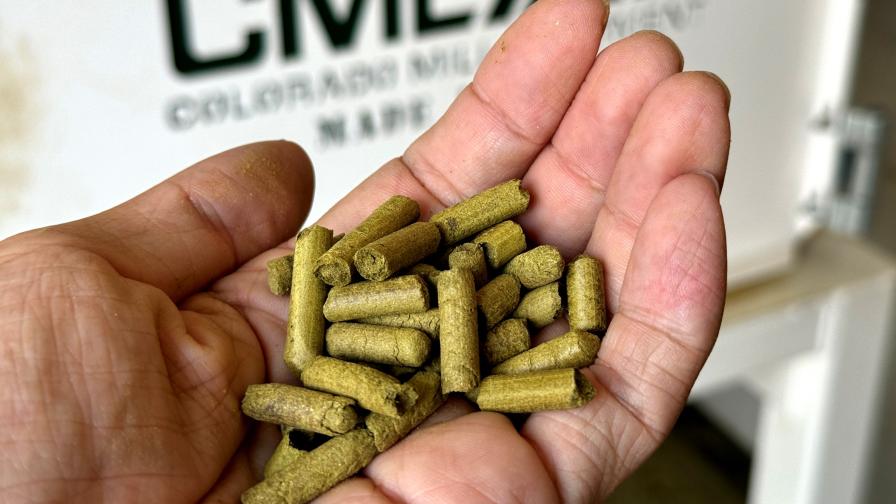
A closeup of hops pellets. Photo by Shinsuke Agehara, UF/IFAS
Among the advantage are smaller size and their ability to break down in water allow for more efficient extraction of essential oils and acids, he says. Pellets are also easier to store and handle, and they have a longer shelf life.
Cypress & Grove Brewing in Gainesville and Sideward Brewing in Orlando are among the first Florida breweries to use hop pellets produced at GCREC, Agehara says.
Representatives from both breweries were on hand during a hops field day recently held at GCREC. They brought beer made with the local hops to sample.
The craft beer scene in Florida continues to hold strong. According to the Brewers Association, Florida has 391 microbreweries. This compared to 45 in 2011.
Demand is there. No doubt. And the ability to grow and supply local hops on a consistent basis looks bright.
“Our immediate goal is to demonstrate the potential of Florida-grown hops to local breweries, while optimizing the production system to maximize the yield and quality” Agehara says. “Our long-term goal is to help establish a market that encourages commercial hop production by local growers.”
Cheers to this! Let’s see what the next 10 years brings.
Subscribe Today For
