



Orchard Ops: Make Wind Machine Maintenance a High Priority
Wind machines play a crucial role in protecting fruit orchards from frost damage. However, it is easy for growers to forget about their wind machines. Unlike everyday tools like tractors and mowers, these frost-prevention systems only run a few nights a year, making regular maintenance easy to overlook.
Consequently, neglected maintenance results in critical and costly failures, says Steve Ott, owner of Wenatchee Wind Machine Service, headquartered in Wenatchee, WA. And a wind machine breakdown is nothing to take lightly. In fact, the results can be downright dangerous.
“Normally, as the propeller spins, the gearbox makes a rotation every four and a half minutes, and there’s a rotation gear responsible for that,” Ott says. “When that [gear] breaks, the physics behind that propeller spinning makes the head want to rotate faster and faster. With that much mass, it’s not long before something comes loose — either the propeller breaks, or the gearbox just comes out of the tower. You don’t want to be anywhere around when that happens.”
Wind machines are essentially large fans mounted on tall towers. They work by pulling the warmer air from the inversion layer above, pushing it down toward the orchard floor, and mixing it with the colder air below. This raises the overall temperature in the orchard, protecting fragile fruit buds from frost damage.
PREVENT DEFENSE
While most mechanical failures in wind machines pose no direct physical danger, problems like broken gearboxes, drive lines, or damaged wiring can still render the machine useless. However, as Ott explains, these costly breakdowns are largely preventable with routine maintenance performed by orchard owners and qualified technicians.
Routine wind machine maintenance offers a clear return on investment. Ott explains that with one machine typically covering every 10 acres, a single orchard might have 10 to 20 units. A new wind machine, installed, costs roughly $45,000 to $50,000. While annual maintenance by a technician averages just $300 to $400 per machine, neglecting this upkeep can lead to far more costly repairs or even premature replacement. And because a wind machine logs so few hours per year — compared to everyday orchard equipment — it is not unusual for a well-maintained unit to last more than 30 years, only becoming obsolete when replacement parts become impossible to source.
“When you consider the cost of routine service and maintenance over 30 years, that’s nowhere near the cost of [replacing and installing] a new machine,” he says.
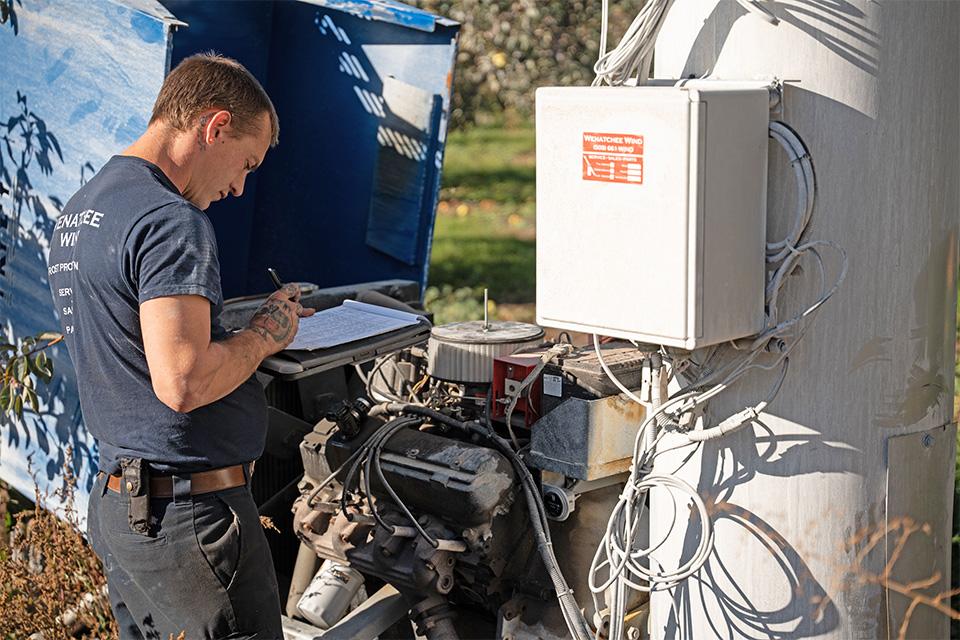
Photo by Steve Ott, Wenachee Wind Machine Service
POST-FROST CHECK-UPS
Ott strongly advises orchard owners to avoid the common mistake of waiting until spring for wind machine inspections. Instead, schedule an annual check-up with a technician following the last frost, ideally in the summer or fall.
“That way, if there’s any work [that needs to be addressed], you’ve got time to determine how and when you want that fixed before the next spring approaches,” he says. “For example, here in Washington, March 1 is a date a lot of [fruit growers] have in mind to have their wind machines ready to go. So, anytime in January or February is a good time [for orchard owners] to go out and run the machines and ensure things are working properly. If you haven’t run [the wind machine] in a long time and expect everything to be fine, well, that’s just not always the case.”
A comprehensive wind machine maintenance strategy involves numerous tasks, some requiring a professional technician but many others that the orchard owner can handle.
For starters, Ott suggests orchard owners check oil, coolant, and fuel levels and conduct a thorough visual inspection of the engine. “A wind machine is a really good shelter for mice, rabbits, even weasels,” Ott says. “They get in there, make nests, and chew up the wiring. A good [preventive] practice is to start throwing poison on top of the engine.”
However, the expertise of a professional technician is crucial for inspecting the drivetrain, gearboxes, and propeller annually.
“The propeller actually rocks back and forth on a shaft, which helps relieve stress on the machine,” Ott says. “But that shaft wears out the gearboxes. You’ve got a lot of moving parts and a lot of seals, and over the life of the machine, problems start to crop up.”
AUTOMATION FACTOR
In addition, many modern units operate off remote-start devices triggered by weather conditions. A service pro can root out issues that a grower may not realize are problems. “There may be an issue that develops every time there is a [remote] start,” Ott says. “But you’re not nearby, so you don’t know about it. Having someone visit and inspect that machine is imperative, especially as these machines become more automated.”
Lastly, Ott says wind machines are the common target of theft, and regular inspections help identify if key components have been stolen, which will render a unit inoperable at a critical time.
“While a catalytic converter or the radiator may not have great value as scrap, they are very expensive to replace,” he says. “Again, these machines are often ‘out of sight, out of mind’ for growers. And left uninspected, this is just another reason why one wouldn’t be ready [to operate] even though it was the last time you used it.”
Definite Don’ts for Wind Machine Maintenance
If you are seeking to extend the life of your wind machines, Steve Ott, owner of Wenatchee Wind Machine Service, headquartered in Wenatchee, WA, suggests avoiding two operational practices.
The first is running the machine on a windy day, which puts undue stress on the machine’s components. “If you fire up a wind machine and it’s windy, that machine lets you know,” Ott says. “The ground shakes, and everything about it feels wrong.”
The second is running the machine out of fuel. Wind machines are largely propane-powered, so there is no fuel pump. Instead, the conversion from liquid propane to vapor provides pressure for the system.
“If you begin running a wind machine out of fuel, it starts to surge,” Ott says. “There’s so much mass that’s spinning when a wind machine is running. If [the system] goes from pushing to pulling, something is going to break.”
Ott warns that a pinhole leak can deplete propane levels in the months that the machine is not in use. Suddenly, spring hits early, and an unsuspecting orchard owner wrongfully believes there was more than enough fuel left in the tank at the end of the previous spring. Ott adds the average 500-gallon propane tank should be topped off when it hits 20%. And those orchard owners not close to a propane source should consider upgrading to a 1,000-gallon tank as a safeguard.
Subscribe Today For
