


Apple Grower Finding Growth on the Soil Moisture Fast Track
 March 10, 2025
Straight out of Washington State University, John Rawley learned really quick about the importance of irrigation and soil moisture monitoring. His first season in charge of four properties owned by Custom Orchards on the region’s Royal Slope will long be remembered for the heat dome of 2021, which drove triple-digit temperatures up to 40 degrees above normal between June 26 and July 2.
“Some orchard managers were doing a good job of keeping up on water, and other ones weren’t,” Rawley recalls. “But for the most part, with that heat dome coming, everybody was trying to save their butts. It seemed like they were just putting as much water out as they could, but sometimes with the (irrigation) canal, they’ll cut off your supply or reduce it. So, guys were trying to put water in the most important spots.”
Where exactly would those spots be? When would they need to be addressed? And with how much water? Rawley, despite being a first-year orchard manager, wound up with all the right answers that season, thanks to a water management platform (Probe Schedule, Wilbur-Ellis Agribusiness) that uses data from soil moisture sensors, weather stations, and other sources to calculate irrigation schedules.
“I was starting out at that time, and I think that was a good time to just watch it and kind of learn from it,” he says. “I’ve taken it from there and added more probes in the ground.”
That 2021 trial run — and those extra sensors — have paid off the last three seasons, each exceptional weather-wise.
“It seems like we experience heat every year,” Rawley says. “One of the things I think I’ve solved is, knowing it’s going to be 100 degrees out or whatever it might be, you can look at your phone and take a snapshot in time and say, “OK, this block is watered.’ Maybe it’s next on the schedule, but it has enough water to at least start getting through the heat.’ Then you can say, ‘I’d rather use this water here because maybe this block is borderline pretty dry.’”
ON THE ROAD AGAIN
Rawley often finds himself tracking irrigation from the inside of his truck instead of the field. His blocks in George, Royal City, and Othello are separated by as many as 60 miles.
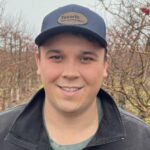
John Rawley
“It’s hard to know what’s going on below the ground. When you’re driving around looking at different blocks and saying, ‘Oh, that’s good enough on water,’ that isn’t always the best way to go about it,” he says. “But if you have probes in the ground, you have something to look at on your phone or your computer and say, ‘This block right here is concerning. I don’t like the numbers that are coming back.’ Then you can schedule out your day and say, ‘I need to go check on these probes and look at them more in depth.’ You can check those dry spots or your wet spots based on that probe.”
The frequency in which Rawley checks each block from his phone varies depending on the time of season. Most of his probes are situated among the varieties that are typically more difficult to irrigate: ‘Gala’, ‘Honeycrisp’, ‘Fuji’, and ‘Granny Smith’.
“I wouldn’t say I check my phone every day. From the springtime into early summer, I’m checking it more often to make sure we’re not watering too much,” Rawley says. “Over the summer I’m checking it probably the most because there’s days of 100°F coming up, and I want to make sure that everything looks like it should, going into this heat. I can also check and see, ‘OK, this 100°F came, we’re having higher rates of evapotranspiration or water loss — the plants are using it more — and we need to water this and this. Then, in the fall, I don’t check it nearly as much, maybe once a week. But in the summer, at least every other day or three days.”
CUSTOMER CARE
Rawley lauds Curtis Pusey, Wilbur-Ellis’ Irrigation Water Management Manager in the Cascades, for the consistent direction he offers. “Being newer in the industry, I’ll call Curtis and say, ‘Hey, I have a couple of questions about this. Can you help me look through this data and see what I need to be doing? Maybe I feel I’m overwatering.’ That’s so important because we obviously don’t have a lot of time to go through orchards and start digging holes and see how deep the water is in the soil profile.”
Adds Pusey: “We have eyes on his probes almost as much as he does.”
As steep as Rawley’s learning curve might have been in 2021, he says his knowledge multiplies each season. “Sandy soil vs. silt soil: Those are our two main soils, and they react totally different,” he says. “I’m learning how to treat those different soils differently and how much water I actually need to put.”
More often than not, concludes Pusey, issues that are seen in the orchard, whether specific to crop nutrition or protection, start with water. With various water management platforms available to purchase, growers should do their homework, he says.
“We have our program; we have our way that we go about things. But if somebody is going to go out and shop around and try to decide what probes they want to use or what system they want to use, just make sure that they have what they need out of it — whether that’s support, whether that’s transparency, or making sure that their data is coming in in a decent amount of time. Just make sure that whatever they’re investing their money into, they’re actually getting what they want out of it.”
Subscribe Today For
