



Fondness for Fungi Makes a Good Case for Growing Mushrooms
 May 15, 2025
John James Staniszewski co-founded Windy City Mushroom in Chicago in 2021 with an unwavering faith in the country’s ability and desire to consume a lot of mushrooms. He’d become a big believer in mushrooms’ health benefits himself a few years earlier, and he’d noticed the increasing demand for affordable gourmet varieties in grocery stores.
“Nobody was manufacturing them at a commodity-level price point,” he says.
Staniszewski and his business partner, Guy Furman, began growing lion’s mane and oyster mushrooms in 2020, which they sold at the local farmers market. Two years later, Staniszewski joined Naturally Chicago, a small co-op that connects leaders, businesses, and advocates across the natural foods sector. Through this network, he was able to pitch his product to Pete’s Fresh Market and Fresh Thyme, two grocery store chains in the Midwest. They both put Windy City’s mushrooms on their shelves in just a few weeks.
“I started Windy City Mushroom thinking that if I grow a bunch of mushrooms, people will buy them,” Staniszewski says. “So we grew our mushrooms in bulk in anticipation that we would get these grocery store contracts. I just knew grocery stores wouldn’t even consider us if we didn’t have our production up.”
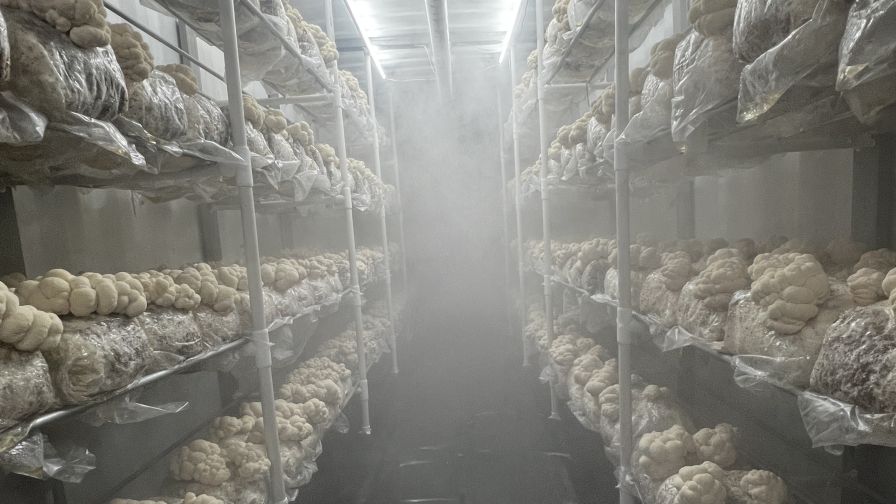
An inside look at Windy City Mushroom.
Photo by John James Staniszewski
The Mushroom Growing Process
Windy City grows its mushrooms in a 50,000 square-foot warehouse – a major upgrade from the 6,000 square-foot grow room it started in. The space has high ceilings and copious amounts of open space to stack growing containers, making it an ideal location for growing mushrooms.
To begin the growing process, Staniszewski explains, mushroom growers take byproducts that traditional farmers normally dispose of, like hardwood and soy hull, and use them as a substrate. At Windy City, a mix of substrate and water goes into polypropylene bags that are then sealed and sterilized in a 40-foot autoclave.
The bags go to a sterile clean room where they’re opened to let the substrate cool down. Then, they’re inoculated, sealed, and sent to the incubation room for colonization.
During the colonization process, growers take oats or millet and douse it with mycelium (the vegetative part of a fungus). Once mycelium colonizes the grain, it becomes “mushroom spawn.” Windy City workers will add 6 ounces of spawn to each bag of substrate, shake it up, and let the bag incubate in a climate-controlled room for two weeks.
The bags are then moved into vertically stacked growing containers; a small hole is sliced into each bag. “We induce the mushrooms by giving them a little light and a little humidity in the growing containers,” Staniszewski says.
Each growing container at Windy City can fit about 500 bags, and growers can typically harvest 2 pounds of mushrooms from each bag. Once harvested, the mushrooms are packed and shipped out to the company’s retail partners.
The Fungitarian Line
Misshapen, discolored, and otherwise not-pretty-enough-for-grocery-store mushrooms are used for Windy City’s Fungitarian line: a selection of nonperishable, pre-cooked, shredded, and seasoned oyster mushrooms in five varieties (marinara, taco, Asian zing, barbecue, and original). “We essentially had to create our own commercialization process to cut, cook, season, and prepare it,” he says.
Windy City worked closely with a kitchen manager and two chefs to make sure consumers would enjoy the final product.
“I threw my chef hat on, my partner threw his chef hat on, and we started formulating recipes people would recognize and enjoy,” Staniszewski says. “But getting our mushrooms to the perfect texture was the real challenge.”
Staniszewski invested in a special slicing machine to get the mushrooms to the right thickness and experimented with cooking times. The time and effort paid off, as he sold more than a thousand bags of Fungitarian when it debuted at a local farmers market in 2023. He now sells the product in various grocery stores across the Midwest.
In addition to finding a market for its “subpar” mushrooms, Windy City Mushroom developed partnerships with Midwest composters to get rid of the organic waste mushrooms leave behind after harvest. Not only does this reduce the amount of waste the company produces, but it also spares them the expense of getting rid of it. “All of our mushroom substrate gets donated and composted, so we don’t have to pay for anything,” Staniszewski says.
What’s Next for the Mushroom Business
Based on data from the most recent USDA Census of Agriculture, mushrooms account for 57% of food sales. But they represent only 7% of operations growing under cover.
“Get ready to start seeing more mushrooms in grocery stores and more mushrooms grown in the U.S.,” Staniszewski says. “Mushrooms are one of the most efficient, highly profitable crops you can possibly grow. I’m just glad consumers have finally caught on and we have the data to confirm it now.”
Subscribe Today For
