



Ways Fruit Growers Can Better Manage Micronutrients in their Soil
 January 19, 2026
 Growers may see the symptoms of a micronutrient deficiency — yellowing leaves, poor fruit set, and inconsistent yields — and assume they need more zinc, iron, or manganese. But if the problem persists season after season, the real issue may not be a lack of micronutrients in the soil. High pH and imbalanced base saturation ratios may be locking up essential micronutrients, making them unavailable to plants. Your soil tests may show adequate micronutrient levels, but if your base saturation ratios are out of balance, those nutrients might as well not exist.
WHY BASE SATURATION RATIOS MATTER
Base saturation measures the relationship between calcium, magnesium, potassium hydrogen, and sodium relative to your soil’s Cation Exchange Capacity (CEC), which indicates its ability to hold these positively charged ions. These nutrients influence each other. If one gets out of balance, others will too.
Consider soil testing at 45% calcium, 25% magnesium, and 4% potassium. Addressing low calcium with lime will lower magnesium, depending on CEC, improving water penetration and cell health.
Addressing high magnesium helps bring low calcium back into balance. I met with a Wyoming grower who had 38% to 39% magnesium on his soil test — far above the ideal range. His soil was rock hard when dry, and sticky when wet. We applied sulfur to reduce excess magnesium. This increases calcium naturally, lowering soil pH and increasing nutrient-holding capacity and water penetration.
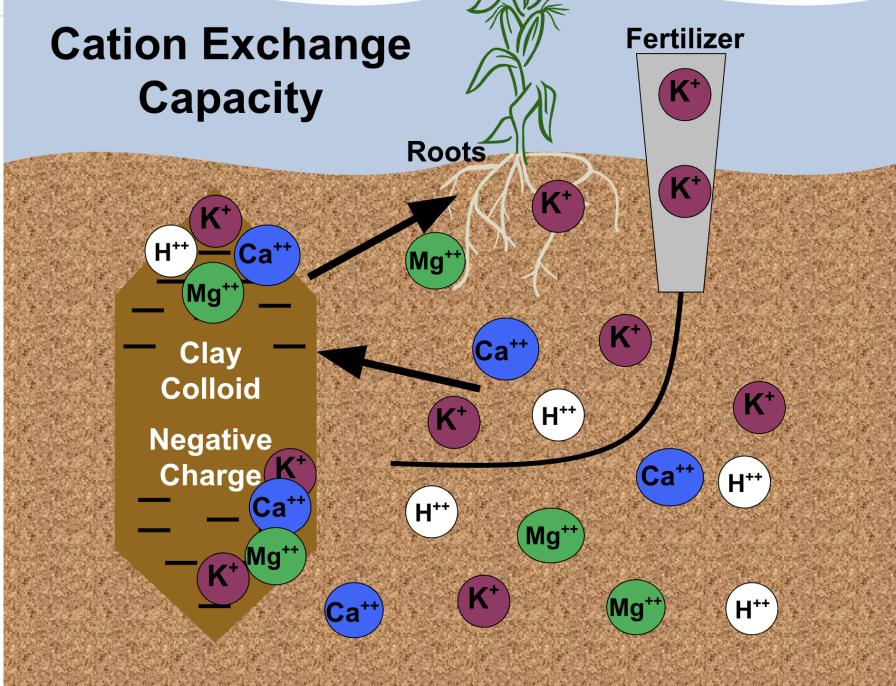
Negatively charged clay colloids act like nutrient reservoirs, holding positively charged cations (Ca++, Mg++, K+) and releasing them for plant uptake. This dynamic exchange keeps essential nutrients available while resisting leaching. The free hydrogen ions (H++) in the soil solution – not bound to colloids – determine your soil’s pH level.
Graphic courtesy of Abe Isaak
Why does this matter for micronutrients? When calcium and magnesium are in excess, pH is usually high, causing conditions where micronutrients become less available. Rebalancing base saturation lowers pH, unlocking micronutrients already present in your soil.
TAKING ACTION: A FIVE-STEP APPROACH
Balancing your soil begins with a comprehensive soil test. Work with an agronomist or trusted advisor to complete these five steps:
- Assess base saturation ratios and pH. Both matter for keeping nutrients available.
- Understand how nutrients react to each other.
- Pair soil test results with realistic yield and budget goals.
- Build a plan that addresses imbalances.
- Develop a multi-year approach that addresses root causes rather than symptoms.
WHEN SHOULD YOU TEST AND AMEND SOIL?
Your soil is most depleted after a full season of crop demand, making fall ideal for testing. In milder western regions, soil biology remains active until hard freezes, and winter amendments can begin breaking down before spring growth. For growers in colder climates, develop your amendment strategy now, so you are ready when conditions allow.
Calcium applied in winter, when crops are dormant, can displace sodium from clay particles into the soil solution, preventing sodium from reattaching. When rain or irrigation is applied, water carries the sodium deeper into the soil and away from the root zone. Better water penetration and balanced pH mean roots can access micronutrients more easily by spring.
MANAGING MICROS OVER THE SEASON
One often-overlooked principle: When you apply calcium amendments, the soil uses them first for structural and pH adjustment before your crop accesses calcium as a nutrient. While dormant-season gypsum or lime rebalances base saturation, your spring crop may still face micronutrient availability issues as amendments slowly break down.
Highly soluble calcium sources like calcium nitrate do double duty during active growth, continuing to manage pH while feeding the crop. The soluble calcium maintains proper base saturation ratios throughout the season, sustaining pH conditions that keep iron, zinc, and manganese available, especially during bloom, fruit set, and rapid cell division.
THE BOTTOM LINE
Those yellowing leaves and poor fruit set are not always asking for more zinc or iron — they are often signaling that your pH and base saturation need attention. When these fundamentals are out of balance, even the best micronutrient applications cannot reach their full potential.
Address pH and base saturation imbalances now, and you will unlock the micronutrients already in your soil while making any supplemental applications far more effective. Test this winter, amend strategically, and give your micronutrients the soil conditions they need to work efficiently.
Subscribe Today For
