


Smart Tech
How To Vet Smart Tech in Your Vegetable Field
 April 18, 2026
Smart tech continues to generate interest across the vegetable industry, promising labor savings, improved efficiency, and better decision-making. But when it comes to making an investment, growers are taking a more grounded approach.
The first question isn’t about features or even return on investment. It’s simpler than that: Does this solve a real problem on the farm?
That mindset is reflected in early results from the 2026 State of the Vegetable Industry survey. Cost remains the most commonly cited barrier to adopting smart tech, but the reasoning shifts by farm size. Smaller farms are more likely to say they don’t need the technology, while larger operations point to the need for more research and confidence in ROI.
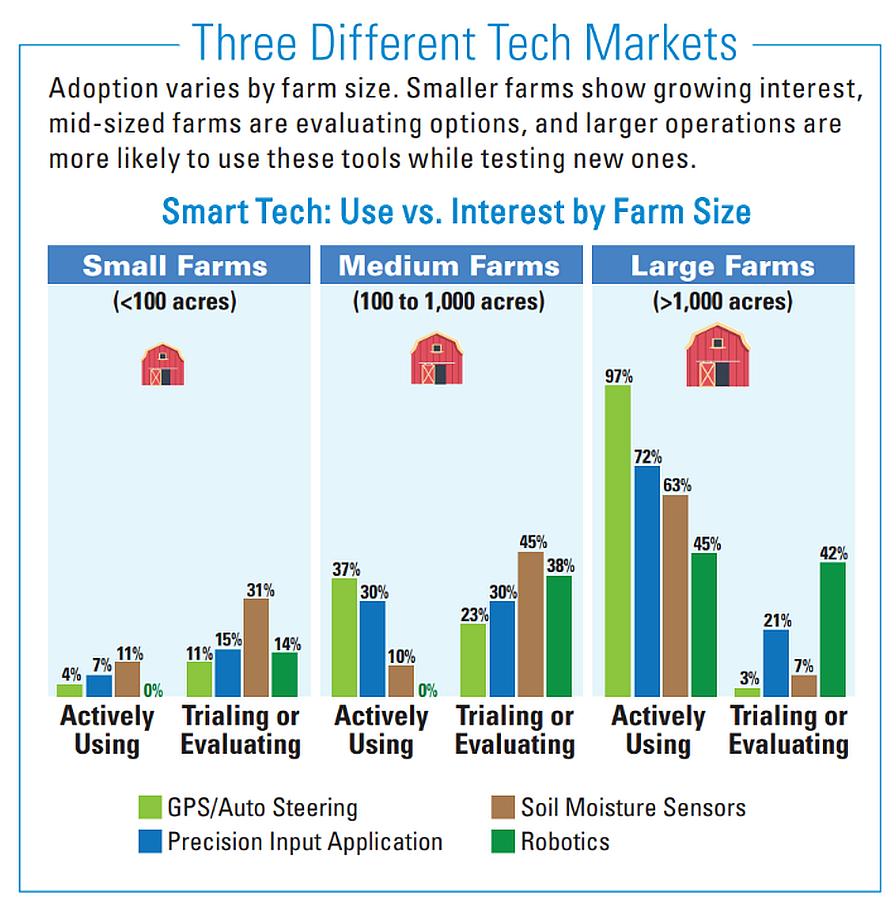
Different farms, it turns out, are asking different questions before they invest. Our survey responses also show adoption rising sharply with farm size — smaller operations are far less likely to use these tools, while larger farms are integrating them across their operations.
Four Filters Growers Are Using
1. Does it solve a real pain point?
Growers are prioritizing tools that address specific challenges, most often labor shortages, repetitive tasks, or production bottlenecks.
If technology doesn’t clearly improve efficiency or reduce pressure in one of these areas, it’s often set aside.
2. Will it be used enough to justify the cost?
Utilization is one of the biggest factors in determining whether a tool delivers value.
A piece of equipment used across multiple crops or throughout the season is far easier to justify than one that only sees occasional use. Even promising technologies can fall short if they don’t fit the scale or workflow of the operation.
3. Can it perform reliably in the field?
Reliability is often more important than capability.
Growers are weighing whether a tool will hold up under real-world conditions, especially during critical windows. Ease of use, service support, and the learning curve all factor into the decision.
A tool that fails during peak season can quickly erase any potential gains.
4. What does a reasonable payback look like?
While ROI is part of the conversation, many growers are not relying on precise calculations. Instead, they are thinking in terms of seasons.
If a tool can demonstrate value within a reasonable timeframe — whether through labor savings, improved consistency, or reduced risk — it is more likely to be considered a viable investment.
How Decisions Shift by Farm Size
Survey data highlights clear differences in how growers approach smart tech.
Survey results show clear differences in farm size. Smaller farms are often deciding whether they need the technology at all, with many reporting no plans to adopt certain tools.
Mid-sized operations are more likely to be testing or evaluating options, especially around labor efficiency and precision applications.
Larger farms, by contrast, are far more likely to report active use or full implementation — treating technology as part of the operation rather than an add-on.
In many cases, adoption is less about the technology itself and more about whether it fits the scale of the operation.
A Measured Approach to Adoption
Rather than making large, sweeping investments, many growers are taking a step-by-step approach.
Testing one tool at a time, focusing on specific challenges, and expanding only after seeing results allows operations to manage risk while still moving forward.
In a market where costs are high and margins are tight, that kind of discipline is shaping how smart tech is being adopted across the industry.

For more Smart Tech topics, click here.
Subscribe Today For
