



Melon Grafting: One Cotyledon
 June 1, 2009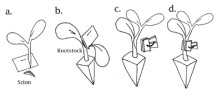
One Cotyledon
This type of grafting application involves cutting the cotyledon on an angle. The growing point and the cotyledon need to be removed together so the rootstock seedling isn’t able to grow a new shoot after it has been grafted. Growers also should be cautious not to remove too much tissue as the remaining cotyledon must be well attached to the stem of the seedling.
Rootstock seedlings should have at least one true leaf, and scion seedlings should have one or two true leaves (Fig. a).
With a single angled cut, remove one cotyledon with the growing point attached (Fig b). It is important to remove the growing point and the cotyledon together so that the rootstock seedling is not able to grow a new shoot of its own after being grafted. This is one of the advantages of using this type of graft. It’s also important, when removing the cotyledon and growing point together, not to remove too much tissue because the remaining cotyledon must be well attached to the stem of the seedling.
Cut the scion and match the two cut surfaces, rootstock and scion (Fig c). Hold in place with a grafting clip (Figs. d and e). Place the grafted seedling in a chamber with high humidity at about 77°F and discard the unused parts.
Advantages:
1) Simple technique, almost anyone can do this type of graft.
2) The only task after grafting is to remove the clip. There is no trimming of unwanted plant parts after healing of the graft union.
Disadvantages:
1) Requires careful control of humidity, light, and temperature after grafting. Can experience high losses due to poor environmental control and possible disease under high humidity conditions.
Subscribe Today For
