



New Lettuce Looms Large
 October 13, 2011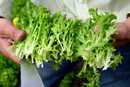
To understand Eazyleaf, the new range of lettuce varieties from Enza Zaden, you first have to understand that they’re not intended to compete with existing varieties. “They’re not intended as a replacement,” says the company’s Salinas, CA, area sales manager, Nick Barnes. “It’s a whole different ball game.”
Walking the unfortunately muddy 25 acres at the company’s San Bautista research station at its October seed trial, Barnes bends down and cuts off a couple of large handsful of the lettuce. “Look at this,” he says. “You’re getting almost a full bag of Eazyleaf lettuce out of just one seed.”
The difference is due to the fact that only one of the Eazyleaf seeds will produce anywhere from 30 to 50 leaves up to 5 inches in height. A single baby leaf seed, on the other hand, produces just one to three 3-inch leaves. That means, on average, growers will plant 3.5 million seeds of baby leaf seed per acre, compared to 400,000 Eazyleaf seeds. In fact, for the trial, Barnes and his crew planted 30 rows of baby leaf seed on the now standard 80-inch beds, but they planted just 11 rows of the Eazyleaf on the same size beds.
Because so little Eazyleaf seed is needed per acre, it’s obviously going to be more expensive, says Barnes. Also, as might be expected, it takes the plants a lot longer to reach full maturity, about 55 days, nearly double the 30 days the baby leaf seed requires. Lettuce growers, particularly in the Salinas area where ground is pricey, traditionally hustle from crop to crop. “That’s a concern, not turning the ground over quicker,” he says with a nod. “It is a concept that will need to be sold.”
Consumers Love Crunch
On the bright side, Barnes doesn’t believe it’s a difficult concept to grasp — or for him to sell. Because while the Eazyleaf crop does require nearly twice as much time in the ground, it pays off with fully twice the yield, producing 18,000 pounds of product per acre, compared with 9,000 pounds of baby leaf.
But more important, he doesn’t think he will have to do all the selling himself. Consumers, by way of the buyers, will do it for him. That’s because the bigger, stronger Eazyleaf plants equate to much longer shelf life, a quality favored by both retailers and food service providers, as well as consumers. Stronger plants should also be a boon to growers, he says, because they should have greater resistance to mildew which would mean fewer fungicide sprays.
But most important of all? Crunch. Even though leaf lettuce sales have zoomed upward in the past couple decades, a lot of people still prefer iceberg because of the crunch. “That’s what people want — they want that crunch,” says Barnes, who adds that at the end of the day that’s the quality that will win growers over to Eazyleaf.
“You’re not introducing new growing practices, or a new harvesting method,” he says, “you’re just getting a crunchier, longer-shelf-life product.”
Subscribe Today For
