



Pest Of The Month: Diamondback Moth
 June 30, 2011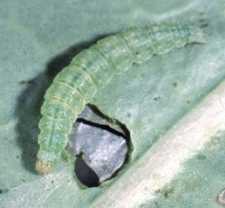
It goes without saying that the diamondback moth can be a devastating pest to cole crops. Its favorites are cabbage and collards but it also attacks many greens and leafy greens.
The path of destruction begins when the adult moth lays individual eggs on the host crop. The early larvae, or the first instar, mine into the leaf but after that, the larva are primarily a defoliator, explains Stormy Sparks, professor of entomology at the University of Georgia. “[The pest] is ¾ of an inch long and doesn’t consume large portions of the leaf like an imported cabbage worm or a looper, but this pest can cause considerable damage on the crop,” he explains.
“In broccoli, you run into the additional problem of them being a contaminant,” Sparks says. “They crawl up into the head and feed. They also pupate there, and the pupa attaches to the plant with a loose mesh webbing that sticks to the plant so it is difficult to remove it from the broccoli head.”
Resisting Insecticides
The biggest issue growers have with diamondback moth is insecticide resistance. According to Sparks, this pest has shown resistance to every class of insecticide targeted against it.
“This is a huge issue in that we will frequently get down to where no product works,” he explains. “We have seven or eight different modes of action that have potential for controlling diamondback. If they all came on the market at once and growers could rotate them, they should be able to delay resistance a lot more than they do.” What typically happens, he says, is that growers tend to use these products to the point where nothing works.
What is the best cost-effective option? A host-free period. In Georgia, Sparks says if growers maintain a host-free period in the middle of summer for six to eight weeks — when diamondback is going through a generation in two weeks — it causes the population to crash and it reduces the amount of insecticide that has to be used.
Growers have helped themselves tremendously simply by reducing selection pressure, he says. Since implementing the program a couple of years ago, however, Sparks says some growers have gotten away from maintaining a host-free period and, as a result, “diamondback moth has popped back into the picture.”
Fortunately, because growers haven’t been spraying too many insecticides, several are working to maintain control. “The problem is that once you have created resistance — even when it reverts back — it is much easier to reselect for that resistance again,”
he explains.
The Role Of Bts
In addition to a host-free period, microbial insect controls such as Bts (Bacillus thuringiensis) can play a pivotal role in resistance management. For example, Sparks says, in crops such as cabbage, Bts should be used early in the season when you can tolerate some damage and don’t need 100% control.
“Later in the season if populations are low again and you don’t need 100% control, you can stay with the Bts,” he explains. “When populations get larger, that is when you come in with the newer chemistries that can give you the 95% to 98% control.”
Sparks’ best advice to growers, however, is to implement a host-free period so diamondback moth doesn’t build up to a population that will overwhelm the crop. “Without having a host-free period — and if you go to year-round production — it is just a matter of time until you run into populations you cannot control,” he adds.
Subscribe Today For
