



Can You Spot the Difference? Diagnostic Pitfalls in Potatoes
 November 14, 2025
 When potato problems have symptoms that closely resemble pictures in guidebooks, diagnosis can be quick and easy. Unfortunately, many potato problems are not that obvious. Here are a couple of challenging cases — ones that make you dig a little deeper.
Challenge #1: Problems That Cause Similar Symptoms
“Purple top” is a term used to describe a set of symptoms associated with leafhopper-transmitted phytoplasmas, such as those that cause aster yellows disease. Affected plants exhibit rolled leaves with yellowing and purple pigmentation, bushy growth at the top of the stem (also known as witches’ broom), and occasionally, aerial tubers forming in the leaf axils.
These symptoms occur because phytoplasmas block the plant’s phloem, the tissue responsible for moving sugars and phytohormones like auxin throughout the plant. When this transport system is disrupted, apical dominance is lost, lateral buds proliferate at the top of the plant, and excess carbohydrates accumulate in the leaves and stems rather than moving down to the tubers.
However, phytoplasmas aren’t the only culprits behind purple top. The early stages of zebra chip disease, caused by a bacterium that also infects the phloem, can appear strikingly similar. Feeding damage from Lygus bugs at the growing point and along the stem can also produce similar symptoms. Stem infections caused by Rhizoctonia can look the same and even a physical injury, such as breaking a stem while walking through a field, may result in comparable purpling and bushy growth.
The reason these different problems appear alike is that the plant is responding to the same type of disruption. Whether a pathogen blocks the phloem or it is physically damaged by an insect or your foot, the plant’s plumbing system is backed up. When that happens, you’ll see the characteristic purple, bushy, and stressed growth patterns of purple top.
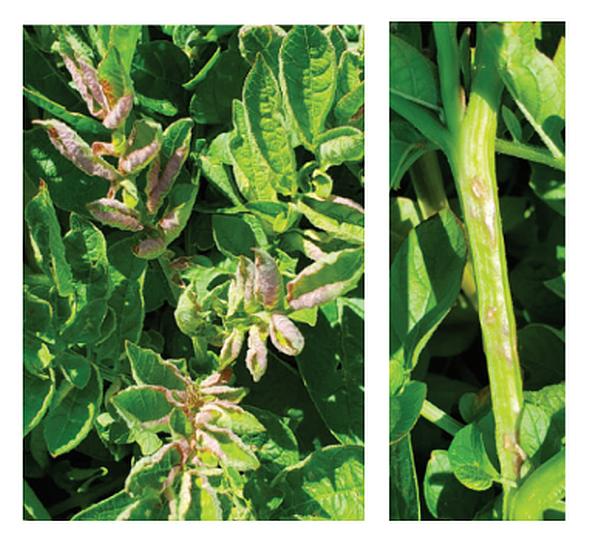
This plant is showing some classic “purple top” symptoms, but in this case, they were caused by Lygus bugs (tarnished plant bugs). If you lift the plant and examine the stem, you’ll see bumps and scars where Lygus bugs fed with their piercing-sucking mouthparts. These scars do not occur with other causes of purple top. Interestingly, the purpling associated with Lygus bug feeding is observed only in some potato cultivars (e.g., Umatilla Russet, Russet Norkotah, Clearwater Russet). Others show similar symptoms without the purpling (e.g., Russet Burbank, Alturas).
Photos by Carrie H. Wohleb
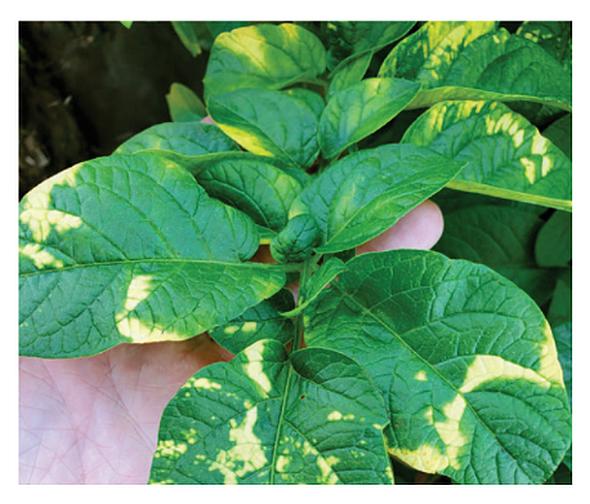
The diseases caused by the potato mop-top virus (PMTV) and tobacco rattle virus (TRV) are another example of problems that produce similar symptoms. They may include yellow spots and blotches on the leaves and brown arcs or flecks in the tuber flesh. The best way to distinguish PMTV and TRV is to send samples to a diagnostic lab, where DNA-based testing identifies the culprit. The plant in the photo is infected with PMTV, verified by leaf sample testing. Diagnosis is important because management steps for these diseases differ greatly.
Photo by Carrie H. Wohleb
Challenge #2: Problems That Cause Various Symptoms
Potato Virus Y (PVY) is another example of a disease that can be difficult to diagnose because of its varied symptoms. The appearance of PVY changes not only from one cultivar to another but even within the same cultivar, depending on the virus strain.
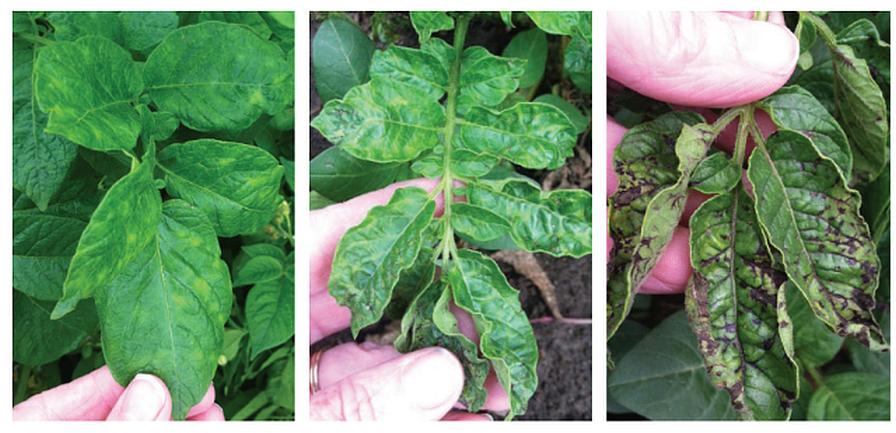
These pictures show leaves of three different potato cultivars infected with the O-strain of PVY. They all exhibit the yellow to light-green mosaic symptom that is characteristic of PVY infections, but with varying degrees of leaf crinkling. The cultivar on the right is also exhibiting a dark necrosis of the veins, a less common symptom, but one that occurs with some cultivars.
Photos by Carrie H. Wohleb
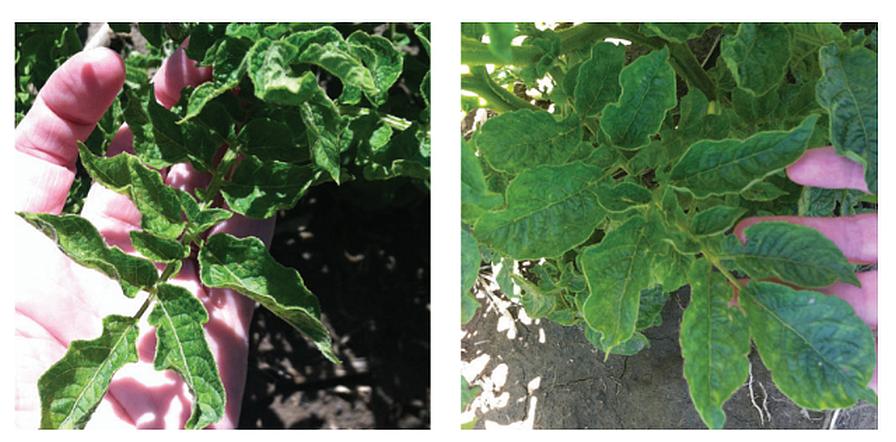
These pictures show the cultivar ‘Alturas’ affected by different PVY strains. The plant on the left, infected with PVY^O, displays mosaic symptoms and severe leaf crinkling. The plant on the right, infected with PVY^NTN, shows much milder symptoms.
Photos by Carrie H. Wohleb
Why should you care which PVY strain is affecting your potatoes? Different strains can have very different impacts on tuber quality. For instance, in Alturas and Yukon Gold, the PVY^NTN strain can cause necrotic rings on the tuber surface (called potato tuber necrotic ringspot disease) that makes the tubers unmarketable, whereas PVY^O does not.
It’s helpful to familiarize yourself with the range of PVY symptoms typical for the cultivars you grow.
Check out the PVY photo gallery at potatovirus.smugmug.com.
However, the best way to diagnose PVY and identify the strain is to submit leaf or tuber samples to a diagnostic lab and request a PVY strain test.
Subscribe Today For
