



Color Matters in New PGR Strategy for ‘Honeycrisp’ Apples
 July 14, 2025
 Managing pre-harvest fruit drop in ‘Honeycrisp’ apples has always come with a trade-off. While plant growth regulator (PGR) tools like ReTain (AVG, Valent U.S.A.) are highly effective at keeping fruit on the tree, they often do so at the cost of red skin coloration — a key quality trait for market acceptance. At my lab at Virginia Tech, we’ve been working to resolve this dilemma. Over the past two seasons, we evaluated a novel strategy: combining AVG with 1-aminocyclopropane-1-carboxylic acid (ACC), a naturally occurring ethylene precursor sold as Accede.
Our results from 2023 and 2024 trials show that this combination holds real promise — offering significant reductions in fruit drop while supporting strong color development. For growers of high-value cultivars like ‘Honeycrisp’, this could be a game-changing approach.
THE CHALLENGE: A HORMONAL TUG-OF-WAR
Ethylene is at the center of both challenges. This gaseous plant hormone, often referred to as the “ripening hormone,” triggers pre-harvest fruit drop by promoting cell wall breakdown at the abscission zone. At the same time, it plays a key role in stimulating anthocyanin production, which gives ‘Honeycrisp’ apples their signature red blush. Inhibiting ethylene with AVG helps reduce fruit drop but often suppresses coloration. Conversely, applying ethylene-releasing PGRs, like ethephon or ACC, enhances red pigmentation — but increases the risk of fruit drop. This trade-off places growers in a difficult position: preserve yield or achieve optimal color — but seldom both.
OUR APPROACH: TESTING A DUAL TREATMENT
We conducted replicated field trials in 2023 and 2024 at the Alson H. Smith Jr. Agricultural Research and Extension Center in Winchester, VA. Eight-year-old ‘Honeycrisp’ trees on B.9 rootstock received one of six treatments: ReTain, Accede, Motivate (ethephon, Fine Americas), ReTain + Accede, ReTain + Motivate, or an untreated control. ReTain was applied once, three weeks prior to the anticipated harvest date. Accede and Motivate were applied at three timepoints: three, two, and one week before harvest.
WHAT WE FOUND
1. Fruit Drop Control: ReTain alone consistently reduced pre-harvest fruit drop across both seasons. However, combining ReTain with Accede further improved drop control at key timepoints. In fact, ReTain + Accede showed statistically lower drop percentages compared to untreated controls and outperformed ReTain + Motivate in year-to-year consistency.
2. Enhanced Color Without Compromise: Accede and Motivate alone intensified red coloration but caused excessive drop. ReTain suppressed color development, resulting in higher chlorophyll content (measured via IAD) and hue angles. But when ReTain was combined with Accede, we observed a balanced outcome: improved red pigmentation and chlorophyll degradation, without compromising fruit retention.
3. Fruit Quality Held Steady — or Improved: Soluble sugar levels (°Brix) and firmness were either maintained or improved under the ReTain + Accede treatment. Importantly, the combination didn’t accelerate ripening beyond the typical harvest window, as shown by starch index measurements.
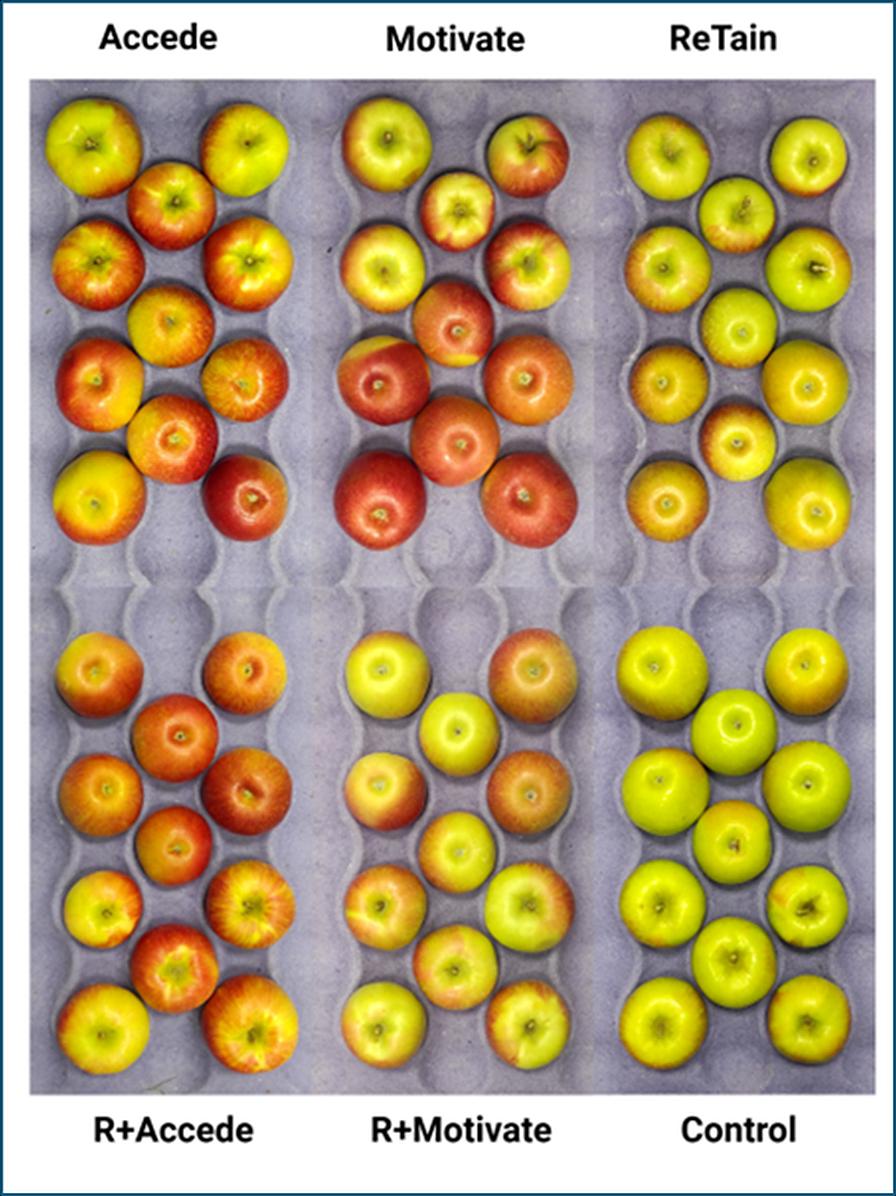
Effect of different PGR treatments on ‘Honeycrisp’ apple coloration at harvest. (Credit: Mohammad Tipu)
WHY IT MATTERS AND WHAT’S NEXT
For growers aiming to achieve high pack-out rates, extend the harvest window, and maximize returns, timing is everything. Our findings suggest that combining ReTain with Accede can offer greater control over harvest timing while maintaining fruit quality and meeting color standards. Rather than forcing a choice between yield and appearance, this strategy presents a practical and balanced solution.
We’re continuing to explore how different PGR combinations can fine-tune apple physiology in ways that benefit both growers and consumers. These trials build on our broader work examining ethylene signaling pathways, and we’re particularly interested in ACC’s emerging role as a signaling molecule beyond its conversion to ethylene. With mounting pressures related to profitability, labor availability, and evolving market standards, practical tools like this one could make a meaningful difference at the orchard level. We look forward to partnering with growers and industry stakeholders to translate this knowledge into broader practice.
It is worth noting that while Accede, a product by Valent U.S.A., is commercially available to apple growers for thinning and crop load management, it is not currently labeled for use in improving fruit coloration in apples at the time of this publication.
This research, first-authored by Mohammad Tipu, a Ph.D. student in Sherif’s Lab, was recently published in the journal Plant Growth Regulation and summarized in a Virginia Cooperative Extension publication (SPES-712).
Subscribe Today For
