


Saga Continues for Calcium vs. Bitter Pit in Apples
 July 4, 2025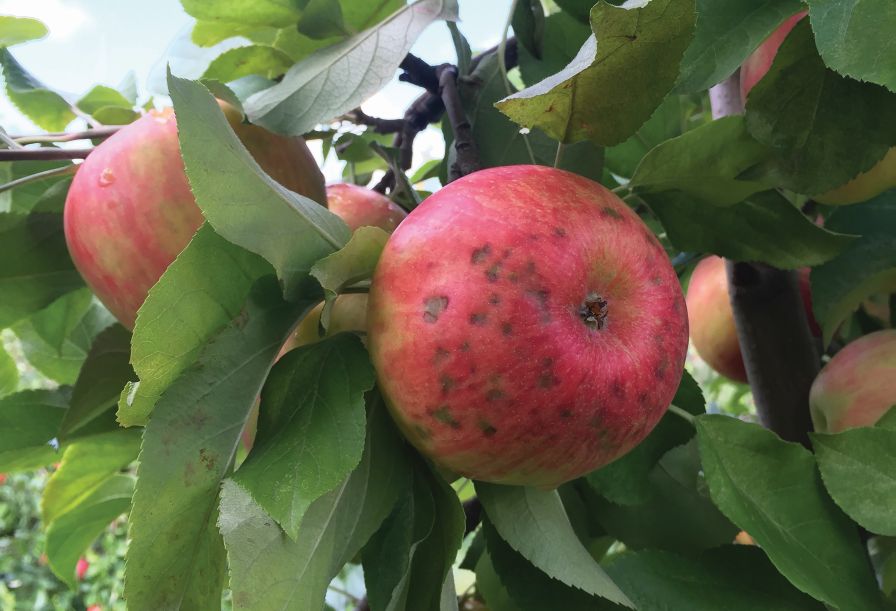
Untreated ‘Honeycrisp’ apples exhibiting bitter pit symptoms. Photo by Poliana Francescatto
A trio of macronutrients — calcium, nitrogen, and potassium — continue to dominate the crop nutrition conversation among fruit growers, according to American Fruit Grower’s 2025 State of the Industry report. Bitter pit, predominantly in ‘Honeycrisp’, again makes calcium distribution the hot-button issue in apple orchards.
“Bitter pit in ‘Honeycrisp’ — we dropped a lot of fruit on the ground,” a New York state grower says.
A grower in Wisconsin has been “trying multiple strategies” against bitter pit, but the physiological disorder is “still a huge problem,” he adds.
MORE, MORE, MORE
Many of those strategies involve calcium. “More calcium for everything,” a Washington state apple and sweet cherry grower says. “We put more on — when we can,” a New York apple and peach grower adds.
Foliar application provides rapid nutrient delivery, while soil-applied calcium nitrate provides long-term availability but may be less efficient.
“We sprayed soluble calcium on certain trees when apples were small,” a California grower says.
“We changed our nutrition program and reduced target fruit size,” a Michigan grower says.
Repeated calcium applications and maintaining nutritional balance in the crop is essential, a Michigan apple and sweet/tart cherry grower says.
An apple grower in Washington is taking a regenerative agriculture approach to battle bitter pit. Another in Ohio focuses on summer pruning in addition to using more calcium.
Understanding rootstock influence in nutrient uptake is critical, according to a New York apple grower, who controls bitter pit in ‘Honeycrisp’ through calcium applications and deficit irrigation.
“Issues relating to calcium deficiency may have been an issue in 2024, and I’m already working to minimize that for 2025,” an Oregon tree fruit grower says.
CALCIUM BEYOND BITTER PIT
Growers outside the apple orchard also consider calcium one of their preferred macronutrients.
“We’ve increased calcium and potassium in our cherries for bigger firmer cherries,” a Washington grower says.
“Calcium and potassium: We applied more foliar,” a California citrus grower says.
Adds a Colorado grower, “Calcium in the apples and iron in the peaches.”
On the berry front, a New York grower continues to soil test while adding calcium where needed.
“Calcium and micronutrients: We fixed by fertigating a variety of high-quality products,” a Washington berry grower says.
“As always, too much magnesium in irrigation water,” a California berry grower says. “We add gypsum to maintain balance with calcium.”
“We tried new products,” a New York tree fruit grower says.
NITROGEN AND OTHER NUTRIENTS
A Colorado stone fruit grower improves his nitrogen content by hauling in dairy manure by the semi. A Washington apple grower also recommends applying nitrogen, although “very carefully” in the process.
Switching to potassium and vineyards, a California grape grower fertilized with it twice to solve his nutrition issues. A fellow grower in California mitigated potassium uptake issues by changing products. Meanwhile, a grower in South Dakota treated his grapes with foliar-sprayed potassium.
As for micronutrients, growers in Michigan and Arizona relied on foliar sprays to solve their berry issues.
“Iron, manganese, and zinc need to be supplemented,” a Colorado stone fruit grower adds. “We use foliar applications.”
OTHER CROP NUTRITION RESPONSES
• “We’re matching plant needs based on tissue and soil analysis. We’re responding with a targeted nutrition plan to meet those requirements.” (Pennsylvania tree fruit)
• “We’re trying to acquire sulfuric acid to treat water for blueberry irrigation.” (Missouri berry)
• “Sweet cherry sizing depends on a good foliar nutrition program. Getting the important sprays on is not always easy with a small operation when competing with other necessary tasks.” (Colorado cherry)
• “We are trying to increase better microbial activity in our soils. We are trying to use less herbicides and create a better environment for microbes.” (Utah tree fruit)
• “I have a very strong nutrition program that has taken many years to develop.” (Washington sweet cherry)
• “High salts — I need to increase the organic matter in the soil; add gypsum, then flush.” (Nevada tree fruit)
• “Extreme weather changes affect crop development. We spoon-feed our nutrition more frequently in smaller amounts.” (California grape)
Stay tuned for more insights from the 2025 State of the Fruit and Nut Industry report in the coming weeks.
Subscribe Today For
