



Red Leaf Blotch: Mitigating an Epidemic in Almonds
 December 17, 2025
 Red leaf blotch (RLB), caused by the fungal pathogen Polystigma amygdalinum, which was first detected in California in the spring 2024, has now reached epidemic levels in the San Joaquin Valley. In 2025 the disease also found its way to the Sacramento Valley, with confirmations this summer in Yolo, Sutter, and Butte counties.
In late April through mid-May, symptoms of red leaf blotch initiate as small, pale, yellowish spots or blotches that affect both sides of the leaves (Fig. 1).
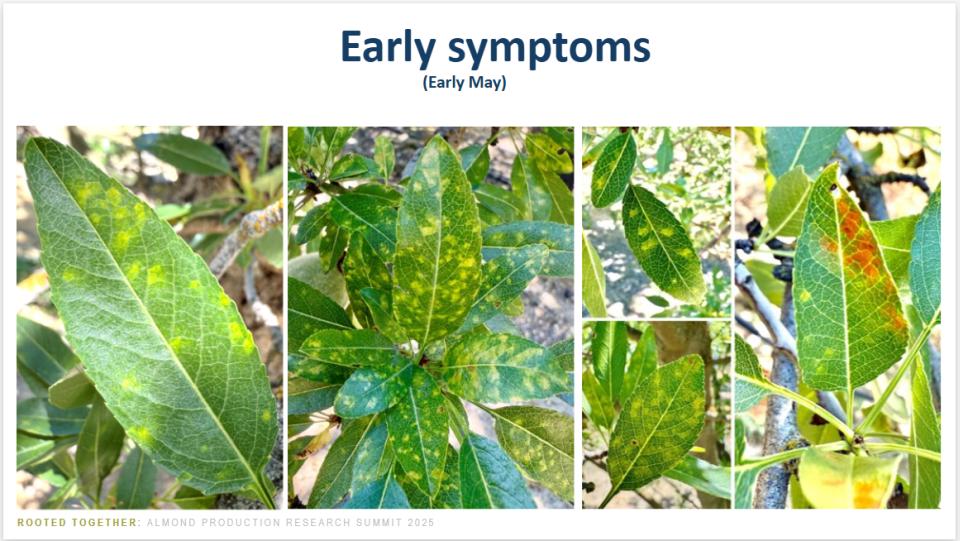
Credit: Alejandro Hernandez and Florent Trouillas.
As the disease progresses, the blotches grow larger (0.4 to 0.8 in) and turn yellow orange with a reddish-brown center (Fig. 2). At advanced stages of disease development, leaves become necrotic, curl, and drop prematurely. Premature defoliation of trees can occur, thus reducing carbohydrate accumulation going into the next growing season, which can decrease future yields.
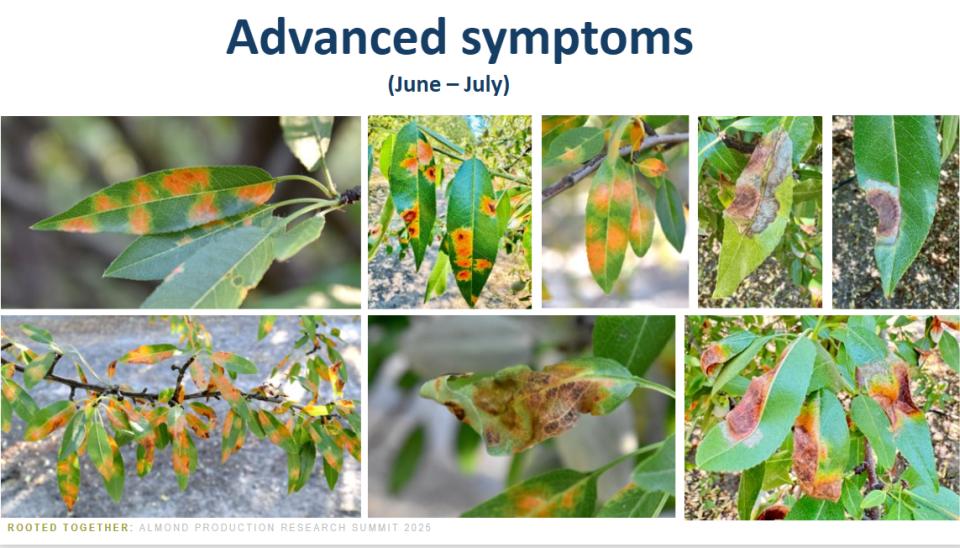
Credit: Alejandro Hernandez and Florent Trouillas.
The disease overwinters on fallen infected leaves from the previous growing season. Provided spring rains, infection occurs after petal fall when young leaves emerge. Infected leaves don’t show symptoms (i.e., remain latent) for 30 to 45 days before presenting in late-April through mid-May. The Trouillas Lab has recently determined that mixed fungicides (*FRAC groups 3+7; 3+11; 7+11; 7+12) and FRAC 3-triazoles are most effective at controlling red leaf blotch in almonds. Rotating between modes of action is critical to avoiding disease resistance and keeping these tools effective.
Research is continuing to determine the optimal number of fungicide applications, but at least two to three applications will be required between petal fall (early March), two to three weeks post petal fall (mid- to late March), and five to six weeks post petal fall (mid- to late April) for effective management. These timings overlap with management timings for shot hole, scab, and rust, and should be implemented as part of the orchard’s IPM program.
Fungicides applied during bloom and after symptoms are visible in late April to mid-May are NOT effective in managing RLB.
Cultural practices, focused on eliminating the primary inoculum of infected fallen leaves, can also help mitigate the disease. These consist of removing leaf litter or applying urea to accelerate its decomposition. It is also important to prevent the transport of infected leaf debris by cleaning equipment before it moves between fields. Cultural strategies are only effective when applied over a wide area, with neighbors working together in a regional effort.
If you suspect that you have this new disease in your almond orchard, please contact your local UC Cooperative Extension farm advisor.
Additional disease details and photos are provided by the Almond Board.
*Mention of a fungicide is not a pesticide recommendation. Merely the sharing of research results. Consult your PCA and the pesticide label. The label is law.
Subscribe Today For
