



Important Points To Know About Red Leaf Blotch of Almond
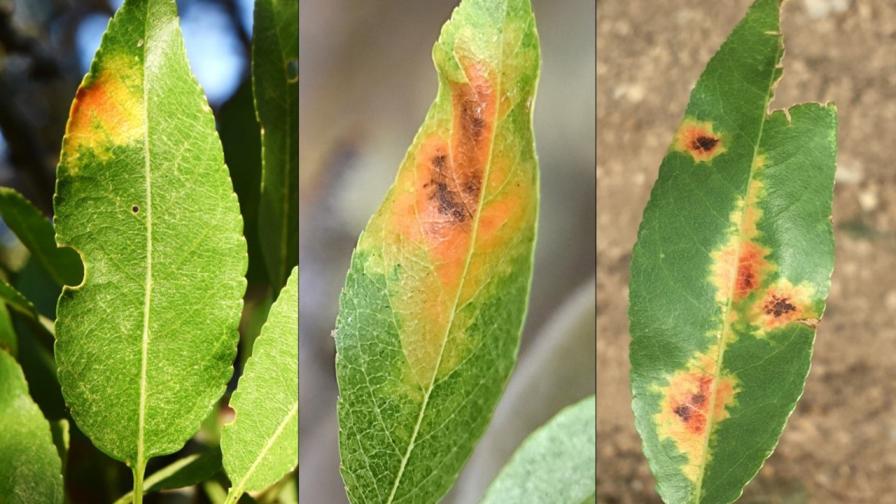
Symptoms of red leaf blotch of almond.
Photo courtesy of JH Biotech, Inc.
Red leaf blotch (RLB) of almond, caused by Polystigma amygdalinum, is a disease currently observed in the Mediterranean region, Spain, the Middle East, and California. In recent years, the incidence of this disease has been expanding, posing a significant impact on the almond industry.
As RLB is spread by the sexual generation of an ascomycete fungus, it is a monocyclic disease. If the humidity is high in autumn and winter, and the temperature remains above 20°C for an extended period, it will result in an increased spore load the following year. The initial infection period mainly occurs in spring and continues into summer, with airborne spores detectable from February to September.
The ascospores of P. amygdalinum are released on the surface of fallen leaves under moist and warm conditions, especially after continuous rainfall. These spores are spread by the wind and infect the young leaves on the tree. Higher temperatures lead to an increase in the number of inocula produced in the region.
Symptoms of the disease first appear as yellow spots on the leaves, which gradually turn orange and eventually reddish-brown as the disease progresses. The number of spots on the leaves indicates the quantity of inocula. Severe RLB can lead to leaf necrosis, curling, and defoliation, resulting in reduced photosynthesis and nutrient accumulation, which in turn leads to a decrease in yield.
Current research on management includes chemical and biological control. Chemical control studies have shown that fluopyram and trifloxystrobin, as well as their mixtures or a mixture of pyraclostrobin and boscalid, can achieve over 90% control efficacy. When applied 15 days after rainfall exceeding 15 mm and when temperatures are between 10 to 15°C, the efficacy is comparable to that of periodic applications (every two weeks, three weeks, or monthly after petal fall) but with fewer applications (two to four applications after rain, compared to five to nine periodic applications).
Biological control studies have found that applying two microorganisms, Myrothecium inundatum and Fusarium oxysporum, in combination with urea to RLB-affected almond fallen leaves showed that M. inundatum, especially when incorporated into the soil, significantly reduced inoculum, while F. oxysporum showed no effect.
From the research on red leaf blotch of almond, we understand that, since RLB is a monocyclic disease, its initial development rate is slower than polycyclic diseases, allowing early detection and prevention. As the inoculum originates from almond leaves, the management of fallen leaves becomes crucial. In Spain urea treatment of leaves is used to adjust the carbon-to-nitrogen ratio of the fallen leaves, promoting the rapid growth of decomposing microorganisms, which in turn quickly decomposes the fallen leaves and pathogens. Due to the dry conditions on the ground, which limit the growth rate of decomposing microorganisms, incorporating the leaves into the soil can maintain moisture, accelerate decomposition, and reduce the release of inoculum into the air.
Using a plant residue decomposer can effectively break down fallen almond leaves. The carbon-to-nitrogen ratio of almond leaves is about 40, so one to two pounds of urea are needed for every 400 pounds of leaves. Plant residue decomposers have the ability to rapidly decompose fallen leaves and twigs. It should contain cellulase, protease, and microorganisms capable of producing cellulase, hemicellulase, and protease. This can quickly break down leaves and branches while releasing nutrients, including various minerals, vitamins, and amino acids, back into the soil for absorption by the almond roots. During the decomposition of the leaves, the pathogens on the leaves are also decomposed. The microbial agent should be applied at a rate of one to two pounds per acre, with a microbial count reaching 109 CFU per gram, and mix with five to 10 pounds of urea dissolved in water, sprayed on the fallen leaves, and then incorporated into the soil. This treatment only needs to be applied once annually during leaf management.
Phosphite-based products may induce resistance and enhance the immunity of almond trees, serving as another key preventative measure. Although there are no reports that phosphite-based products can control RLB, almond trees in the same environmental conditions are also susceptible to other fungal diseases, such as anthracnose, downy mildew, powdery mildew, and rust. Phosphite can stimulate the production of salicylic acid, jasmonic acid, and ethylene in plants, further promoting the generation of PR proteins. These proteins are systemically produced in various parts of the plant to resist pathogen attacks. Phosphite-based products, with a phosphorus pentoxide content ranging between 250 to 300 grams per liter, may be applied at a rate of one to three quarts per acre and sprayed on the leaves of almond trees.
Plant residue decomposers and phosphite-based products may be used as preventive measures to protect almond trees from various fungal diseases. These measures reduce the incidence of fungal diseases and protect almond trees from disease-related yield reductions and form an integral part of integrated crop management.
Subscribe Today For
