



What To Do When Fruit Harvest Bins Become Codling Moth Havens
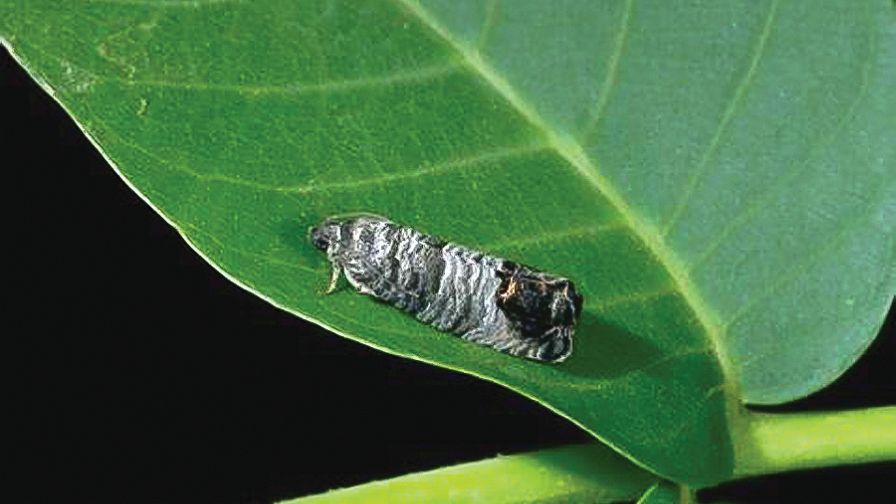
Codling moth can look benign, above, but do serious damage. (Photo: UC Statewide IPM Project)
While harvest bins, especially wooden ones, serve as prime overwintering sites for codling moths, several factors could affect larvae’s ability to establish populations and become a problem for fruit growers.
Codling moths are a major nuisance because their larvae tunnel into apples, pears, and walnuts, feeding on the core and seeds, making fruit unmarketable and causing severe economic losses.
Why Harvest Bins Matter
As part of a recent Washington State University College of Agricultural, Human, and Natural Resource Sciences Webinar, Bradley Higbee shared his experiences investigating the effect harvest bins have on codling moth populations. Higbee is the field R&D Manager for Trécé Inc., a biotechnology company specializing in insect pheromone and kairomone products. However, during the 1990s, Higbee played a pivotal role in the Area-Wide Codling Moth Project, a landmark initiative that transitioned mating disruption from an experimental concept to a mainstream industry standard. Investigating the link between bins and moth populations was an aspect of that project.
“At the time, nobody really knew the extent or the impact of these harvest bins on introducing codling moth into an orchard,” he says.
Higbee’s studies revealed a stark contrast between harvest bin materials, noting a nearly 98% reduction in moths emerging from plastic bins compared with wooden ones. And while larvae preferred the ease of burrowing into natural wood material, they could occasionally form their cocoons — or hibernacula — by making small indentations into synthetic material.
“If you’re going to have wood bins, and they’re coming from a packer, and you don’t know the history of where they’ve been, then it would be worth your while to keep an eye on them,” Higbee says.
Additionally, there was no significant difference in the number of codling moths emerging from bins that were full of fruit versus those that were empty during harvest, Higbee says. This suggests that larvae move into the bins’ wood very quickly, regardless of how long the fruit has been present.
RELATED CONTENT: Unique Way To Keep Codling Moth at Bay
Bin Storage Shapes Moth Emergence
Using temperature monitors, Higbee says the study showed that the way the bins were stacked and stored significantly impacted when the moths emerged in the spring. In stacked bins, the top levels are the warmest, and the bottom levels are the coolest, he explains. Because the center and bottom of a bin stack stay cooler, the moths inside them emerge much later than the “field” population.
“While the first field peak might occur in May, emergence from uncovered bin stacks can continue well into June,” Higbee says. “Could we cover these with plastic [to impact temperature], and what effect would that have on these emerging moths?”
Covering bin stacks with clear plastic increases internal temperatures, causing moths to emerge a week to a month earlier than those in uncovered stacks, aligning their emergence more closely with the natural field population, Higbee says.
Monitoring for Early Warning Signs
To best manage codling moths emerging from bin piles, Higbee says monitoring remains the most straightforward approach for growers.
“Every group of bins is not necessarily a problem,” he says. “If there was very little or no damage in an orchard that those bins were used in the year prior, then you may not have much of a threat. But you don’t know until you do some monitoring.”
Higbee suggests placing traps along the edges of the orchard near bin stacks, as well as in the interior of the orchard for comparison. If the edge traps reveal high counts, then the bins are most likely the source of infestation. If monitoring confirms a codling moth population in the bins, Higbee recommends one or two additional insecticide cover sprays on the trees immediately adjacent to and surrounding the bin stacks.
“If you have wooden harvest bins coming in then I recommend doing some monitoring to establish whether you have moths coming off that stack of bins,” he says. “And if you do, you may need to do a little extra insecticide treating in the general vicinity of this storage pile.”
CLICK HERE to access the complete webinar and learn more about codling moth management.
Subscribe Today For
