


Smart Tech
Why This Grape Grower Is Going All in on Smart Technology
 September 29, 2026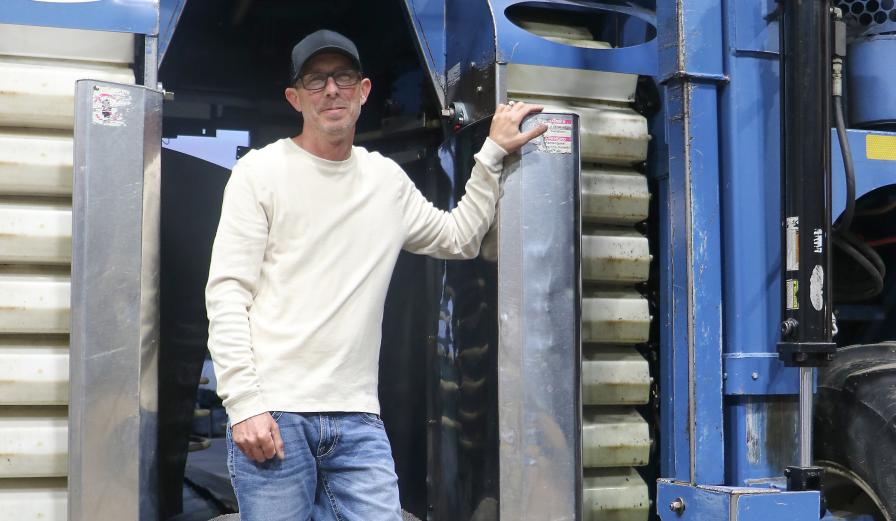
Steve Holden of Holden Farms in Paw Paw, MI, is a believer in autonomy and smart technology to grow ahead.
Photo: Thomas Skernivitz
Steve Holden still remembers the concrete barriers. It was 2014, and Holden had traveled from Michigan to California with his uncle to attend World Ag Expo for the first time. Among the equipment demonstrations was something Holden had never seen before: an autonomous tractor.

The machine drove around a demonstration area surrounded by concrete barriers, a precaution that seemed appropriate for technology that was still foreign to most growers.
“You could just tell that everybody was nervous,” Holden says. “I was so amazed. And from that day, it’s always been something that I was really interested in.”
More than a decade later, autonomous tractors have advanced well beyond circling behind concrete barriers. They can spray, mow, and perform other field operations, and Holden has followed their development closely, returning several times to World Ag Expo to see their progress.
What he would like to see now is more of that progress taking place closer to home.
Holden, a fourth-generation grape grower and owner of Holden Farms in Paw Paw, MI, believes the state could provide an ideal proving ground for autonomous machinery and other agricultural technology.
“I think technology, automation, and better use of information are going to become increasingly important, and growers who don’t adapt are going to have a difficult time remaining competitive,” Holden says. “What I’d really like to see is Michigan become a bigger part of that development.”
STARTING OVER
Holden’s enthusiasm for technology is rooted in a career that has required plenty of adaptation of its own.
He learned farming from two uncles who operated the family farm after his grandmother took over following the early death of his grandfather. Holden eventually worked for one of those uncles, Bill Mihelich, and the two were developing a plan that would allow Holden to take over the operation when his uncle retired.
Together, they planted 14 acres of hops and established a processing facility. His uncle lived to see their first hop harvest in 2014. Then, during grape harvest that fall, Mihelich died unexpectedly of a heart attack.
The succession plan had not been completed. Holden finished the grape and grain harvests and initially believed the farm would continue operating under his uncle’s stepchildren.
Then he arrived for work one day and found the doors locked.
“I didn’t get any equipment. I didn’t get any land,” Holden says. “I didn’t get anything. I had to buy everything. Everything I own, I bought. I started from zero.”
Holden secured a government loan and began rebuilding. He bought his grandmother’s farm in 2015. Six years later, he purchased the farm his uncle had owned — the same place where Holden had once reported to work every day.
Today he farms about 125 acres of grapes, including leased acreage. His grandmother’s farm has 16 acres of hybrid wine grapes and approximately 36 acres of Concord juice grapes, while his uncle’s former farm has another 20 acres of Concords.
The operation was once larger. Holden farmed more than 200 acres as recently as last year before beginning to downsize.
EFFICIENCY BECOMES ESSENTIAL
The contraction comes as grape growers face a much more difficult marketplace.
Holden says business was strong during the COVID-19 pandemic and several years afterward. More recently, grape markets have weakened while growers continue contending with high labor and input costs.
Those economics make technology less of a luxury, in Holden’s view, and more of a tool for survival.
“If you’re not doing it efficiently in today’s ag world, you’re going to really, really struggle,” he says.
Holden participated in the H-2A guestworker program for two years and calls it a good program. But as grape economics deteriorated, he could no longer justify the expense. He now relies on local labor while replacing hand work with mechanization where possible.
Precision technology is already part of that effort. Holden uses Ag Leader equipment for spraying, including rate control and mapping to track vineyard rows and avoid unnecessary applications. Mechanical trimming replaces hand trimming, and autosteer is used on much of his equipment.
Autonomy, he believes, is the next step. When Holden was farming more than 200 acres and spending $80,000 to $90,000 annually on labor, he says even a $200,000 to $300,000 autonomous machine could potentially make sense if it substantially reduced that expense.
A MICHIGAN TEST
The challenge is not convincing Holden that autonomous equipment has potential. It is making sure the equipment can perform under Michigan conditions.
Specialty crop technology is frequently developed and initially deployed in western agriculture, where larger operations can make the economics easier to justify. But Holden sees Michigan’s smaller scale as an opportunity rather than a disqualifier.
“There’s apples. There’s everything that they have in California in Michigan,” he says. “It’s here. It’s just on a little smaller scale.”
The operating conditions can be considerably different.
Some older Michigan vineyards were planted using horses, Holden notes, meaning rows may not be perfectly straight. Tree lines can interfere with GPS signals. Michigan’s wetter climate creates different field conditions and greater disease pressure. Holden says his grapes may receive nine or 10 sprays in a season.
Then there is service. A sophisticated autonomous machine is not much of a help if a grower cannot get it running during a critical production window.
“The challenge I see isn’t the technology itself — it’s getting enough testing, infrastructure, and service support into areas like Michigan, so growers here can confidently adopt it,” Holden says.
His solution is straightforward: Bring the technology to Michigan earlier in the development process.
“They should come to Michigan to test their stuff,” he says, “because then it will definitely work in California.”
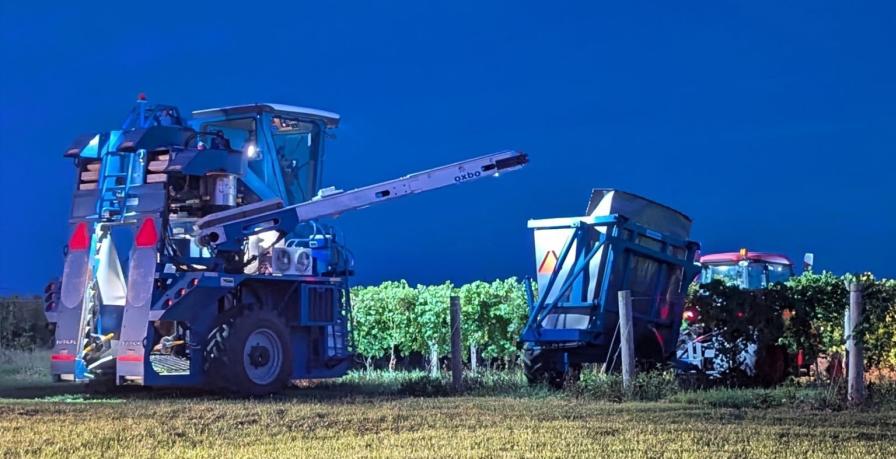
Nighttime wine grape harvest at Holden Farms.
Photo: Lauryn Holden
FROM GROWER TO INNOVATOR
Holden has done more than watch autonomous equipment from afar.
He once put down $1,000 toward an autonomous electric tracked tractor, with plans for the manufacturer to demonstrate the machine on his farm before he decided whether to complete the purchase. The company subsequently went bankrupt.
He remains interested in autonomy, although downsizing his acreage makes purchasing an expensive autonomous tractor harder to justify today.
Instead, Holden increasingly sees an opportunity on the development side.
One problem particularly interests him. Autonomous tractors can perform numerous vineyard operations, but mechanical grape harvest presents a complication. The tractor and grape harvester travel alongside one another and must remain synchronized. If growers still need conventional tractors for harvest, the economics of investing in a separate autonomous fleet becomes less compelling.
Holden has ideas about solving problems such as that, but he is not ready to reveal much about them. He is also developing an app whose details he is keeping private.
Downsizing the farm, he says, should give him more time to explore those ideas and apply his viticulture experience to agricultural technology.
It is another turn in a career that has already taken several unexpected ones.
Holden once went to California because his uncle told him to pack a bag. He returned fascinated by a tractor that could drive itself.
Now he would like growers in Michigan to have fewer reasons to travel West to see what comes next.
“I think we’re going to need a lot more of it,” Holden says of agricultural technology, “and I’d like to see Michigan agriculture have a bigger role in where that technology goes next.”

For more Smart Tech topics, click here.
Subscribe Today For
