



Ground Truthing When It Comes To Aerial Images
 August 1, 2007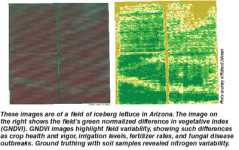
Growers have achieved such great results utilizing aerial images of their fields, as well as other elements of precision agriculture, that it’s easy to forget one of the fundamental truisms of agriculture: There’s no better fertilizer than the farmer’s shadow. Just ask Richard Johnson, national accounts manager for John Deere Agri Services up in the Great Northwest. While he’s heavily involved in precision agriculture, Johnson cautioned vegetable growers at the recent InfoAG Northwest Conference in Kennewick, WA, not to forget “ground truthing.”
With all the tools available to growers today, such as variable-rate application and auto-steering, it’s easy to lose focus on the basic agronomics those tools support, said Johnson. “Just because you can get an image doesn’t mean you can do desktop farming,” he said. “You still have to get your boots dirty.”
Johnson doesn’t foresee a day anytime soon when field scouting becomes obsolete. Precision agriculture doesn’t replace field scouting, it just makes it a lot more convenient and efficient. “It used to be you had to walk around, hoping you’d find something,” he said. “Now you’re not guessing. It’s like putting a scope on a rifle.”
Getting A Picture
Deere calls its “scope,” or one key tool to target crop variability, the OptiGro system. The way it works is that the grower consults with his agronomic adviser to determine what aerial images are needed. It could be just a single shot, said Johnson, but usually, to get an accurate picture of what’s going on, a series of images are taken during critical times in the growth cycle. The agronomist then places the order online, and John Deere Agri Services develops a flight plan, which is then e-mailed to the pilot.
The fields in question are “georeferenced,” meaning that the coordinates are recorded with Global Positioning System (GPS) technology. This allows for focused field scouting. It also allows the pilot to take accurate images, said Johnson. “The camera automatically takes the imagery when the pilot goes over the field,” he said. “He also overlaps by one-third on each pass to make sure we can maintain the integrity of the image.”
The pilot then downloads the image to one of the company’s four operating centers to be processed. “It allows for quick turnaround time,” says Johnson.
Easy Reading
The images are processed and then made available to the agronomic adviser. With a focus on image quality, the farm adviser can reject the image if there are clouds obscuring the image or if there’s another factor that skews the results, such as an irrigation pivot being left on. If the adviser accepts the image, he gets not only the color image, but a color infrared image and one showing the field’s green normalized difference in vegetative index (GNDVI), as well. GNDVI images highlight field variability, showing such differences as crop health and vigor, irrigation levels, fertilizer rates, and fungal disease outbreaks.
The grower’s adviser then takes the zone prescription maps that are generated, grabs a personal digital assistant (PDA), and heads out to the field in question to see what is accounting for the variability. The adviser generally takes soil and tissue samples in the area in question, and the grower then gets a good picture of precisely what is going on. “Then you close the loop,” said Johnson, “by applying fertilizers, pesticides — whatever’s needed.”
One nice thing about the OptiGro system, says Johnson, is that the zone prescription maps can be used for any material or machine. In other words, if a variable rate applicator is used, it doesn’t have to be a Deere unit. It could be a unit from Raven, Ag Chem, or other companies, he said. Also, another advantage is that the images that are generated can be easily understood by pretty much anyone with some agronomic experience, said Johnson. “You don’t need a whiz-bang computer guy to help you,” he said. “It’s in a very usable, readable form, and the growers really appreciate that. And they appreciate the turnkey approach, from image acquisition to field execution.”
Subscribe Today For
