



High-Flying Crop Protection
 November 18, 2011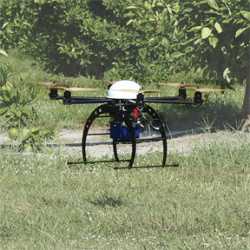
When you hear about unmanned aircraft, you likely think of the Predator Drones that have been used extensively in the war against terrorism or those flown by hobbyists. But, remotely controlled aircraft are finding many applications including those in agriculture.
Rheza Ehsani, an associate professor of agricultural and biological engineering with UF/IFAS, is developing mini helicopters with his colleagues at the Citrus Research and Education Center in Lake Alfred. The goal of this research is making the “crop copter” available so growers can monitor their crop from above for pest and disease pressure, monitoring tree inventories, and irrigation operations. It could have particular usefulness in helping growers identify trees infected with HLB.
“My group at the University of Florida was the first one in the nation that used this platform for applications in precision agriculture/horticulture,” says Ehsani. “The major advantages of this system include high spatial and temporal resolution, ease-of-use, and low cost. Since the system is fully automated and very easy to operate, people can learn to fly this copter with one day of training. This system could potentially change the way we monitor crops and can be an excellent tool for a wide variety of field sizes and different crops including fruit and vegetable producers, as well as other specialty crop producers.”
Other features include its fully automated GPS waypoints navigation capabilities. It can store the flight paths and can fly to the same points in the field over time, which is very important for temporal data collections. The platform can maintain the flight altitude automatically, which Ehsani says is an important future for collecting useful data.
Ehsani and his team have submitted a proposal to the Citrus Research and Development Foundation in hopes of securing funds for further study of how this application might be used to monitor groves for HLB.
AutoCopter Flies Into Ag Markets
“We started in the Cell Tower Inspection area and were guided into the precision agriculture market,” says Donald Effren, the president of the company. “Our Industrial strength UAV, remote controlled helicopter with GPS enabled autopilot software and HD video and multi-spectral camera can provide the replacement of satellite images or expensive airplane fly overs.”
The technology can provide growers with targeted maps daily, weekly, or the interval of choice. Flight missions can be saved and the copter can re-fly the exact GPS route to track variations in the crop.