



Trial Uses Sheep In Vineyard As Wooly Weed Eaters
 August 1, 2007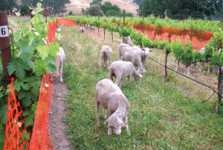
Ask organic growers — particularly those who are making the transition from conventional fruit growing — what their chief problem is, and many will tell you of their weed woes. If only there were a truly effective, reasonably priced, organic herbicide to get rid of those pesky weeds. University of California (UC) researchers believe they may have found the solution. Only it’s not an herbicide, precisely, but an herbivore.
Morgan Doran, a UC Cooperative Extension livestock adviser in Solano, Yolo, and Napa counties, is leading a project to train sheep to clear winegrape vineyards of weeds. It’s certainly not a new concept. After all, it’s not as if sheep don’t like to eat. In fact, some winegrape growers have been using sheep to do just that for years. But in the past, most growers could only introduce the sheep when the vines were dormant. Otherwise, the sheep would dine on the vines themselves, defeating the purpose.
So Doran consulted an animal behaviorist, Fred Provenza of Utah State University, and came up with a plan. The UC researchers allowed the sheep to gorge on grape leaves. Once the sheep had their fill, the researchers administered a small amount of lithium chloride, which, while harmless, induces stomach discomfort. “The sheep don’t get sick, exactly, they just experience a brief period of malaise,” says Doran. “They recover quickly, but they had a very strong aversion (to grape leaves) even nine months later.”
Selective Grazing
In a field trial, the researchers brought sheep, both trained and untrained, into a Hopland vineyard and let them go to work. The 10- to 12-inch shoots on vines exposed to the untrained sheep quickly disappeared. In the part of the vineyard exposed to the trained sheep, the vines were undisturbed, says Doran. “We will follow (the trained sheep) to make sure the aversion persists,” he says, adding that they are seeking funding to look at the ramifications of long-term grazing.
A herd of sheep doesn’t have the same impact as do a few tractors, and points up another benefit to the use of sheep to clear vineyards. A couple years ago growers were faced with an unusually wet spring, and couldn’t get equipment into their vineyards. “The sheep would give them another tool to use when they can’t get into their vineyards,” he says.
Doran doesn’t know what the potential costs of the sheep would be, but based on talking with growers and sheep herd managers, he estimates that it would be in the neighborhood of $100 an acre for “high-density grazing,” or placing 100 to 200 sheep on about 5 acres for a few days. High-density grazing is preferred, because if there are just a few sheep, the animals will only select the more tender, tasty weeds. There needs to be a little competition to achieve optimum clearing. “It’s like a big family of kids,” says Doran. “Whether or not they like it, they’ll eat it.”
Commercial Application
Lithium chloride is not yet registered for this use, so commercial application is still a way’s off. Doran would also like to look at the use of other potential chemicals. He thinks that tannic acids, which are used by vintners in making wine, might work well. There are also other avenues to explore, such as the impacts on soil fertility, vine health, and grape quality. In addition, he’d like to see if the sheep are feasible on a very large vineyard. And, of course, whenever livestock are involved these days, the potential presence of E. coli must be considered.
Doran expects organic growers will be the most interested in the research. In fact, some are already getting into the act by using Babydoll Southdown sheep, which are so short that they can’t reach the vines’ leaves. While effective, the breed will not provide a long-term answer, says Doran. “The problem is that they are rare and expensive,” he says. “If growers wanted to use them, they’d have to get in line.”
Subscribe Today For
