



Discovering New Vegetable Diseases Always a Work in Progress
 November 3, 2025
 “New” is not a word you want to see associated with “vegetable disease concerns.” However, growers, production advisors, and other field professionals are periodically faced with new and unfamiliar diseases. Researchers have an established protocol for proving that a problem is indeed a new one. This universally accepted set of procedures is followed by any scientist working with disease issues, which includes diseases of crops, commercially raised animals, and wildlife. In fact, in August 2025, marine biologists achieved an outstanding scientific milestone by using these pathology principles to document the cause of sea star wasting disease (SSWD), which is now known to be caused by the bacterium Vibrio pectenicida.
Beginning in the 1970s, this mysterious SSWD killed huge numbers of sea stars (“starfish”). Periodic plagues have occurred in waters off the US east coast, Gulf of California, and west coast. The current outbreak on North America’s west coast has been going on since 2013. Over this 12-year period, more than 20 sea star species have been affected. Estimated losses put the death toll at more than 5 billion animals. Losing these populations is an ecological disaster; as one example, loss of these predaceous sea stars caused sea urchin numbers to explode, with the resulting destruction of kelp forests, the sea urchin’s favorite food. If we examine the pathology procedures used by marine scientists for SSWD, we are reminded of how plant pathologists prove there’s a new disease on your vegetable crop.
Symptoms. Details of a possible new disease first have to be observed and documented.
SSWD: Marine scientists noticed increasing numbers of sick and dying sea stars. Symptoms were described: lack of animal moment and feeding activity, lesions forming on the sea star body, arms twisting and falling off, eventual disintegration of the body. Distribution maps were created to show where disease outbreaks were located, and which species were affected.
Vegetable crops: Likewise, plant pathologists first have to notice that a new problem may be developing. When Verticillium wilt first occurred in California lettuce, researchers saw a distinct, never before seen, internal blackening of the tissues. Such plants had good root systems but still were dying by the time the lettuce should be harvested. Previously documented lettuce diseases did not cause this combination of symptoms. The apparently new problem was first seen in a single field; however, researchers later found the same symptoms on other lettuce plantings in the region.
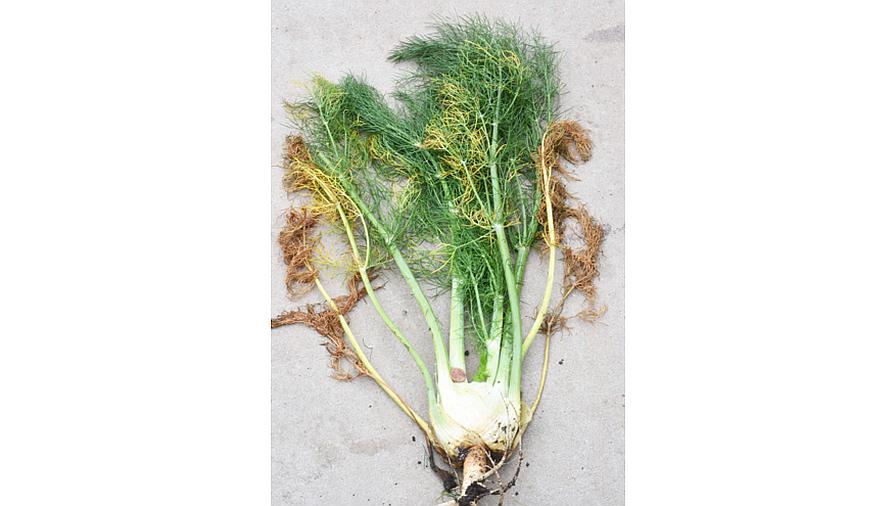
To document a new disease on a crop, such as Verticillium wilt of fennel, a standard set of research procedures must be completed.
Photo by Steven T. Koike, Tri-Cal Diagnostics
Suspect pathogen. Pathologists look for, recover, purify, and identify possible pathogenic agents.
SSWD: Researchers collected dying sea stars and intensely studied them by tissue examination with microscopes, dissections, and analysis of samples to find possible microorganisms. Once the suspicious bacterium was isolated and purified, other steps (lab testing, gene sequencing) were taken to characterize and give the Vibrio name to the bacterium.
Vegetable crops: Plant pathologists invest lots of lab time trying to find suspect organisms that might be causing new problems. Various techniques are used to extract and grow out fungi, bacteria, and other possible agents. Damage caused by Stemphylium leaf spot of spinach was first thought to be related to chemical spray injury until the Stemphylium fungus was extracted from numerous leaves. It took the use of a special agar medium to find the Phytophthora pathogen that was rotting shallot bulbs and roots. Fennel crops, which are subject to relatively few problems, began to show symptoms of decline; sterile lab isolations surprisingly found Verticillium deep within the plant tissues. For all these cases, finding the organism is just the beginning. The suspect pathogen has to be purified, then studied using microscope examinations, morphological characterizations, and molecular sequencing in order to give a name to the recovered entity.
Proving pathogenicity. Finding a suspect microbe is not enough; one has to prove that the organism will cause disease in the host by following the established protocol (called Koch’s Postulates).
SSWD: The great breakthrough occurred when the marine biology team took the purified Vibrio bacterium, injected it into healthy sea stars, and within a few weeks saw the telltale symptoms of SSWD. The team subsequently isolated bacteria from the now sick sea stars, characterized the recovered bacteria, and found the post-inoculation Vibrio to be identical to the pre-inoculation Vibrio. This “exposure experiment” conclusively proved that Vibrio causes SSWD.
Vegetable crops: To prove we have a new disease on a vegetable crop, researchers also must fulfill the Koch’s postulates protocol. For Stemphylium leaf spot of spinach, we grew a purified culture of the fungus, sprayed thousands of spores onto greenhouse grown spinach, saw leaf spot disease, and finally isolated a Stemphylium fungus that was identical to the original isolate. For Verticillium wilt on fennel, we soaked healthy fennel transplant roots in a spore solution of the fungus, replanted the fennel, and waited for something to happen. A month later the fennel started to wilt and then decline. Lab isolations recovered Verticillium that matched the pre-inoculation Verticillium. This proof of pathogenicity is a mandatory step in documenting new diseases that occur on our crops.
Research teamwork. Discovering and documenting new diseases requires the work of research teams.
SSWD: In this successful study, an international team of talented researchers collaborated to achieve this ground-breaking result. Each member brought their particular expertise to the group, resulting in an integrated team effort to solve this decades-old dilemma.
Vegetable crops: Each research group is different. In my own experience, I can enthusiastically attest to the necessity and value of collaborative research teams. I’ve had the pleasure of working with outstanding researchers from diverse universities, state and federal agencies, and industry. Such collaborations rely on dedicated support personnel and technicians. Only through such highly qualified teams are we able to address new diseases and new challenges that our growers encounter.
Subscribe Today For
