


The Right Combination Can Limit Shoot Blight in Tree Fruit
 February 20, 2025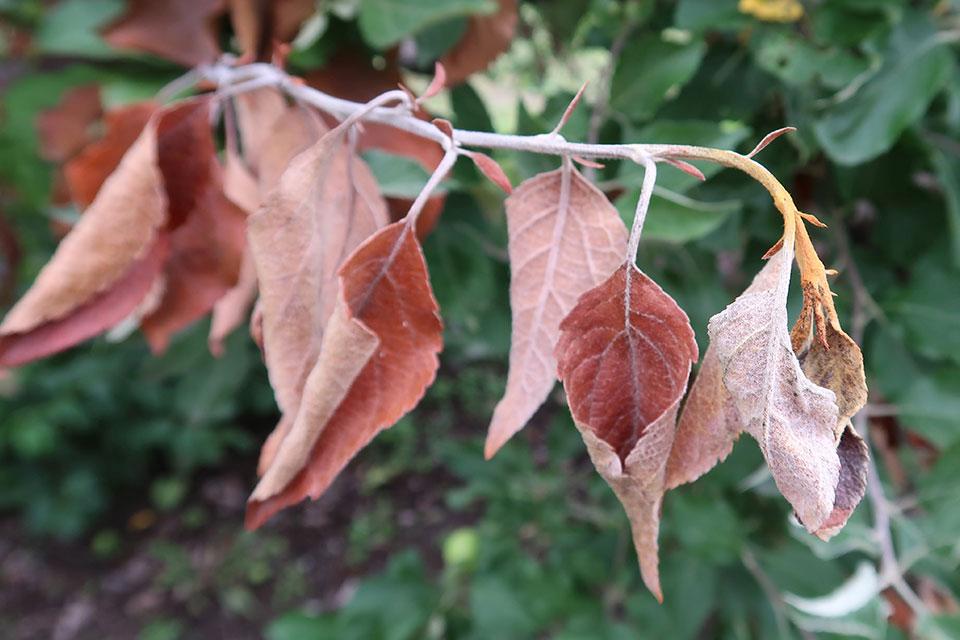
Scouting shoot blight. Here, Erwinia amylovora bacteria infects apple tree shoot.
Photo by George Sundin, Michigan State University
A combination of Apogee at 2 oz. and Actigard at 1 oz. in 100 gallons per acre continues to exhibit the most potential in the management of shoot blight, according to Michigan State University tree fruit disease specialist George Sundin.
Promise can also be expected of Actigard alone at 2 oz., Sundin said during a fire blight plant defense webinar hosted by Washington State University Extension.
“We’re looking at the combo as kind of a marriage of two compounds that we can tell genetically works synergistically to promote plant defense and to get plant efficacy against fire blight with a minimum impact on the tree in terms of growth and yield,” Sundin said.
While control of initial infection is never an absolute, the effect of pathogen population reduction and limiting internal spreading does provide the opportunity for pruning removal of infected limbs, the Professor and Extension specialist said.
Apple growers who choose to ignore the capabilities of the plant growth regulators will be in jeopardy of suffering significant tree loss to fire blight, he added.
“There is tremendous risk every year,” particularly for growers in the highly humid climates of the Midwest and eastern U.S., Sundin said. “My belief is that active shoot blight management —especially applying these programs that are conditioning your tree for reduction of infection, reduction of systemic movement — is essential to orchard maintenance.
“We have to condition the tree. We have to do it every year. Even though we can predict epidemics of fire blight, we can’t really predict outbreaks on your farm, and even small outbreaks could cost you 200, 300 trees very easily and could spread into much worse than that.”
High-density systems, while bountiful, only heighten the risk of fire blight, especially in young trees (years one through six) and trees with high-vigor shoots.
“Our high-density plantings are excellent for yield; they’re great for everything we want to do in terms of maximizing potential,” Sundin said. “But these trees, especially during the first six years, are very highly susceptible to infection and systemic spread of the fire blight pathogen (Erwinia amylovora) that can result in tree death very rapidly.”
Unfortunately, most of the popular cultivars these days — ‘Gala’, ‘Fuji’, ‘Evercrisp’ — are also highly susceptible, Sundin said. “We did observe differences in cultivar susceptibility, with ‘Honeycrisp’ being the least susceptible … but it still can get fire blight, especially if you have rows of ‘Honeycrisp’ next to rows of ‘Gala’ that have shoot blight already,” he said.
PGR EFFECTIVENESS
Acibenzolar-S-methyl (Actigard, Syngenta) and prohexadione calcium (Apogee, Bayer; Kudos, Fine Americas) are PGRs that have proven to reduce the incidence and severity of shoot blight infection and, at low rates, can do so without negatively impacting growth and other horticultural parameters.
Acibenzolar-S-methyl, or ASM, activates the systemic acquired resistance (SAR) in a plant. In turn, if a pathogen challenges a plant on one of its leaves, the plant recognizes that it is being attacked by the pathogen. “It turns on a defense response that systemically moves through the plant … and tells the other potential sites of infection to turn on defense: ‘There’s a pathogen around. We have to stop this thing before it causes a lot of problems,’” Sundin said.
While the PGR does shift the plant from growth mode to defense mode, apple systems — with fewer treatments, at lower rates — do not need as much time to switch back to growth. PGRs have a more significant impact on the yield of a system such as tomato, which is treated up to 12 times a season, at higher rates, Sundin said.
“If we get the defense response turned on before the Erwinia pathogen arrives at the shoot tip, that’s when we get protection. If the response is turned on after arrival, then the tissue is not going to be protected,” he said. “If you saw an outbreak of shoot blight in your orchard, and then you went and sprayed Actigard, it would only protect uninfected shoots, not the ones that are infected.”
Prohexadione calcium, meanwhile, widens the walls of a plant’s cells, conditioning the tree to create a physical barrier that prevents infection. This “Apogee effect” on shoot blight control becomes apparent approximately 10 to 14 days after application.
SCRI GRANT UPDATES
Sundin and his team’s ongoing $5.2 million four-year multistate SCRI fire blight grant — “Comprehensive Fire Blight Management for the United States” — involves five treatments applied at seven-day intervals: Actigard alone (1 oz. and 2 oz.), Apogee or Kudos alone (2 oz.), Actigard (1 oz.) plus Apogee (2 oz.), and Actigard (drench). Cultivars vary among ‘Gala’, ‘Evercrisp’, ‘Honeycrisp’, ‘Pink Lady’, ‘Fuji’, and ‘WA 38’. Shoot blight incidence (or infection) and systemic spread (or severity) are the main parameters.
- New York (Kerik Cox, Cornell University): In 2023 and ’24, all treatments were effective against incidence during similar cool, dry seasons. “These are ideal seasons for fire blight in terms of management because the fire blight bacterium does not do well in cooler conditions — 50-, 60-degree weather. Typically, when the infection pressure is low, everything works about the same.” However, epidemic conditions had occurred in 2022. “In this case, it potentially exposed a weakness of these programs in terms of reducing incidence of infection,” Sundin said. “But even if infection does occur, it still gives you the potential to get those shoots pruned out before there is too much spread (severity) happening.”
- Michigan (Nikki Rothwell, Sundin, Michigan State University): Sprays of Apogee 2 oz. plus Actigard 1 oz. were put on ‘Gala’ 13 days and six days before inoculation and two days after. “When we look at the treated, we’re not observing much of anything in terms of Erwinia through two weeks after infection, especially at the junction between the end of the woody growth of last year and the beginning of the shoot from this year,” Sundin said. “This treatment really arrested the ability of Erwinia to move systemically. Whereas in untreated, we’re seeing that rise in population.”
- North Carolina (Sara Villani, North Carolina State University): In 2024, all programs reduced incidence and severity in ‘Gala’. Apogee 2 oz. fared best in reducing incidence. Incidence on ‘Fuji’ was higher in 2024 but spread was reduced. In ‘Evercrisp’, there was no difference from control, Sundin said.
- Washington (Tianna Dupont, Washington State University): Similar amounts of control have been observed for most of the treatments, Sundin said. “The difference is the combination of ASM plus Prohexadione — the 2 plus 1 — gives us that synergy. We haven’t tested these under all possible conditions, but it is our feeling that the combination gives us the best bet in terms of management for conditions that we haven’t assayed yet,” Sundin said.
Subscribe Today For
