



How This Plant Pathologist Picks Research Projects
 September 26, 2025
 Participants in tours I’ve led or attendees at field days sometimes ask how I pick research projects. With the renewed focus on what types of research the federal government should fund, here are the six criteria I’ve used during my 40-year career in plant science. The criteria are roughly arranged from more to less important.
Need. Is there a critical reason to do research for my state, region or country? My M.S. advisor at Cornell University said, if the New York State budget was funding your graduate assistantship, which it did back in the 1980s, then you had a responsibility to work on a disease that was a problem in the state. So, I studied Verticillium wilt of alfalfa, a new disease in the state and the U.S. at that time.
I stuck with this guideline for the rest of my career. Many of the topics I’ve covered in previous columns are vegetable diseases South Carolina growers have specifically asked for help on, like Fusarium wilt of watermelon, black spot on kale, and green fruit anthracnose on pepper.
Funding. Research requires money to pay assistants and purchase supplies. To get a “decent” amount of funding from a large grant usually requires finding cooperators in other states, other disciplines or both. Ideally, this team approach improves the quality of the research, because “two heads are better than one.” Instead of competing on separate projects, scientists cooperate on one. On the other hand, I have sometimes joined a project that is not critically important to “my” growers just to get a grant, my most important job duty nowadays.
Probability of Success: There’s not enough time to test every idea. I avoid studies for which there is good evidence showing they probably won’t yield useful results. This step is the start of the scientific process, coming up with a realistic, logical hypothesis of what you expect to happen. Another of my job duties is generating publishable data, which most often means showing what works, not what doesn’t work.
Feasibility: The off-campus research station where I am located has excellent field facilities, one reason that I do applied research.
Does the target pathogen occur naturally? If it does, it makes life much easier for a pathologist. I’ve recently started a project on white mold (Sclerotinia) on kale (another concern of growers), because I now have an infested field at the station where disease will develop on its own, instead of me using rather artificial techniques to start it.
Powdery and downy mildews will not grow in petri dishes; these pathogens must be kept on living plants year-round in the lab or a growth chamber. To eliminate that extra step, I only do field experiments with these diseases and plant crops when I expect airborne spores to arrive.
On the other hand, I don’t work on Phytophthora blight in the field, because this water mold is so persistent it would compromise other studies at the station on susceptible crops — mine and my colleagues’. I only work with this “beast” in the lab.
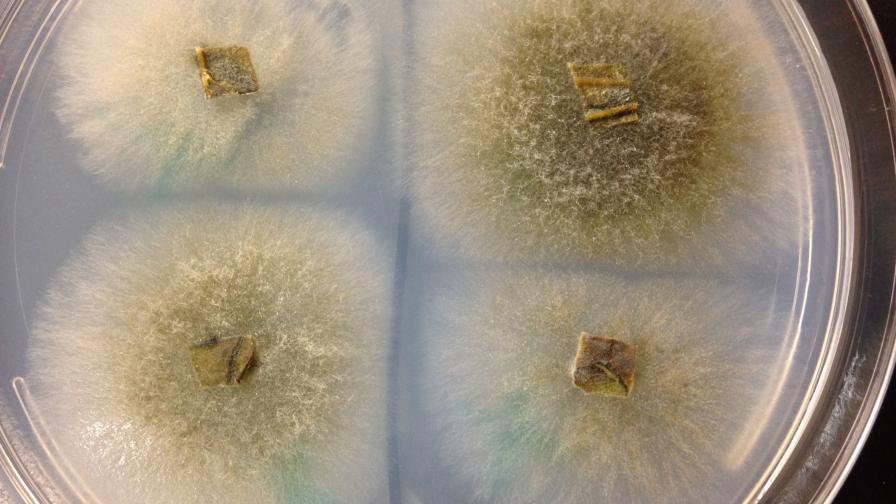
The gummy stem blight colony under microscope.
Photo by Anthony P. Keinath
Experience. My assigned crop is vegetables, and my expertise is fungi and water molds that cause diseases on these crops. If a problem is caused by bacteria, viruses, or nematodes, I need cooperators with the right expertise to help.
Interest. Personal interest provides motivation. Faculty also need to develop an area of expertise. I joke that the gummy stem blight fungus is “my favorite pathogen,” but it’s true. By persisting with this fungus, gummy stem blight became one of the cucurbit diseases for which I’m known.
This disease, however, does not attract a lot of funding. My best-funded projects were on Fusarium wilt of watermelon.
When I was deciding what to study in graduate school, I chose plant pathology over plant physiology, because plant pathology has a greater chance to produce outcomes that will help growers sooner.
In summary, keep in mind that an ideal research project provides three things: useful information for growers and fellow scientists, income (in the form of a successfully funded grant) and a publication in a scientific journal.
Subscribe Today For
