



Nothing but Net! Unique Way To Keep Codling Moth at Bay
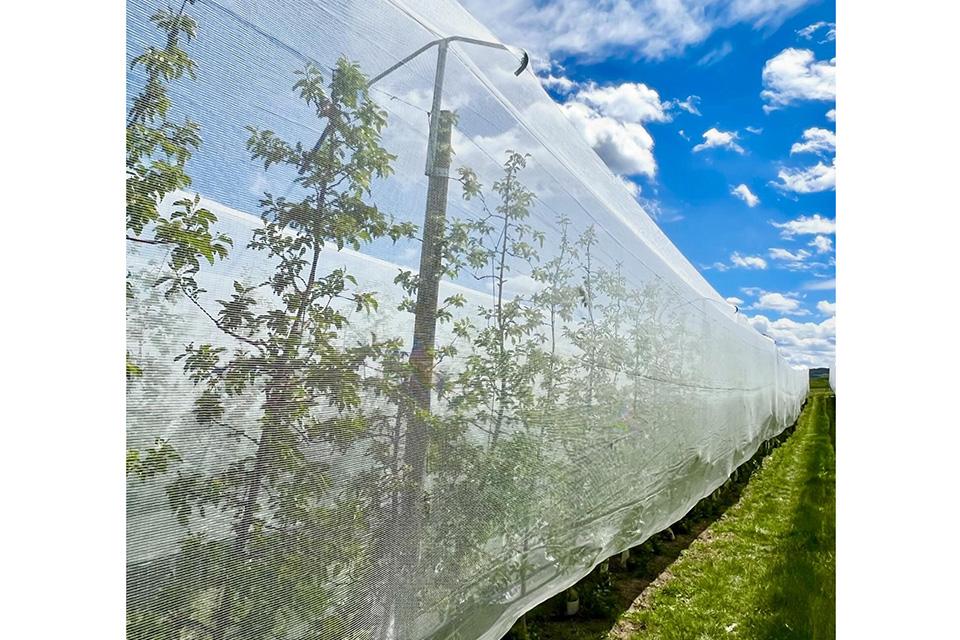
Drape netting over each row of trees shields apples from codling moths and birds. Meanwhile, the opening at the bottom allows entry to beneficial insects.
Photo courtesy of Drape Net

Daniel Godsey, owner of Ezekiel Farm in Zillah, WA, is passionate about organic farming and regenerative agriculture practices. So much so that for more than a decade, the soil has been tested on an annual basis to ensure the farm’s organic apples, cherries, and hazelnuts grow in the most beneficial, nutrient dense environment possible. The farm’s commitment to raising nutritious, clean fruit has led to its apples being sold at Trader Joe’s, Whole Foods, and Walmart to name a few.
Four years ago, in 2021, the unthinkable happened. Ezekiel Farm lost more than $330,000 in organic apples to codling moths. Typically, organic farms can expect a loss of about 10% to codling moths, whose larva feast on apples and pears. But this unexpected infestation resulted in a total loss of the year’s apple crop.
“We had an increase in codling moth damage in 2020, but 2021 was devastating. Typical organic-approved methods of pest control methods weren’t working,” Godsey says. “Some individuals I consulted with said we might have to go to conventional chemical spraying to get rid of the moths. But I wouldn’t hear of it; we wanted Ezekiel Farm to remain organic.”
Godsey turned to another expert at Washington State University, who suggested he cover his apple trees with a non-structured netting solution originally created in 2005 in Australia to protect fruit and nut trees from hail damage. Both organic and conventional orchards in 15 states across the U.S. have been using Drape Net’s patented netting systems to protect apples, cherries, and other tree fruits from codling moths and other threats with great success.
At first Godsey was skeptical. “I’d heard of others using netting, and it wasn’t a slam dunk. I thought Drape Net would be similar but did my own research and learned about the UV coating and how the netting is woven to create a physical barrier. I then got ahold of a guy who used it and has had such a good experience that I decided to give it a shot.”
Codling Moth Out; Ladybugs In
After consulting with Drape Net’s North American Sales Manager, Jeff Whitehall, Godsey decided in early 2022 to trial the product in a 4.5-acre block of apples that had experienced a total crop loss due to codling moths the previous year. Because of the width of Ezekiel Farm’s tree rows, Drape Net customized its original V trellis system that covers entire rows — trellis and trees — from top to bottom. The easy-to-install netting rests on the trees themselves and is loosely secured at the bottom of the trees with cable ties.
That looseness of the netting at ground level is critical for organic growers like Godsey who rely on “good” insects like ladybugs to combat aphids. “I had initial concerns beneficial insects would not be able to access my trees. So, we rolled the netting up slightly at the bottom of the trees. I literally watched ladybugs crawl in and out of the netting doing their job.”
Although it might seem like codling moths would take advantage of this point of entry, Whitehall explains why it is a nonissue. “Codling moths fly around the top of a tree before they come in, almost like they are staking the tree out. It’s not their behavior to approach a tree from the ground. We’ve also found that using white netting adds another layer of deterrence. Codling moths are attracted by green. The white netting doesn’t say ‘food’ to them.”
Big Difference
At the end of the 2022 growing season, Godsey saw codling moth-related losses in the test block plummet to a mere 1%. To say he was stunned is an understatement. “I really didn’t expect Drape Net to be as effective as it is.”
He also experienced other benefits. The netting significantly reduced crop loss to birds that, while pursuing the codling moths, could not penetrate the barrier to the fruit. “Birds love ‘Honeycrisp’ apples,” Godsey smiles. The netting protected the apples from sunburn, and when it came time to color, the apples developed to an even, brilliant red. Drape Net also reduced the farm’s spend on chemicals, another welcome win.
Today Godsey has 30 acres of organic apple trees under netting and has plans to add more in 2025. The decision was not tough. “We had another total loss this year in a block that didn’t have netting. Ideally, I’d cover all remaining acres of my organic apples.”
Subscribe Today For
